



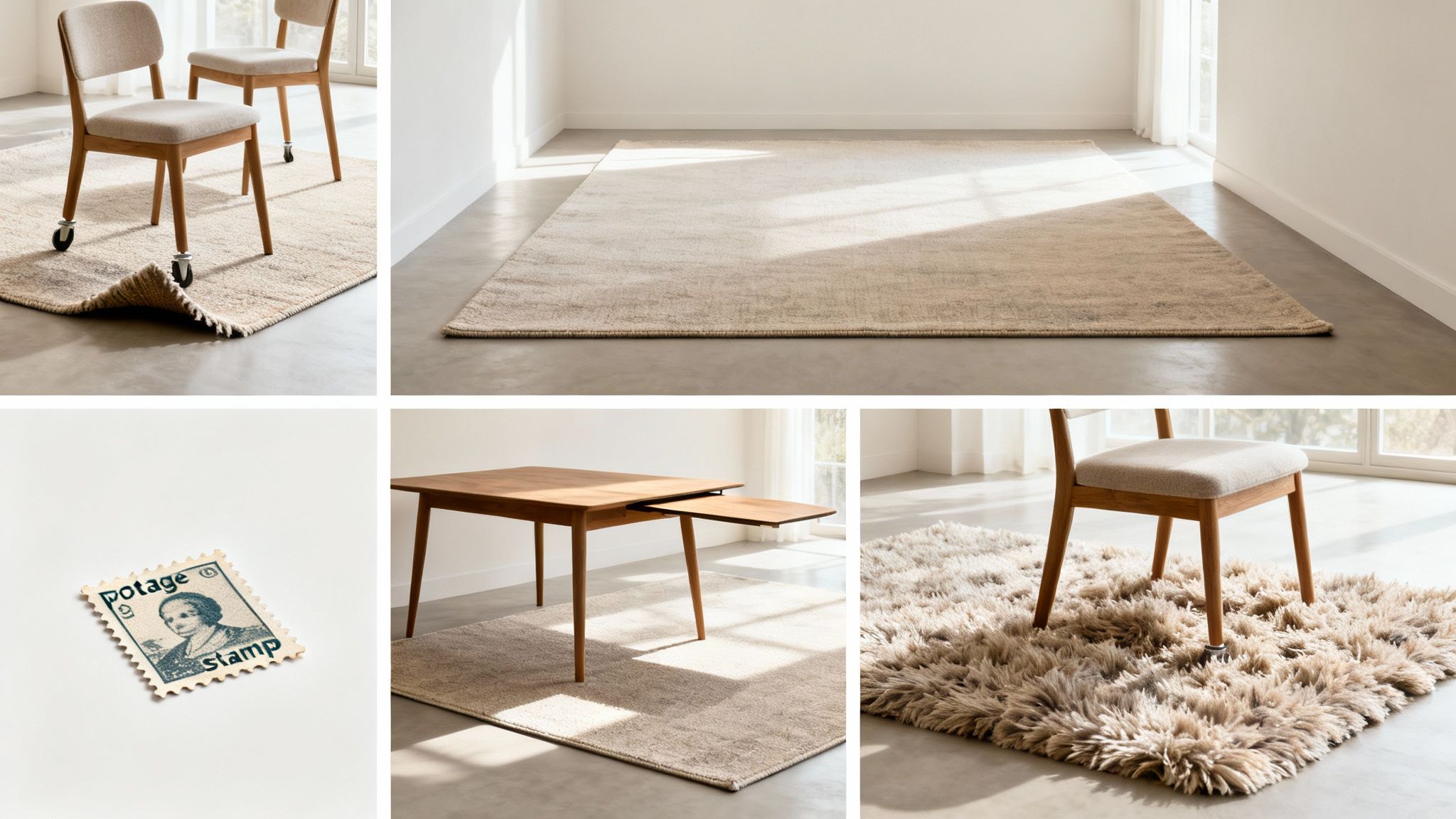
When you’re picking out a rug for your dining room, there’s one golden rule that trumps all others: all four chair legs must stay on the rug. This is true even when someone is sitting in the chair and has pushed back from the table.
If the rug is too small, you’ll constantly have chairs snagging on the edge. It’s not just annoying; it makes for a wobbly, unstable seat for your guests. Getting this one principle right is the secret to a dining room that looks great and actually works.
The Unspoken Rule of Dining Room Rugs
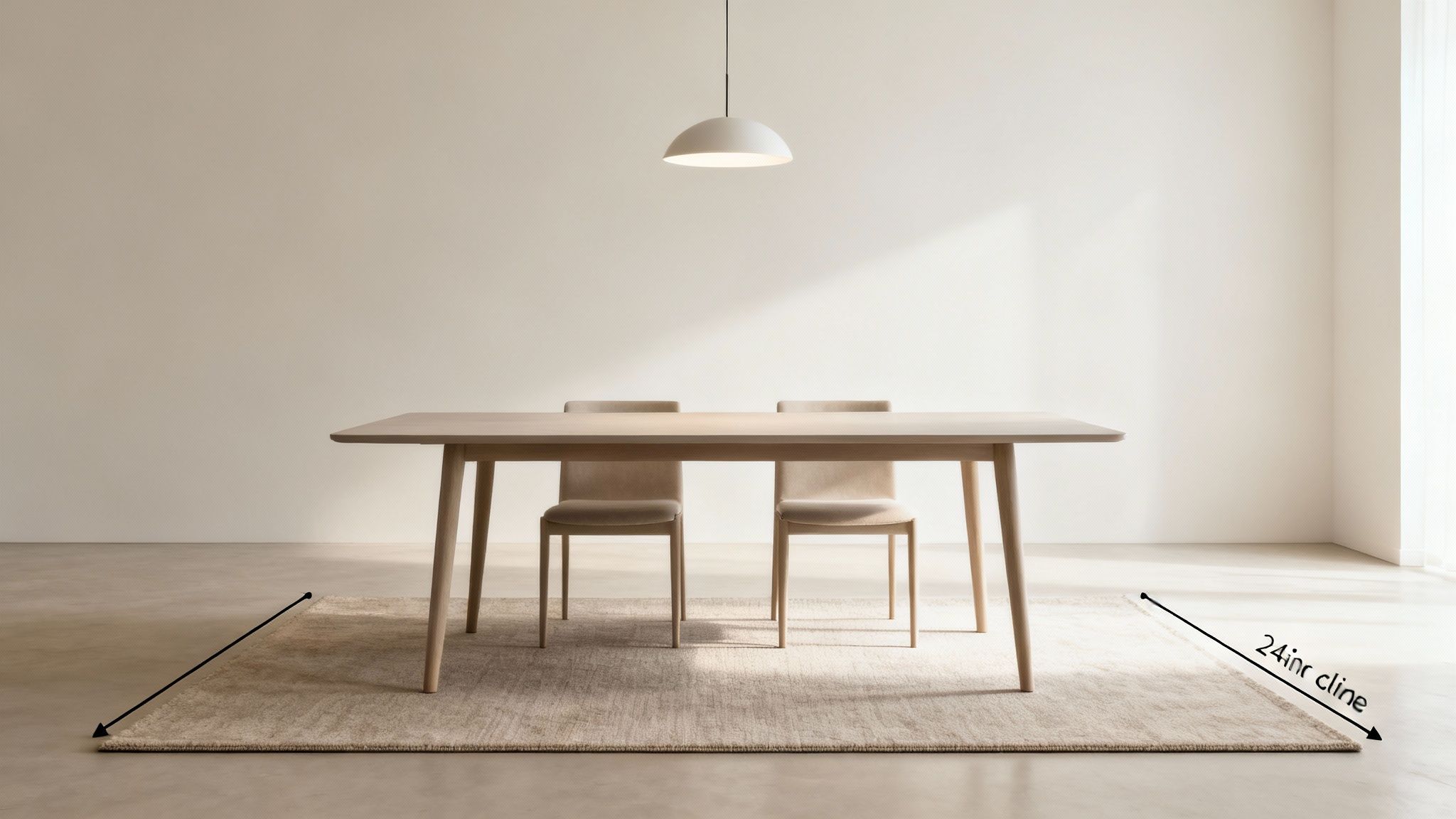
Think of your dining rug as more than just a pretty floor covering. It’s the functional foundation that defines the whole dining space, creating a cozy “island” for your table and chairs. If the island is too small, the whole setup feels off, and the room’s harmony just isn’t there.
So, how do you get it right? Follow the 24-inch rule. This simple guideline says you should have at least 24 inches of rug showing on all sides of your dining table. This buffer is what gives your chairs enough room to slide back smoothly without the back legs falling off the edge.
Key Takeaway: The rug needs to be big enough to handle the full range of motion for your chairs. A properly sized rug doesn’t just look better—it also protects your floors and saves your guests from that frustrating teetering of a half-on, half-off chair.
Why Size Matters More Than Style
It’s easy to get caught up in colors and patterns, but picking the wrong size is one of the most common—and jarring—design mistakes you can make. A rug that’s too small, often called a “postage stamp” rug, can make the entire room feel cramped and disconnected.
On the other hand, getting the scale right brings a ton of benefits:
- It creates cohesion. A good rug anchors the whole dining set, pulling the table and chairs together into a single, intentional group.
- It adds comfort. That layer of softness and warmth underfoot makes the dining experience feel much more inviting.
- It protects your floors. No more worrying about scrapes and scratches from chairs sliding back and forth.
- It defines the space. In an open-concept home, a rug is the clearest way to draw a line around the dining area, separating it from the living room or kitchen.
The rule of thumb, backed by pretty much every interior designer out there, is to leave between 24 to 36 inches of extra rug space. For a typical 6-seater dining table, this usually means an 8×10 foot rug—which happens to be the most popular size in over 60% of American homes.
Once you have that perfect rug in place, you can finish the look by learning how to set a table place setting.
Quick Rug Size Reference by Table Seating
Not sure where to begin? This table is a great starting point. It matches your table’s seating capacity to a minimum rug size, all based on that crucial 24-inch rule we talked about.
| Table Seating Capacity | Common Table Shape | Recommended Minimum Rug Size |
|---|---|---|
| 4 People | Round or Square | 8′ Round or 8’x8′ Square |
| 6 People | Rectangular or Oval | 8’x10′ Rectangular |
| 8 People | Rectangular or Oval | 9’x12′ Rectangular |
| 10-12 People | Rectangular or Oval | 10’x14′ Rectangular or larger |
Remember, these are minimums. If your room is large enough, feel free to go a little bigger for an even more luxurious and grounded feel.
Getting it Right: How to Measure for the Perfect Rug
Alright, you get the theory. Now let’s get practical. Measuring your dining room is a quick, five-minute job that takes all the anxiety out of the equation. Forget the rules of thumb for a second—this is about getting the exact numbers for your room and your table.
All you need is a tape measure. By grabbing a few key dimensions, you’ll know precisely what size you’re looking for, making the shopping process a whole lot less stressful. Let’s walk through it.
Step 1: Start with Your Dining Table
Your table is the star of the show, so it’s the natural place to start. Grab that tape measure and get the length and width of the tabletop.
- For a rectangular or square table, just measure the two sides. Easy.
- For a round table, you’ll want the diameter—that’s the distance straight across its widest point.
Jot these down. This is your baseline, the core measurement we’ll build on to find the perfect rug size.
Step 2: The All-Important Chair Test
This next part is the secret sauce to nailing your dining room rug size every single time. Pull each chair out from the table, just like you would if you were getting up after dinner. You don’t need to yank it all the way across the room—just a natural, comfortable distance will do.
With the chairs in place, measure the total footprint of your entire dining set. Go from the back of the chair on one end to the back of the chair on the opposite end. Do the same for the width. These two numbers give you your absolute minimum rug size.
Pro Tip: Your chairs should never feel like they’re teetering on the edge of a cliff. This measurement guarantees enough room for guests to slide in and out without their chair legs snagging the rug’s edge—easily the most common and annoying dining room rug mistake.
Step 3: Measure the Whole Room
Last but not least, get the overall dimensions of your dining room itself. Measure the full length and width, from one wall to the other. A well-proportioned rug always leaves some of your beautiful flooring showing around the edges.
A great rule of thumb is to leave about 18 inches of bare floor between the rug and the walls. This space acts like a mat around a picture, keeping the rug from looking like it’s trying to swallow the room whole. It makes the space feel bigger and more balanced. If your room is on the smaller side, a gap of 8 to 12 inches works just fine.
Step 4: Visualize Before You Buy
Numbers are great, but seeing is believing. Before you hit that “add to cart” button, do yourself a favor and grab a roll of painter’s tape. Use it to mark out the dimensions of the rug you’re considering right there on your floor.
This simple trick lets you see the scale and placement in your actual space. You can walk around it, pull the chairs out, and get a genuine feel for how that size will affect the room’s flow. It’s the single best way to avoid buyer’s remorse and know for sure you’ve found the perfect answer to “what size rug for my dining room?”
Matching Rug Size to Your Table Shape
The shape of your dining table is your North Star when picking the right rug. Think of the rug as a frame for your dining set—it should echo the shape of the table to create a look that feels intentional and visually harmonious.
This simple principle is what separates a thoughtfully designed space from one that just feels… off. The goal is to make the table and rug feel like a single, cohesive unit. Whether you have a long rectangular table for big family dinners or a cozy round one for breakfast, the right rug is out there, ready to pull it all together.
For Rectangular and Oval Tables
Rectangular tables are the most common shape out there, and luckily, they’re the easiest to pair with a rug. The rule is simple: a rectangular table belongs on a rectangular rug. This creates clean, parallel lines that just feel right, reinforcing the shape of the table and often the room itself.
The same logic applies to oval tables. While you could hunt for a rare oval rug, a rectangular one works just as beautifully. It provides a structured frame that actually highlights the table’s soft curves. In both cases, just remember to maintain that crucial 24-to-36-inch buffer for the chairs on all sides.
This diagram breaks down the core ideas of dining room rug sizing, showing how it should be large enough for chairs while keeping the room feeling balanced.
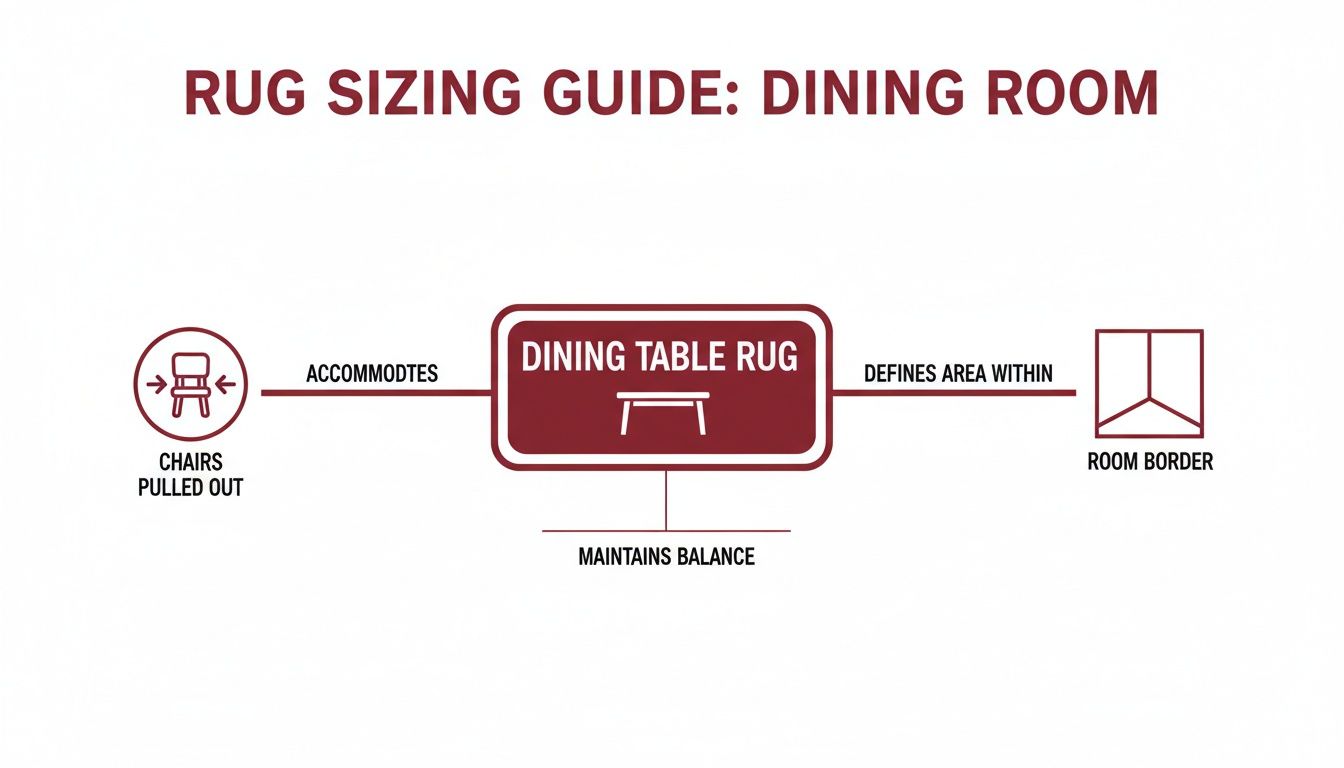
As you can see, the rug acts as a “landing pad” for the entire dining set, making sure chair legs never catch on the edge when people pull out their seats.
For Round Tables
Round tables create a sense of intimacy and flow, and the rug underneath should do the same. The most natural fit is a round rug under a round table. It creates a beautiful, concentric look that draws the eye inward and makes the space feel complete. An 8-foot round rug, for example, is a perfect partner for a standard 48-inch round table that seats four.
But don’t feel locked into circles. A square rug can create a really striking, modern contrast under a round table. The sharp, geometric lines of the rug ground the table’s curves, adding a layer of visual interest. Just make sure the square is large enough to comfortably contain the chairs when they’re in use.
For Square Tables
Just like with rectangular tables, the answer here is straightforward. A square rug is the ideal choice for a square table, as it mirrors the dimensions and creates a clean, symmetrical foundation. This pairing is perfect for defining smaller dining areas or breakfast nooks without overwhelming them.
If you have a larger square table in a long, narrow room, you could also place it on a generously sized rectangular rug. This can help the rug fill the footprint of the room more effectively while still giving you that all-important chair buffer.
A Critical Sizing Insight: Statistically, 70% of dining room rug returns are because the rug was too small. People often buy a 6×9 rug for a 6-seater table, only to discover their chairs are hanging off the edge in 85% of cases. The fix is always to go bigger than you think you need, adding at least 36 inches to your table’s length and width for a perfect, frustration-free fit.
Comprehensive Sizing Guide for Rectangular and Round Tables
To take the guesswork out of it, we put together this quick-reference chart. We’ve laid out both a “Good Fit” (which meets the minimum 24-inch rule) and a “Best Fit” (which gives you a more luxurious 36-inch clearance). This should help you pinpoint exactly what size rug your dining room needs.
And if you’re hunting for quality options, you might find this in-depth review of RugSource.com helpful.
| Table Shape & Size | Good Rug Size (Minimum) | Best Rug Size (Generous Fit) |
|---|---|---|
| 48″ Round Table (Seats 4) | 8′ Round or 8’x8′ Square | 9′ Round or 9’x9′ Square |
| 60″ Rectangular Table (Seats 6) | 8’x10′ Rectangular | 9’x12′ Rectangular |
| 72″ Rectangular Table (Seats 6-8) | 8’x10′ Rectangular | 9’x12′ Rectangular |
| 96″ Rectangular Table (Seats 8-10) | 9’x12′ Rectangular | 10’x14′ Rectangular |
| 60″ Square Table (Seats 8) | 9’x9′ Square | 10’x10′ Square or 9’x12′ Rectangular |
Remember, these are guidelines, not unbreakable laws. But starting with these recommendations will put you on the right track to finding a rug that not only looks fantastic but also functions perfectly for your space.
Selecting a Rug Material Built for Real Life
A dining room rug needs to do more than just look pretty; it has to be a certified workhorse. This is where style takes a backseat to practicality for a moment. Choosing the right material is what ensures your rug can handle the daily reality of spills, crumbs, and scooting chairs without looking ragged after a year.
Think of your dining room rug as the unsung hero of your decor. It has to be tough enough for the messiness of life but stylish enough to anchor the whole room. Let’s break down the materials that actually strike this crucial balance.
Why Pile Height Is Non-Negotiable
Before we even get into specific materials, we need to talk texture. For a dining room, low-pile or flatweave rugs are your best friends. Seriously. That plush, high-pile shag rug might feel amazing in a living room, but it’s a complete functional nightmare under a dining table.
Here’s why a low profile is absolutely essential:
- Smooth Chair Movement: You need chairs that can glide in and out without a fight. A low-pile rug allows for seamless movement, preventing those frustrating snags and wobbles every time someone gets up.
- Easy Cleanup: Crumbs and spills have nowhere to hide on a flatweave rug. A quick vacuum is usually all it takes to keep it looking fresh, rather than becoming a permanent food graveyard.
- Durability: Tightly woven, low-pile rugs are just built tougher. They’re inherently better suited to withstand the constant friction from chair legs sliding back and forth.
A high-pile rug under a dining table is a recipe for trapped crumbs and frustrated guests. Always opt for a low-profile design to ensure both function and cleanliness.
The Best Materials for Dining Room Durability
Okay, now let’s get into the top contenders for materials. Each one offers a different mix of durability, stain resistance, and style, making them perfect for this high-traffic, high-spill zone.
Wool: The All-Around Champion
There’s a reason wool has been the go-to fiber for rugs for centuries. It’s incredibly durable, naturally resilient, and has a soft, comfortable feel underfoot. Wool fibers even have a natural coating called lanolin, which acts as the first line of defense against stains, giving you a precious few moments to clean up a spill.
While it’s definitely a premium option, its longevity often makes it a worthwhile investment. A well-cared-for wool rug can easily last for decades, looking beautiful the entire time.
Synthetics: The Practical Powerhouses
For busy households—especially those with kids or pets—synthetic materials like polypropylene, nylon, or polyester are fantastic choices. These aren’t your grandma’s scratchy synthetics; modern versions are engineered for performance and can look surprisingly high-end.
- Polypropylene: This is the undisputed king of stain resistance. It’s non-porous, meaning spills just sit on the surface instead of soaking in, making cleanup a breeze. It’s also super budget-friendly and holds its color well.
- Nylon: Known for its exceptional durability and resilience, nylon is a great pick for areas with heavy foot traffic. It can stand up to years of sliding chairs without crushing or matting down.
Finding stylish and practical options is easier than ever, and many sources for affordable home decor online feature extensive collections of these hardworking synthetics.
Natural Fibers: The Eco-Friendly Option
Natural fibers like jute, sisal, and seagrass bring an earthy, organic texture to a dining room that’s hard to replicate. They are known for being incredibly durable and are often more affordable than wool. Their neutral tones and rich textures can beautifully ground a space, adding a touch of casual elegance.
However, they do come with a trade-off. These fibers can be more absorbent and harder to spot-clean than synthetics. They’re best for dining rooms where spills are less of a concern, or for homeowners who love their rustic, perfectly imperfect look. When a spill does happen, a quick response is crucial to prevent staining.
Common Dining Room Rug Mistakes and How to Avoid Them
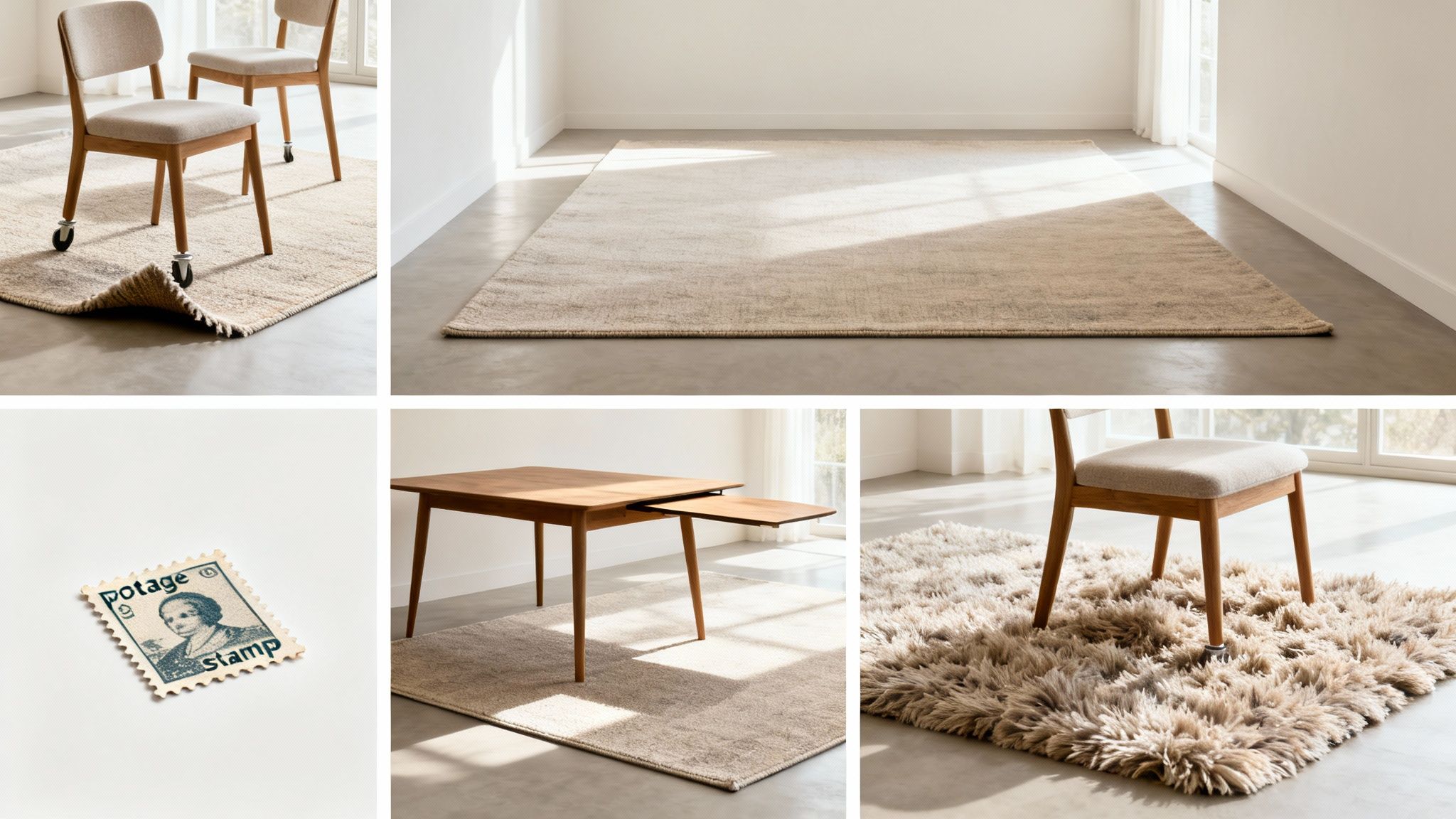
Even with all the charts and rules in the world, it’s surprisingly easy to get a dining room rug wrong. We’ve all seen it. But learning from the most common pitfalls can save you a ton of time, money, and buyer’s remorse. Think of this as your field guide to spotting—and sidestepping—the classic blunders.
Let’s walk through the four mistakes I see most often. Once you understand why these slip-ups throw off a room’s entire vibe, you’ll be able to choose your rug with total confidence.
Mistake 1: The Postage Stamp Rug
This is, without a doubt, the number one offender. A “postage stamp” rug is one that’s just too small for the table and chairs it’s supposed to anchor. It might look okay when every chair is perfectly tucked in, but the second someone pulls out their seat to sit down, the back legs fall right off the edge. It’s an annoying, wobbly, and jarring experience for guests.
- Why it’s a problem: A tiny rug doesn’t just feel unstable; it visually shrinks your entire dining set. Instead of defining the space, it makes everything look cramped and disconnected, like an afterthought.
- The easy fix: Live by the 24-inch rule. Measure your tabletop, then add at least 24 inches (or two feet) of rug on all sides. This simple buffer gives every chair a smooth, stable landing pad, even when fully pulled out.
Mistake 2: Forgetting the Table Leaf
This one is sneaky. You buy a rug that fits your table perfectly for everyday use. But you completely forget about that extension leaf you pop in for Thanksgiving or big dinner parties. Suddenly, your perfectly sized rug becomes a postage stamp, and the chairs at the head of the table are left half-on, half-off.
- Why it’s a problem: This oversight undermines the rug’s purpose at the very moment you need your dining room to shine. It creates an awkward, unbalanced look right when you’re hosting and want everything to feel seamless.
- The easy fix: Before you even start shopping, measure your table at its fully extended length. Size your rug to that dimension. Your rug needs to work for your biggest crowd, not just your quiet Tuesday night dinner.
Key Takeaway: Always size your dining room rug for your table’s largest possible setup. Planning for the big party ensures your rug is the right fit for every occasion, big or small.
Mistake 3: The Room Swallower
On the other end of the spectrum, we have the rug that’s simply too big for the room. This happens when the rug stretches so far it nearly touches the walls, leaving almost no visible flooring around the perimeter. It’s a common overcorrection when trying to avoid the postage stamp mistake.
- Why it’s a problem: Instead of defining a zone, a massive rug just consumes the space, making the entire room feel smaller and more claustrophobic. It loses its impact as a distinct design layer and starts to look like cheap wall-to-wall carpeting.
- The easy fix: You need to let your floors breathe. Aim for a border of at least 18 inches of bare floor between the rug’s edge and the walls. In a smaller room, a gap of 8 to 12 inches still works beautifully to create that necessary visual balance.
Mistake 4: The High-Pile Problem
I get it. A thick, plush, high-pile rug feels incredibly luxurious underfoot. But in a dining room, it’s a functional nightmare. Chairs get stuck, making it a workout just to slide in and out. Worse, those dense, shaggy fibers are a magnet for every crumb, spill, and speck of dust.
- Why it’s a problem: A high-pile rug creates constant, low-grade frustration. It makes moving chairs a chore and cleaning an absolute headache. You’re prioritizing a cozy texture over the practical needs of a space designed for eating and gathering.
- The easy fix: Just say no to shag. Stick with low-pile or flatweave rugs. Options like wool, jute, or synthetics are durable, a breeze to clean, and allow chairs to glide smoothly. It’s the perfect blend of style and real-world practicality.
Got Questions? We’ve Got Answers.
Even after you’ve measured twice and browsed a hundred options, a few tricky questions can still pop up. It happens to everyone. Let’s tackle some of the most common dilemmas people face when picking a dining room rug, so you can solve those last few puzzles and feel great about your final choice.
Think of this as your go-to guide for those nagging “what if” scenarios.
Can I Really Put a Round Rug Under a Rectangular Table?
Absolutely! While matching shapes is the safe and classic route, breaking that rule can create a seriously stylish, dynamic look. A round rug under a rectangular table is a fantastic way to soften all the hard lines and sharp corners in a dining room, adding an unexpected and playful touch.
The key to pulling this off is to go big. The rug has to be significantly larger than the table. You need enough rug real estate for every single chair to rest comfortably on it, even when people are pushing back to leave the table. This look works especially well in a square room, where a large round rug can beautifully anchor the dining set right in the center.
What if My Dining Room Is Tiny or Just… Weirdly Shaped?
In a smaller space or one with an odd layout, the standard rules sometimes need a little wiggle room. Your top priority is no longer about hitting that perfect 18-inch border; it’s about making sure the rug doesn’t completely swallow the room.
- Prioritize Clearance: Instead of 18 inches, aim to keep at least 8 to 12 inches of bare floor showing around the rug. This smaller buffer is just enough to keep the room from feeling cramped.
- Consider a Custom Cut: If standard sizes just aren’t hitting the mark, a custom-sized rug can be a game-changing investment. It lets you get the proportions exactly right for your unique floor plan.
- Go Bare: Honestly, sometimes the best choice for a very small or awkward space is no rug at all. If a rug would get caught on a doorway, create a tripping hazard, or cramp a busy walkway, letting your beautiful floors shine is a perfectly stylish and practical decision.
Expert Tip: Painter’s tape is your best friend in a tight spot. Before you buy anything, map out the rug’s dimensions on the floor. This five-minute trick gives you a real-world feel for how the size impacts the room’s flow and can save you from a major headache later.
How Do I Keep My Rug From Becoming a Permanent Spill Magnet?
Let’s be real: the dining room is a spill zone. But that doesn’t mean you have to wrap your rug in plastic. It all comes down to choosing the right material and acting fast.
First, start with a rug made from a stain-resistant material like polypropylene or wool. These fibers are naturally better at shrugging off liquids. Second, think about treating your rug with a fabric protector spray to create an invisible shield. When the inevitable spill happens, remember the golden rule: blot, don’t rub! Grab a clean, dry cloth and gently blot the spot immediately to soak up as much as you can.
How Do I Coordinate Rugs in an Open-Concept Space?
In an open-plan home, your living and dining room rugs shouldn’t be twins, but they should definitely feel like they’re part of the same family. The goal is cohesion, not a carbon copy.
To pull this off, just find a common thread that links them together. This could be:
- A Shared Color: Pick one or two colors that show up in both rugs, even in different amounts.
- A Similar Style: If your living room has a traditional Persian rug, your dining room could feature a more modern, abstract pattern that echoes a similar vibe.
- A Consistent Texture: Using two jute rugs or two low-pile wool rugs creates a subtle sense of unity that ties the whole space together.
This approach lets each area have its own identity while still feeling like part of a thoughtfully designed, harmonious home.
At Reva Housing, we believe that the right information turns stressful decisions into confident purchases. For more in-depth reviews and guides on everything from kitchenware to homeware, visit us at https://revahousing.com.
