



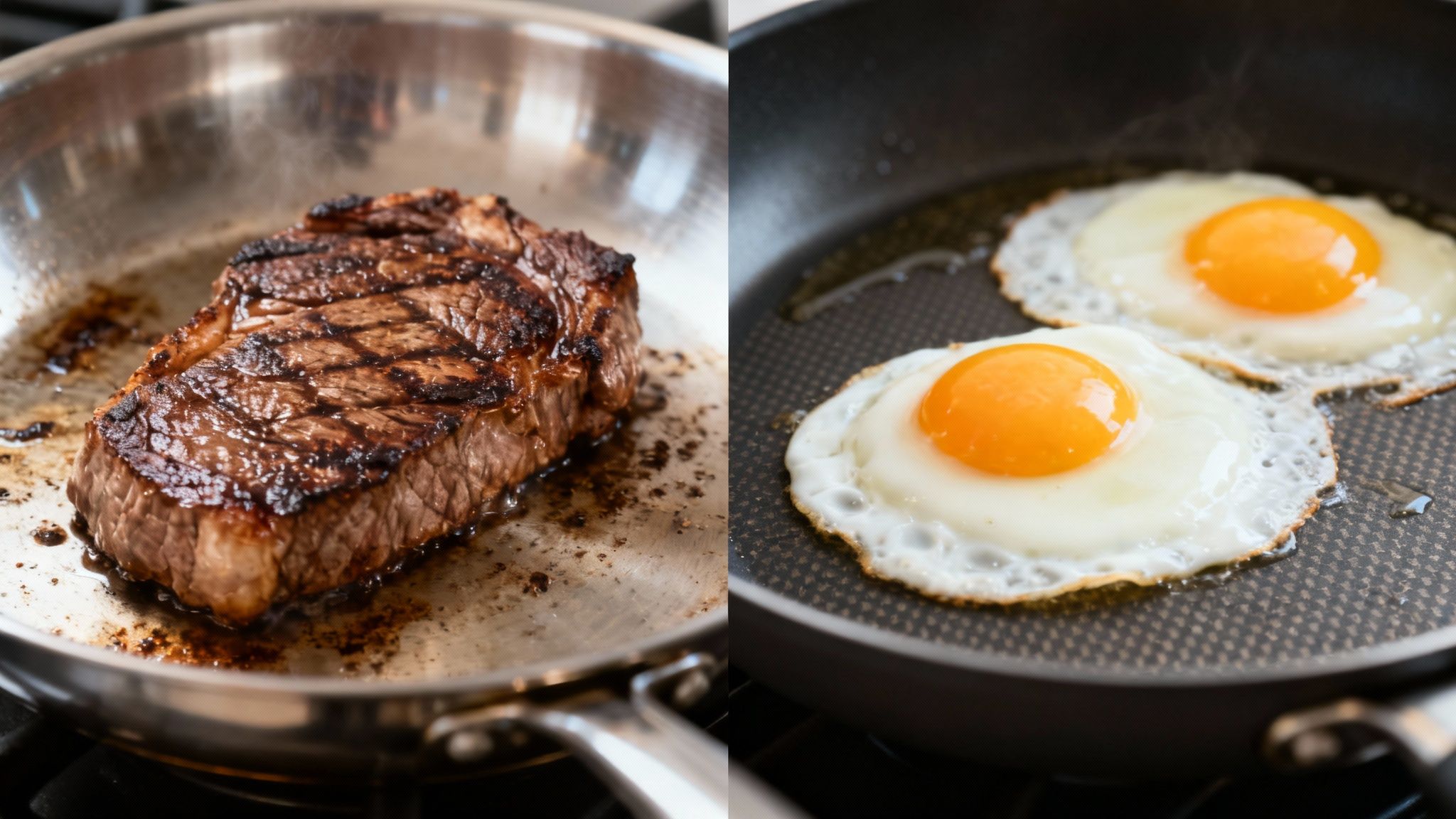
The great stainless steel vs. nonstick debate really boils down to one simple question: What kind of cook are you? Stainless steel is the undisputed workhorse of the professional kitchen, built for high heat, perfect sears, and a lifetime of use. On the other hand, nonstick is all about convenience, offering a forgiving surface for delicate foods like eggs and fish with virtually zero cleanup stress.
Your choice isn’t just about a pan; it’s about whether you’re chasing pro-level performance or just want to make breakfast without a fight. This guide will break down the key differences to help you make an informed decision based on your cooking style and needs.
The Great Cookware Debate: Stainless Steel vs. Nonstick
Walking down the cookware aisle can feel like a huge commitment. On one side, you have the gleaming, heavy-duty stainless steel pans that every TV chef seems to use. They promise durability and incredible heat control. On the other, you have the sleek nonstick pans, the obvious choice for busy home cooks who just want their food to slide right out.
This guide is here to cut through the marketing noise and give you a real-world comparison. We’re going to look at how these pans actually perform day-to-day, so you can figure out which one truly fits your cooking style, your kitchen, and your budget.
At a Glance: Stainless Steel vs. Nonstick Showdown
Before we get into the nitty-gritty, let’s start with a quick overview. This table breaks down the key differences between these two kitchen staples so you can get a feel for where they shine and where they fall short.
| Feature | Stainless Steel | Nonstick |
|---|---|---|
| Best For | Searing, browning, sautéing, acidic sauces | Eggs, pancakes, delicate fish, sticky foods |
| Heat Tolerance | Very high (oven-safe up to 500-600°F) | Low to medium (coating can degrade at high heat) |
| Durability | Extremely durable; can last a lifetime | Limited lifespan (1-5 years); coating scratches easily |
| Utensil Use | Metal utensils are generally safe | Only wood, silicone, or nylon utensils recommended |
| Maintenance | Can require soaking and scrubbing; dishwasher safe | Very easy to clean; hand washing recommended |
| Health | Inert and non-reactive material | Concerns over coatings (modern versions are PFOA-free) |
| Learning Curve | Moderate; requires preheating and oil management | Low; very beginner-friendly |
Think of this as your cheat sheet. As you can see, there are clear trade-offs with each option. Now, let’s dig deeper into what these differences actually mean for your cooking.

How Cooking Performance Truly Compares
Alright, let’s get past the marketing labels and talk about what happens on the stovetop. This is where the real differences in the stainless steel vs. nonstick debate show up—it’s all about how heat, surface texture, and food interact. Think of them less as competitors and more as specialized tools for different culinary jobs.
When you’re after a deep, flavorful crust on a steak or perfectly caramelized vegetables, stainless steel is the undisputed king. Its surface is designed to create tiny, microscopic bonds with your food, which is the magic behind the Maillard reaction—that beautiful chemical process that creates rich, savory browning. Nonstick coatings are built to do the exact opposite, actively preventing this from happening, which can leave you with a steamed or pale finish instead of a true, hard sear.
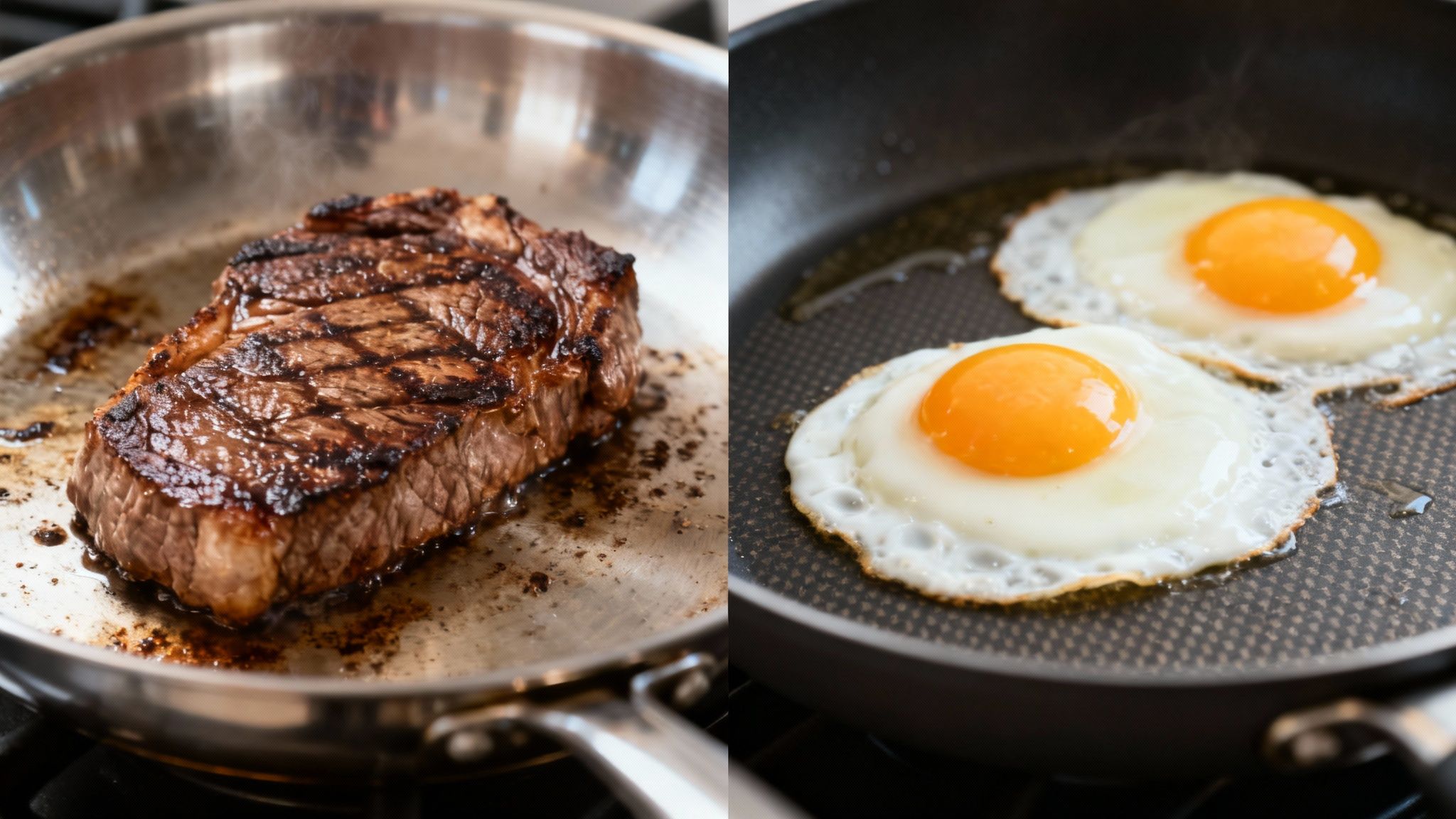
Searing and Browning: The Stainless Steel Advantage
A stainless steel pan is a canvas for building flavor. Those little browned bits that stick to the bottom after you sear a piece of meat? That’s called fond, and it’s basically culinary gold. You can deglaze the pan with a splash of wine, broth, or even water to lift that fond right off, creating an intensely flavorful base for a pan sauce you could never get from a nonstick skillet.
Stainless steel cookware is prized for its ability to produce gorgeous browning and searing effects, a quality that nonstick products just can’t match. This makes it a go-to for both professional chefs and serious home cooks.
The material’s ability to handle and hold onto screaming-hot temperatures without breaking a sweat is the key here. This makes it perfect for getting that hard sear on a steak or a crispy edge on roasted potatoes. If you want to really get the most out of your pans, check out our guide to the best frying pan for a gas cooktop.
Gentle Cooking: The Nonstick Domain
Now, let’s flip over to nonstick’s home turf. For delicate foods, that slick surface is an absolute game-changer. Just imagine trying to cook a perfect, fluffy omelet or a flaky piece of cod in a pan where it’s guaranteed to stick and tear. It’s a nightmare.
Nonstick cookware was born for these scenarios:
- Eggs and Omelets: Your food will slide right out, preserving its delicate structure without you needing to drown it in oil.
- Pancakes and Crepes: It guarantees an even, golden-brown surface and a flawless flip every single time.
- Delicate Fish: This is how you prevent fragile fillets from breaking apart the second you try to move them.
- Sticky Sauces and Glazes: It dramatically reduces the risk of sugary sauces scorching and makes cleanup ridiculously easy.
While it can’t sear like stainless steel, nonstick offers something just as valuable: peace of mind and consistency for everyday meals. It’s the pan you grab for low-to-medium heat cooking where convenience and a perfect release are what matter most.
Making Sauces: A Tale of Two Pans
When you get to sauces, the right pan depends entirely on what you’re making. The non-reactive surface of stainless steel means you can simmer acidic ingredients—think tomatoes, wine, or citrus—for hours without any weird metallic taste leaching into your food. This makes it the only real choice for a classic marinara or a wine reduction.
But if you’re making a sweet, sticky teriyaki glaze or a caramel sauce, a nonstick pan will be your best friend. The slick surface prevents the sugars from burning and gluing themselves to the pan, a common frustration when working with stainless steel. Each pan has its purpose, which just goes to show that a well-equipped kitchen really does need both.
Durability and Lifespan: A Lifetime Investment or a Short-Term Fix?
Cookware is an investment, but let’s be real—not all pans are built to last. When you stack up stainless steel against nonstick, the difference in durability is one of the biggest stories. One is basically a tank built for decades of service, while the other is a convenient—but temporary—kitchen helper.
High-quality stainless steel cookware is engineered to be a buy-it-for-life kind of purchase. Its heavy-duty, multi-ply construction makes it incredibly resistant to warping, even if you make the mistake of moving it from a scorching hot stovetop straight to a cool sink. Unlike coated pans, there’s no surface to chip, peel, or scratch away. That means it can take a beating from metal utensils and aggressive scrubbing without losing its core ability to cook. A well-cared-for stainless steel pan can easily be passed down through generations.
The Achilles’ Heel of Nonstick Pans
Nonstick cookware, on the other hand, comes with a built-in expiration date. The very feature that makes it so popular—its slick coating—is also its greatest weakness. Even if you treat it like a precious jewel, using only silicone or wood utensils and gentle handwashing, the nonstick surface will inevitably start to break down.
This slow decay happens from the constant cycle of heating and cooling, plus all the microscopic abrasions from cooking and cleaning. The performance drop-off is subtle at first, but eventually, you’ll notice that your morning eggs are starting to stick in certain spots. The average nonstick pan has a lifespan of just one to five years, and that’s highly dependent on its quality and how you treat it.
Once a nonstick pan has deep scratches that expose the metal underneath, or if you see the coating starting to flake or peel, it’s done. Continuing to use a heavily damaged pan isn’t a great idea, which turns replacement into a recurring cost.
How the Market Sees It: Long-Term Value vs. Quick Convenience
This choice between durability and convenience shows up clearly in how people shop. The nonstick market owned about 61.8% of the market share last year, a testament to how much people value its ease of use. But don’t count stainless steel out—it captured a significant 38.2%, driven by cooks looking for durability, corrosion resistance, and better long-term value. You can dig deeper into these cookware market trends if you’re curious.
This data paints a picture of two different mindsets. A lot of home cooks are perfectly willing to accept the recurring cost of replacing nonstick pans for the day-to-day convenience they offer. But a huge chunk of the market would rather pay more upfront for stainless steel, seeing it as a one-time purchase that pays for itself over decades of reliable cooking. Your decision really comes down to what you prioritize: a short-term fix or a lasting investment.
Health and Maintenance: What You Really Need to Know
Beyond how a pan sizzles a steak, the day-to-day reality of using and caring for it is what really matters. We’re talking about health, safety, and the elbow grease required to keep your cookware in top shape. Understanding this stuff not only helps your pans last longer but gives you peace of mind every time you cook.
Let’s get one of the biggest questions out of the way first: material safety, especially with nonstick coatings. Modern nonstick pans are a world away from the stuff our parents used. Today’s versions are PFOA-free, a chemical that was rightfully phased out due to health concerns. Most are now made with PTFE (Polytetrafluoroethylene) or ceramic, both considered perfectly safe for regular home cooking.
The real key is how you use them. High heat is the mortal enemy of any nonstick coating. Pushing temperatures past 500°F can cause the surface to break down and release fumes. So, stick to low and medium heat, and never, ever preheat a nonstick pan while it’s empty.

The Stainless Steel Standard of Safety
On the flip side, high-quality stainless steel is about as inert and non-reactive as cookware gets. What does that mean for you? It won’t leach weird chemicals or metallic tastes into your food, even if you’re simmering a big pot of acidic tomato sauce for hours. Its stability at scorching temperatures makes it a completely worry-free choice for anything you throw at it, from a hard sear on the stovetop to finishing a dish in a ripping-hot oven.
For cooks who prioritize material purity and long-term stability, stainless steel is the undisputed benchmark. Its non-porous, non-reactive surface guarantees that what you taste is your food—and nothing else.
This built-in stability just makes cooking simpler. There are no temperature limits to remember or acidic ingredients to avoid.
Practical Upkeep and Cleaning Routines
This is where the two materials really go their separate ways. Nonstick pans are famous for their effortless cleanup; a little soap and a soft sponge is usually all it takes. But to protect that delicate coating, you have to treat them with care—no metal utensils, no abrasive scouring pads. Handwashing is pretty much non-negotiable if you want to get the most out of its already short lifespan.
Stainless steel, on the other hand, demands a bit more technique but is built like a tank. You’ll definitely deal with stuck-on bits and occasional heat discoloration, but it’s nothing a little know-how can’t fix.
Quick Tips for Maintaining Your Pans:
- Nonstick Care:
- Stick to wood, silicone, or nylon utensils. Always.
- Avoid abrasive scrubbers and harsh detergents like the plague.
- Hand wash whenever you can to protect the coating’s integrity.
- Stainless Steel Care:
- For stubborn stuck-on food, just simmer a little water or a vinegar-water mix in the pan to loosen it right up.
- A simple paste of baking soda and water is your secret weapon for scrubbing away tough stains without scratching the surface.
- Always dry your pans thoroughly after washing to prevent water spots and keep that beautiful shine.
And if you really want to learn how to restore your pans to their original glory, check out our complete guide on how to clean stainless steel. This stuff can handle a serious cleaning and still look brand new for decades—a far cry from its coated cousin that needs coddling from day one.
Pros & Cons at a Glance
For a clear, balanced perspective, here’s a straightforward breakdown of the advantages and potential drawbacks of each cookware type.
Stainless Steel
- Pros:
- Superior Searing: Achieves high heat for incredible browning and flavor.
- Extreme Durability: Resistant to warping, scratching, and chipping; can last a lifetime.
- Versatility: Oven-safe to high temperatures and compatible with metal utensils.
- Non-Reactive: Perfect for acidic ingredients like tomatoes and wine without altering flavor.
- Cons:
- Learning Curve: Requires proper preheating and oil management to prevent sticking.
- More Cleanup Effort: Stuck-on food may require soaking and scrubbing.
- Higher Initial Cost: Quality stainless steel is a bigger upfront investment.
Nonstick
- Pros:
- Effortless Food Release: Ideal for delicate foods like eggs, fish, and pancakes.
- Easy to Clean: The slick surface often just needs a quick wipe with a sponge.
- Beginner-Friendly: Very forgiving and requires less oil for cooking.
- Affordable: Generally less expensive, making it accessible for any budget.
- Cons:
- Short Lifespan: The coating wears down over time, requiring replacement every 1-5 years.
- Lower Heat Tolerance: Not suitable for high-heat searing or oven use above 400-500°F.
- Fragile Surface: Prone to scratches from metal utensils and abrasive cleaners.
Customer Impressions: What Real Cooks Say
To give you a sense of real-world performance, we’ve summarized common feedback from home cooks who use both types of pans daily.
- “Stainless steel changed my cooking game,” says an avid home chef. “I was intimidated at first, but after learning to preheat it correctly, the sears I get on steak are incredible. The cleanup can be a pain if I forget to deglaze, but the performance is worth it. It feels like a professional tool that will last forever.”
- “My nonstick pan is my weekday morning savior,” a busy parent comments. “I use it every single day for scrambled eggs and pancakes. Everything slides right out, and I can clean it in 30 seconds. I know I have to replace it every couple of years, but for the convenience, I don’t mind at all.”
- A more critical user notes, “I love my nonstick for its ease of use, but I’ve been through three of them in six years. My stainless steel skillet, on the other hand, is over a decade old and still looks new. I’m trying to rely on the stainless more, but it’s hard to beat nonstick for a quick omelet.”
Frequently Asked Questions
Choosing between stainless steel and nonstick usually boils down to a few key questions. Nailing these details will help you feel confident in your choice.
Can I really use metal utensils on stainless steel?
Yes, you absolutely can. A good stainless steel pan is built like a tank. It’s a kitchen workhorse, designed to handle metal spatulas, spoons, and whisks without any fuss. While you should avoid intentionally gouging the surface, normal use with metal tools is perfectly fine.
Why is everything sticking to my stainless steel pan?
This is a classic problem, and it almost always comes down to two things: improper preheating or not using enough fat (oil or butter). To prevent sticking, heat the empty pan over medium heat for a minute or two. Add a drop of water; if it forms a bead that glides across the surface, it’s ready. Then, add your oil, let it shimmer, and finally, add your food.
When should I replace my nonstick pan?
You should replace your nonstick pan as soon as you see deep scratches that expose the metal underneath, notice the coating flaking or peeling, or find that food consistently sticks. A drop in performance is the clearest sign. Depending on quality and care, most nonstick pans last between one and five years.
Is one type of cookware better for my glass-top stove?
Both stainless steel and nonstick work well on glass-top stoves, provided they have a flat, heavy bottom for good contact. Stainless steel, especially multi-ply versions, often offers superior heat distribution on electric surfaces. Avoid dragging any pan across the glass to prevent scratches.
Do I really need both types of pans in my kitchen?
For the most versatile kitchen, having at least one of each is the ideal setup. A 10- or 12-inch stainless steel skillet is perfect for searing meats and general-purpose cooking, while an 8- or 10-inch nonstick pan is invaluable for eggs and other delicate tasks. This combination covers virtually all your stovetop needs.
The Final Verdict: Making the Right Choice for Your Kitchen
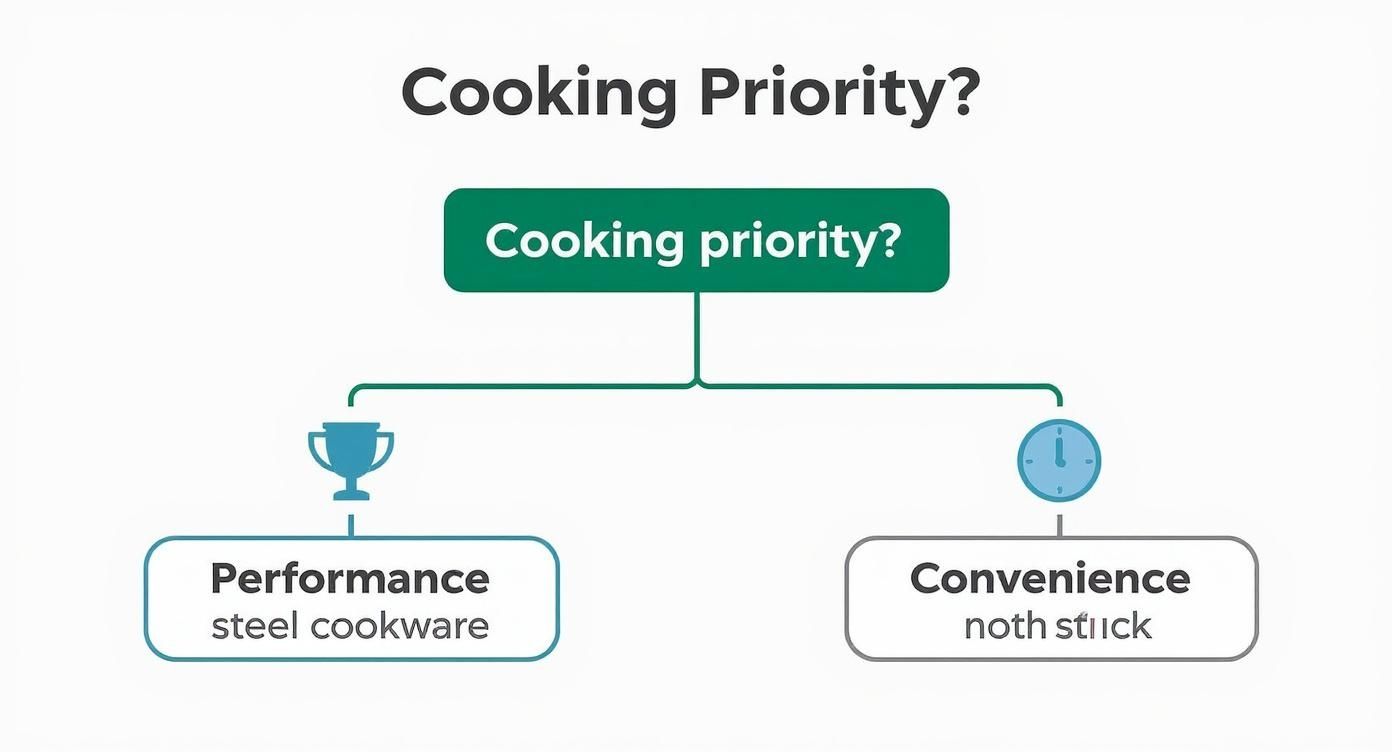
So, in the stainless steel vs nonstick showdown, which pan comes out on top? The truth is, there’s no single winner. The best choice is the one that aligns with your cooking habits, priorities, and budget.
Choose stainless steel if: You are a passionate cook who values performance, wants to master techniques like searing and creating pan sauces, and prefers a “buy it for life” product.
Choose nonstick if: You prioritize convenience, quick cleanup, and a forgiving surface for everyday meals like breakfast and delicate fish. It’s the perfect choice for busy households and those new to cooking.
Ultimately, a well-equipped kitchen often includes both. A trusty nonstick pan for the daily scramble and a high-performance stainless steel skillet for culinary adventures will ensure you always have the right tool for the job. Consider your needs, and you’ll make a choice you’ll be happy with for years to come.
