



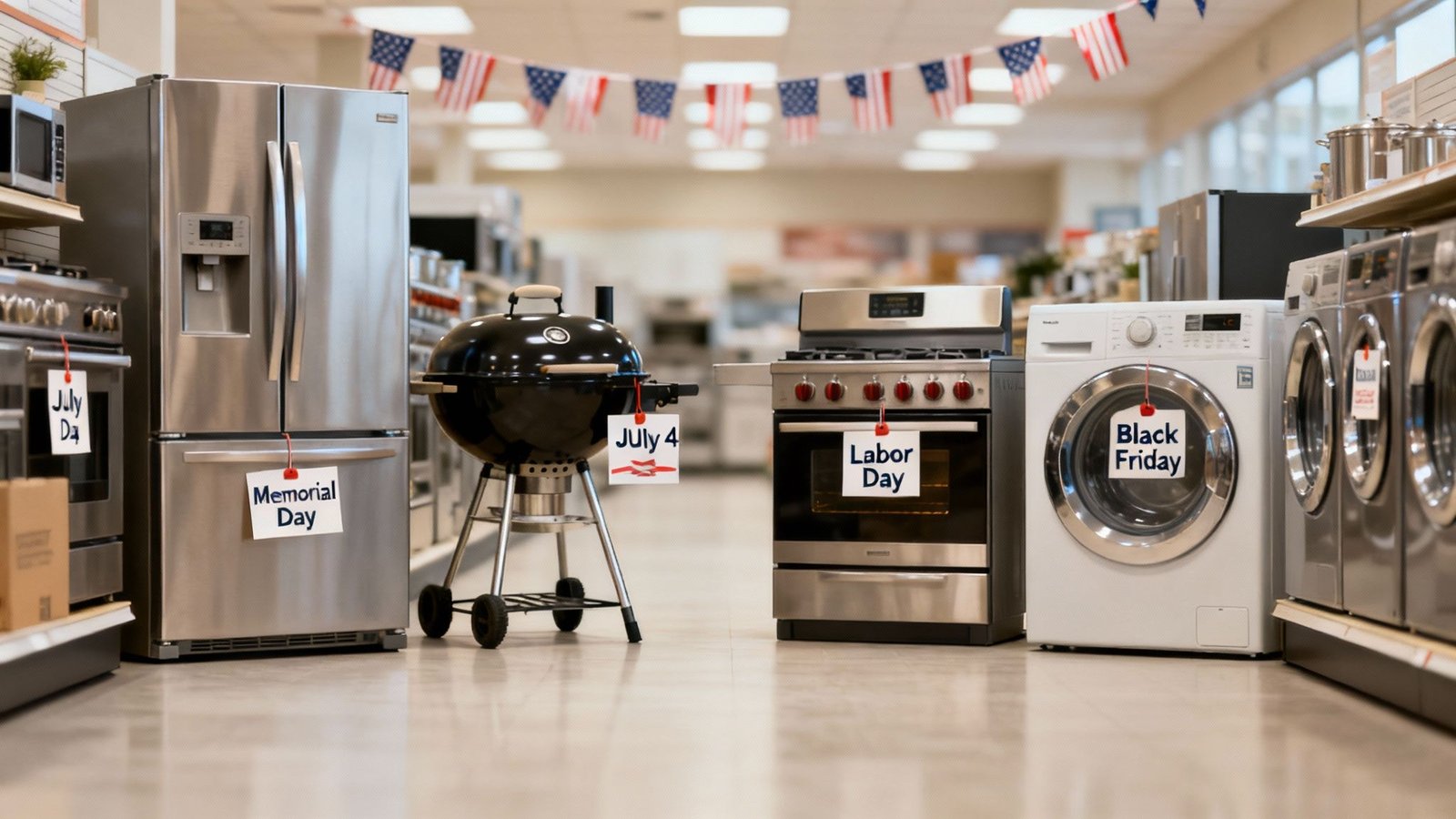
If you’ve ever wondered about the best time to buy a new appliance, the short answer is this: wait for a major holiday weekend or for the new models to be released in the fall. Appliance pricing isn’t random. It follows predictable cycles tied to retail events and manufacturer schedules, which makes timing your best tool for saving some serious cash.
Your Quick Guide to the Best Appliance Deals
Navigating the world of appliance shopping can feel like a guessing game, but understanding the rhythm of the retail calendar can save you hundreds, if not thousands, of dollars. The real key is to line up your purchase with one of these predictable sales events instead of waiting until your old dishwasher finally gives up the ghost.
This proactive approach means you can shop calmly, compare features without pressure, and pounce when the price is right. Instead of paying a premium out of sheer necessity, you can plan your upgrades around the moments retailers are most eager to move inventory. These windows of opportunity pop up all year long, offering huge discounts on everything from refrigerators to washing machines.
Key Savings Periods Throughout the Year
The appliance sales calendar is really marked by a few standout events. Holiday weekends get all the attention, but the changing of seasons and new product launches create just as many opportunities to save.
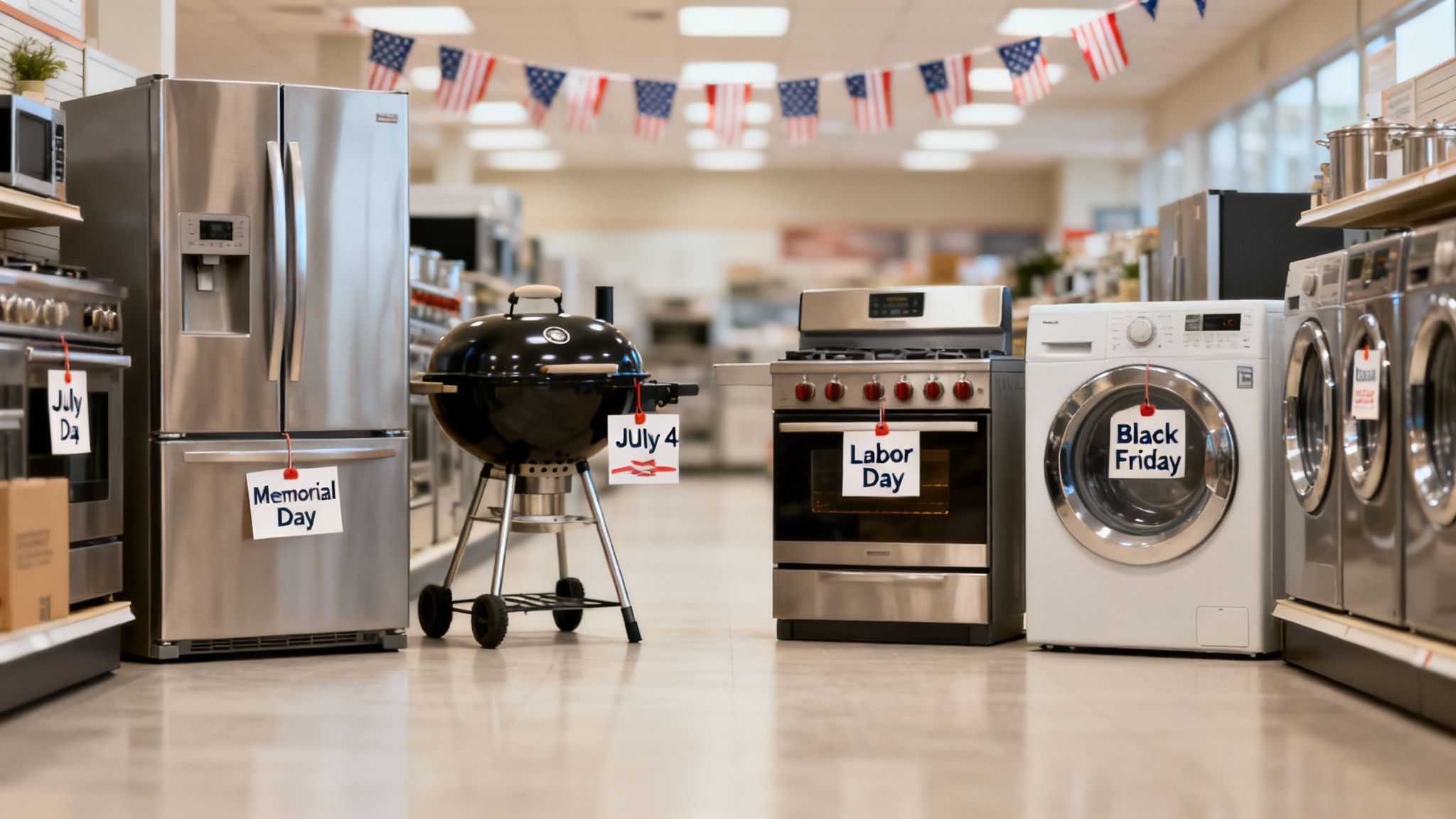
- Holiday Weekends: This is the big one. Events like Memorial Day, the Fourth of July, Labor Day, and especially Black Friday are prime time for deep discounts across pretty much every major appliance category.
- New Model Releases: Most manufacturers roll out their new washers, dryers, and dishwashers in September and October. This makes late fall the perfect time to snag last year’s models at a steep discount as stores clear the floor.
- End-of-Year Sales: From October through December, stores are laser-focused on clearing out old stock to make way for next year’s inventory. This creates a true buyer’s market.
This timeline gives you a great visual of the peak savings opportunities for specific appliance categories throughout the year.
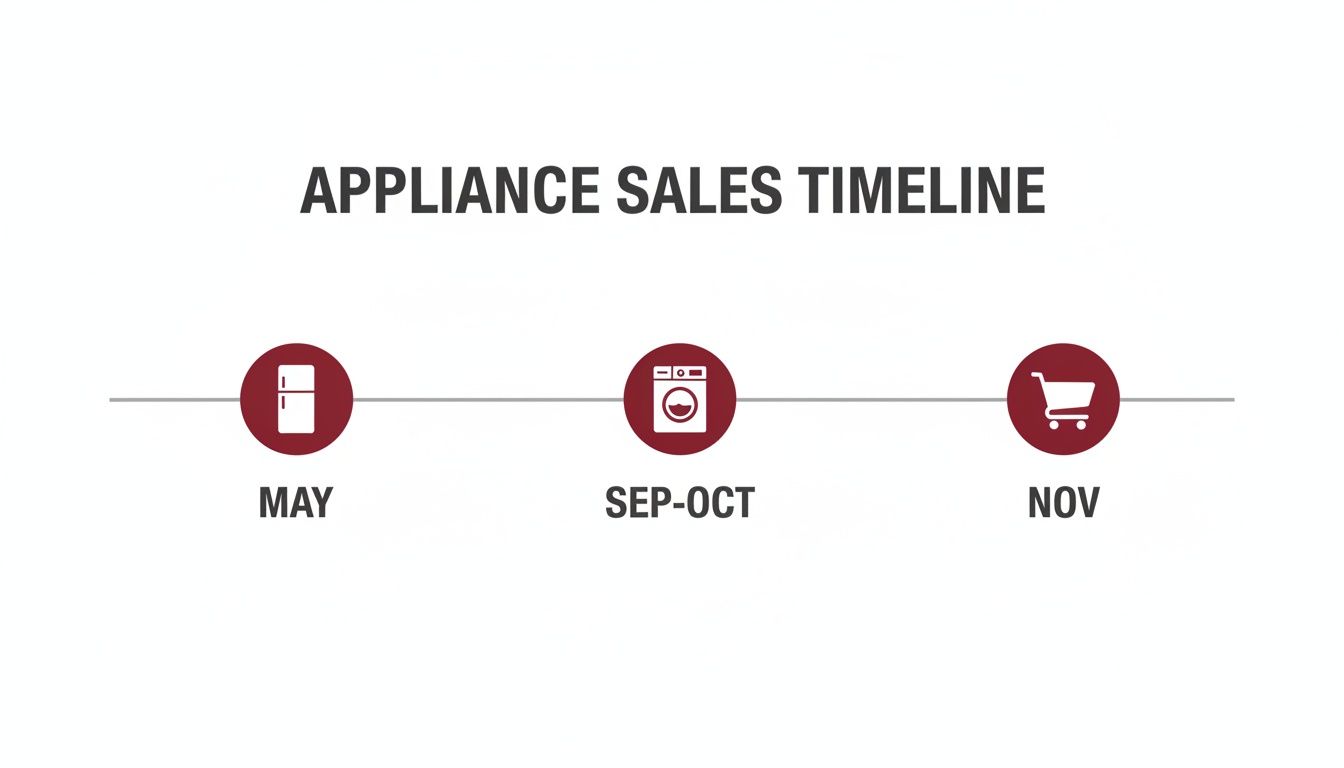
As the graphic shows, different appliances hit their rock-bottom prices at specific times. Refrigerators are often cheapest in May, laundry units get major markdowns in the early fall, and Black Friday is a free-for-all with deals on everything.
To make this even easier, here’s a quick cheat sheet for the major appliance sales events.
Appliance Sales Calendar at a Glance
| Sale Period | Typical Discounts | Best For |
|---|---|---|
| Holiday Weekends | 10% – 30% off | Buying a full kitchen suite or laundry pair for bundled savings. |
| New Model Release (Fall) | 20% – 40% off last year’s models | Getting a high-quality, feature-rich appliance without paying for the “newest” tag. |
| End-of-Year Clearance | 30% – 50% off or more | Finding the absolute deepest discounts on floor models and remaining stock. |
These sales offer a predictable rhythm to the market, giving you a massive advantage if you can plan ahead.
The data consistently shows that patience pays off. By waiting for these key sales periods, you’re not just getting a small discount—you’re often capturing the lowest price of the entire year.
This isn’t just a hunch; extensive price tracking backs it up. Research from Consumer Reports, for example, followed prices for about 1,500 appliances over a full year. Their analysis found that refrigerators saw an average price drop of nearly $250 between their peak in May and the sales in November.
Similarly, ranges were about $178 cheaper on Black Friday compared to their February highs. You can discover more about these pricing trends and how to save, but the takeaway is clear: timing is everything.
Decoding the Major Holiday Sales Weekends
While timing your purchase with new model releases is a great insider trick, the most famous—and easiest—strategy is to aim for a major holiday weekend. These are the blockbuster events of the retail world. Stores slash prices to pull in customers who have the day off and are ready to spend.
But these sales aren’t just random acts of generosity. They’re carefully planned promotions designed to tap into how we shop and what we need each season. Once you understand the logic behind each holiday sale, you can target the right one and walk away with a fantastic deal.
From the kickoff of summer to the year-end blowout, each holiday event brings its own flavor of deals. Let’s break down the heavy hitters on the appliance sales calendar.
Memorial Day: The Summer Kickoff Sale
Memorial Day in May is the unofficial start of summer, and retailers lean into that hard. This is a prime time to find deals on appliances that are about to go into overdrive during the warmer months.
Think about what everyone needs for summer cookouts and keeping food fresh. That’s exactly why you’ll see some of the year’s best prices on:
- Refrigerators: With families stocking up for barbecues and parties, retailers discount refrigerators heavily. If your old fridge is on its last legs, May is the perfect time to upgrade.
- Outdoor Grills: Sure, it’s not a traditional indoor appliance, but Memorial Day sales are legendary for deals on grills, smokers, and all sorts of outdoor cooking gear.
- Freezers: Extra freezer space is a lifesaver for summer produce and bulk meat buys, making this a hot item during the May sales events.
Fourth of July: Mid-Summer Bargains
Right in the middle of summer, the Fourth of July sales event rolls in like a second wave of discounts. It might not always be as massive as Memorial Day or Black Friday, but it’s a fantastic second chance to catch deals you might have missed.
This sale often targets a broad range of home goods. Retailers use the mid-year holiday to clear out inventory and give sales a boost during what can be a slower period. You’ll find solid discounts across the board, especially on kitchen and laundry appliances.
Labor Day: End-of-Season Clearance
Held in early September, Labor Day weekend signals the unofficial end of summer. For retailers, this is a critical transition. They need to get rid of any lingering summer-related stock to make room for new appliance models and the avalanche of holiday season inventory.
This timing creates a perfect storm for savings. You’ll find excellent clearance deals on outdoor gear like grills, but it’s also a fantastic time for major indoor appliances.
Labor Day sales are especially powerful because they often overlap with the arrival of new appliance models. This means you can find “last year’s” brand-new washer or dishwasher at a significant discount as stores scramble to clear floor space.
Black Friday: The Undisputed Champion of Sales
When it comes to appliance deals, Black Friday in November is the main event. It’s the one time of year when nearly every single category sees deep, aggressive price cuts. Retailers are in a fierce battle for holiday shoppers, and that competition drives prices way down.
What makes Black Friday unique is the sheer breadth and depth of the discounts. It’s not unusual to find savings of 30% to 50% on everything from a high-end French door refrigerator to a basic countertop microwave.
- Appliance Bundles: This is, without a doubt, the best time to buy a full kitchen suite. Retailers roll out package deals that can save you thousands when you buy a refrigerator, range, dishwasher, and microwave all at once.
- Door Busters: While less common for the really big appliances, some stores offer limited-quantity “doorbuster” deals on smaller items like stand mixers or air fryers that are too good to pass up.
- Across-the-Board Savings: Unlike other holidays that might focus on specific categories, Black Friday discounts cover pretty much everything. That makes it the most reliable time to buy if you have multiple appliances on your list.
By strategically targeting these holiday weekends, you can turn what would have been a major purchase into a major win for your wallet.
How New Model Releases Create Hidden Deals
Forget the big holiday sales for a moment. One of the sneakiest—and most effective—ways to score a deal on a new appliance is to understand the industry’s product cycle. It works a lot like the car industry: every year, manufacturers roll out new models with fresh features, which means last year’s perfectly good, brand-new models have to go.
This predictable cycle creates a fantastic, often overlooked, opportunity to save big.
Retailers only have so much floor space. When a truck full of 2025 models rolls up, the 2024 versions have got to move, and fast. This gives stores a powerful incentive to mark down the outgoing inventory, often slashing prices by 20% to 40%. You get a factory-fresh appliance with a full warranty for a fraction of the original cost, all because you timed your purchase right.
It takes a little planning, sure, but the payoff is huge. You’re not just buying a discounted item; you’re buying a top-notch appliance whose only “flaw” is that a slightly newer version now exists.
The Annual Appliance Calendar Unpacked
Different appliances follow different release schedules, which opens up specific windows of opportunity all year long. Knowing this calendar is like having an insider’s guide to savings.
The trick is to start shopping right as the new models are hitting the showroom floors. Here’s a general breakdown of when manufacturers typically roll out their latest and greatest.
- Refrigerators: New fridge models usually make their debut in the spring, typically around May. This makes late spring the perfect time to hunt for deals on last year’s units.
- Washers, Dryers, and Dishwashers: The release cycle for laundry and dish appliances is packed into the fall. You’ll see new models arriving in September and October.
- Ranges and Ovens: Cooking appliances also tend to follow a fall release schedule, so September through November is a prime time to find deals on the outgoing stock.
By targeting these specific months, you can strategically buy what you need right when retailers are most motivated to clear out older inventory. It’s a win-win: they free up space, and you walk away with a fantastic deal.
Why Fall Is a Prime Time for Deals
September and October are especially powerful months for appliance shoppers. This is when the release schedules for many major appliance categories—washers, dryers, dishwashers, and ranges—all line up. Retailers get flooded with new inventory and are under immense pressure to clear out the old.
This period often overlaps with Labor Day sales, giving you a chance to double-dip. You get the benefit of a holiday sale stacked on top of the urgency of a model-year clearance.
The real secret to maximizing savings is recognizing that “last year’s model” is often nearly identical to the new one. Unless the new version introduces a must-have feature, you’re essentially getting the same technology and performance for much less.
When shopping for these clearance models, pay attention to the little details. For instance, if you’re upgrading your refrigerator, understanding dimensions is key. You can learn more about what counter-depth means to ensure the model you choose fits perfectly into your kitchen layout, avoiding any costly installation surprises.
The key takeaway is that patience and a little knowledge of these cycles can unlock deals that are just as good as—if not better than—the Black Friday frenzy. By stepping outside the major holiday events and focusing on the industry’s own calendar, you put yourself in the driver’s seat.
Finding Value in Open-Box and Floor Models
For the truly savvy shopper, the best time to buy an appliance isn’t always tied to a holiday sale. Sometimes, the most incredible savings are hiding in plain sight, right on the showroom floor, available any day of the year.
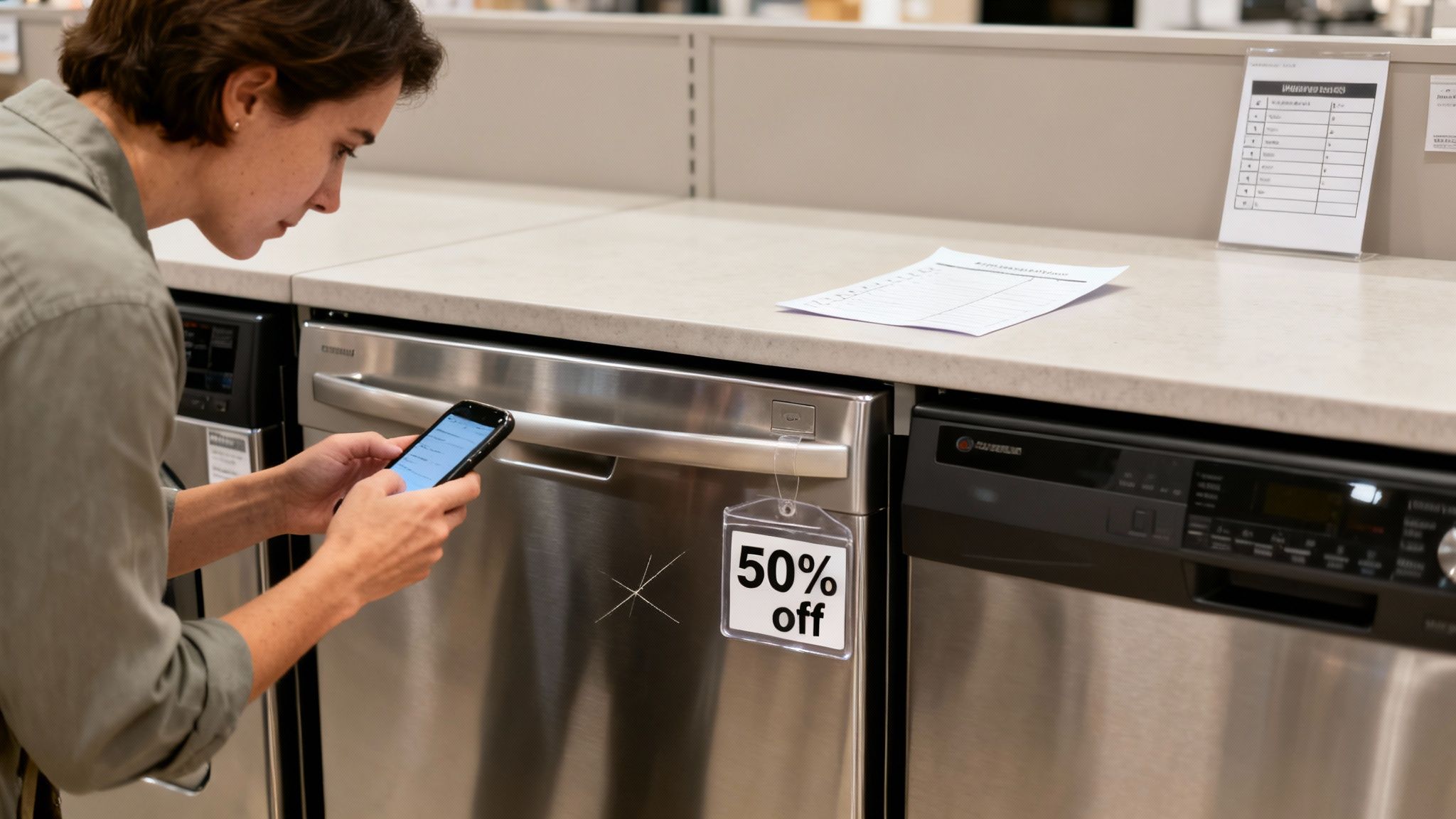
I’m talking about open-box, scratch-and-dent, and floor model appliances. These are items that can’t be sold as “new” for one reason or another, but they often deliver the exact same performance for a fraction of the price. This is where a small cosmetic flaw can translate into huge savings. A minor scuff on the side of a high-end fridge or a tiny dent on a dishwasher panel—often completely hidden once installed—can slash the price by up to 50% or more. For anyone on a budget, this is one of the most powerful ways to get premium features without the premium cost.
What’s the Difference, Really?
Navigating this world of discounted appliances starts with knowing the lingo. While they all offer savings, the reason for the markdown is different, which can impact the appliance’s condition and warranty.
- Open-Box: These are usually just customer returns. Maybe someone bought a dishwasher, opened it up, and realized it was the wrong size or color for their kitchen. The appliance is often completely unused but can no longer be sold as brand-new.
- Scratch-and-Dent: Just like it sounds, these appliances picked up some minor cosmetic damage, usually during shipping or while being moved around a warehouse. Functionally, they’re perfect and have never been used.
- Floor Models: These are the display units you see in the store. They’ve been handled by customers and powered on for demonstrations, but they haven’t been used for actual cooking, washing, or refrigerating.
Each category is a unique opportunity, but it requires a careful eye. Your goal is to find an item where the cosmetic imperfection is something you can easily live with in exchange for a deep discount.
The key is to separate cosmetic flaws from functional defects. A scratch on the side of a washing machine that will be hidden in a laundry closet is a bargain; a crack in the control panel is a deal-breaker.
Before you get too excited about the price tag, a thorough inspection is crucial. Don’t be shy about giving a potential purchase a full check-up right there in the store to make sure you’re getting a great deal, not someone else’s headache.
To help you sort through the options, think of it like this:
Open-Box vs. Floor Model vs. Scratch-and-Dent
| Appliance Type | Key Considerations | Potential Savings |
|---|---|---|
| Open-Box | Typically customer returns. Often unused but check for missing parts or subtle signs of installation. Warranty status is critical. | 20% – 40% |
| Floor Model | Has been on display and handled by customers. Check for wear on doors, knobs, and surfaces. May have reduced warranty. | 25% – 50% |
| Scratch-and-Dent | Cosmetic damage from shipping/handling. Functionally brand new. Great value if the damage is on a hidden side. | 30% – 60% |
Ultimately, your comfort level with minor imperfections will determine which category offers the best value for you.
Your Pre-Purchase Inspection Checklist
Before you commit, run through this quick but essential checklist. It’ll help you spot potential issues and confirm you’re buying a reliable machine.
- Examine Every Surface: Look for scratches, dents, and scuffs. Pay close attention to corners and edges, which are most prone to damage. Can you live with the blemishes, especially if they’ll be hidden after installation?
- Check All Moving Parts: Open and close every door, drawer, and latch. Do they operate smoothly and seal properly? For refrigerators, check the door seals for any rips or warping. For a range, test the oven door hinge.
- Inspect for Missing Pieces: Confirm all shelves, racks, drawers, and accessories are present. Replacing these parts can be expensive and wipe out your savings. Ask a salesperson for a manual or product sheet to cross-reference what should be included.
- Confirm Functionality: Ask the salesperson to plug it in. While you can’t run a full wash cycle, you can at least check if the control panel lights up, the interior lights work, and you don’t hear any scary noises from the motor.
Critical Questions to Ask Before You Buy
Your inspection is only half the battle. The other half is getting crystal-clear answers about the warranty and return policy, as these can be wildly different for discounted items. An appliance’s longevity is a key factor in its overall value, so knowing your coverage is essential. For more insights, you can read our guide on how long kitchen appliances typically last to put your potential purchase into perspective.
Here are the non-negotiable questions to ask:
- “What is the warranty situation?” Does it come with the full manufacturer’s warranty, a limited store warranty, or is it sold “as-is”? This is the single most important question you can ask.
- “What is the return policy on this specific item?” Many stores have a shorter return window or a “final sale” policy on clearance appliances. Know your options before you pay.
- “Is the price negotiable?” If you spot multiple cosmetic issues, use them as leverage. There’s often more wiggle room in the pricing on these items. Don’t be afraid to ask.
Smart Shopping Tactics to Maximize Savings
Knowing when to buy is half the battle. But knowing how to buy? That’s where you can unlock a whole new level of savings. Timing your purchase with a big holiday sale or a model-year clearance gets you in the door, but a few smart tactics can turn a good deal into a great one.
This is where you shift from just being a buyer to becoming a strategic shopper. By looking beyond the sticker price and understanding the levers you can pull, you can make every dollar count. These strategies work year-round and become especially powerful when you stack them with seasonal sales events.
Master the Art of Negotiation
You might not be able to haggle over a brand-new, still-in-the-box refrigerator at a big-box store, but don’t be fooled—negotiation is very much alive in the appliance world. Your best opportunities are with items where the price is already a bit flexible.
- Floor Models and Scratch-and-Dent: We’ve already touched on these, but they’re prime territory for negotiation. If you spot multiple cosmetic flaws, use them as respectful bargaining chips. A polite, “I see a few scratches here; is there any flexibility on the price?” can often knock a little more off the top.
- Independent Retailers: Smaller, local appliance stores often have more wiggle room than national chains. They survive on building relationships and may be more willing to work with you to make a sale, especially if you’re buying several items at once.
Don’t ever be afraid to ask. The worst they can say is no, but a simple question could easily save you an extra 5% to 10%.
The Power of Bundling Your Purchases
If you’re staring down a full kitchen remodel or need to replace both your washer and dryer, bundling is one of the single most effective ways to save. Retailers and manufacturers love to offer significant package discounts when you buy multiple appliances from the same brand.
You’ll see these deals pop up most often during major sales events like Black Friday and Memorial Day. A typical bundle might require you to purchase three or four major appliances—think a refrigerator, range, dishwasher, and microwave—to unlock savings that can range from a few hundred to well over a thousand dollars.
Think of it as a volume discount. By committing to a full suite of appliances, you become a much more valuable customer. Retailers reward that loyalty with exclusive pricing you simply can’t get by purchasing each item separately.
Leverage Price-Matching Policies
Most large retailers have a price-matching guarantee, and it’s a tool you should absolutely use. Before you pull the trigger, do a quick online search to see if a competitor is offering the same model for less.
If you find a better price, save the proof (a screenshot or a link to the ad) and show it at checkout. This simple step takes just a few minutes but ensures you get the absolute lowest price without driving all over town. Just be sure to read the fine print, as some policies might exclude online-only retailers or clearance items.
Use Technology to Your Advantage
Don’t leave pricing to chance. Online price-tracking tools and browser extensions can be your secret weapon. These tools will monitor your desired appliance and send you an alert the second the price drops.
Set up alerts for the models on your wishlist, and you’ll get an email the moment a sale hits. This proactive approach lets you act fast on flash sales or unannounced discounts that others might miss. It turns you from a passive browser into an informed buyer, ready to pounce on the best deal.
Look Beyond the Sticker Price
The price tag on the appliance is just one piece of the puzzle. To really understand what you’re spending, you need to consider the total cost of ownership. These “hidden” fees can add up quickly and turn a great deal into a mediocre one if you’re not paying attention.
Before you finalize any purchase, always ask about these three things:
- Delivery Fees: Is delivery free, or is there a charge? Some retailers offer free delivery on purchases over a certain amount, while others don’t.
- Installation Costs: Does the price include professional installation? For things like gas ranges or built-in dishwashers, this is a crucial service that can cost $150-$300 if it’s not included.
- Haul-Away Service: Will the delivery team take your old appliance with them? Many stores offer this for a small fee (or sometimes for free), saving you a massive disposal headache.
By factoring in these extra expenses, you can make a true apples-to-apples comparison between retailers and ensure your final cost has no nasty surprises.
When Is the Worst Time to Buy Appliances?
Knowing the best time to buy appliances is a great start, but let’s be honest, knowing when not to buy is just as critical for keeping your budget intact. While sales cycles create some amazing opportunities, there are definitely times when you’re almost guaranteed to pay a premium. Sidestepping these moments is a huge part of shopping smart.
The most common trap? The emergency purchase. Your refrigerator gives up the ghost on a random Tuesday, or the washing machine decides to flood the laundry room. This is, without a doubt, the worst time to be shopping. You’re forced to buy out of pure desperation with no time to compare prices, wait for a sale, or even properly research models. You’re at the mercy of whatever a store has in stock, and you’ll be paying full price for it.
Paying Full Price Right Before a Big Sale
There are few things more frustrating than buying a new appliance only to see it go on sale for hundreds less just a few days later. Retailers lock in their holiday sale prices well in advance, but they have zero incentive to give you that price early. If you buy a new dishwasher the weekend before Memorial Day weekend officially starts, you could easily pay 20-30% more than if you’d just held out for a few more days.
The same goes for buying a brand-new model the week it hits the showroom floor. New releases always command the highest price tag. If you can wait just a couple of months, the initial hype usually fades, and you might catch the first small discounts or promotional offers.
Here’s a simple rule of thumb: if a major holiday like Memorial Day, Labor Day, or Black Friday is less than two weeks away, it pays to wait. The potential savings almost always outweigh the inconvenience of holding on a little longer.
The Pitfalls of Panic Buying
The emergency purchase is where even the most careful shoppers get tripped up. When you’re in crisis mode, your priority shifts from finding the best value to just solving the problem—fast. This leads to a cascade of expensive mistakes:
- Limited Selection: You’re stuck with whatever models are in stock and available for immediate delivery, which might not be the best fit for your home or your budget.
- No Time for Research: You can’t spend time reading reviews, comparing energy ratings, or double-checking your measurements. This dramatically increases the risk of buyer’s remorse.
- Zero Negotiating Power: When a salesperson knows you’re in a bind, there’s no reason for them to offer a discount. You’ve lost all your leverage.
Your best defense here is a good offense. Start paying attention to the warning signs of a failing appliance—is it making weird noises, performing inconsistently, or are your utility bills creeping up? By planning for a replacement before it completely dies, you give yourself the gift of time. That lets you shop strategically during one of the prime buying seasons we’ve already covered.
Frequently Asked Questions About Appliance Shopping
Even after you’ve mapped out the best sales and picked a model, a few nagging questions can pop up. Getting them sorted out is often the last step between a good deal and a great one. Let’s tackle some of the most common ones that come up before you pull the trigger.
Is It Better to Buy Appliances Online or In-Store?
Honestly, the best strategy is a mix of both. They each have their perks, and you can play them off each other.
Online shopping is fantastic for its endless selection and the ability to compare prices with a few clicks. The big downside? You can’t actually see or touch the appliance. That’s a huge deal if you’re eyeing a floor model or just want to feel the build quality.
That’s where heading to a physical store comes in. You can inspect everything up close, open the doors, and get a real sense of its size and finish. Plus, it’s way easier to negotiate on an open-box or scratch-and-dent item when you’re standing right there.
My advice? Do a little hybrid shopping. Visit a store to get your hands on your top picks, then head home and compare the final, all-in prices online. Just don’t forget to factor in delivery and installation fees for both—that’s where the “true” final price is hiding.
Should I Buy an Extended Warranty for My New Appliance?
This one really boils down to your personal tolerance for risk. Before you even think about saying yes, do two things. First, pull out the credit card you plan on using; many cards automatically extend the manufacturer’s warranty for free. Second, do a quick online search for the reliability record of your specific model. Some are built like tanks, while others have a reputation.
If you’re buying an appliance known for needing a few repairs down the line, that extra cost might buy you some serious peace of mind. But for a highly-rated, dependable brand? You’re probably better off skipping it and just setting that money aside in your own “uh-oh” fund for any future fixes.
Think of an extended warranty as a simple insurance policy against repair bills. Just weigh the price of the policy against the potential cost of a major repair and the appliance’s track record.
How Much Can I Realistically Save by Waiting for a Sale?
The savings can be massive, and it’s almost always worth the wait. During those big holiday blowouts like Black Friday, you can pretty easily find discounts of 20-40%. On a $1,500 fridge, that’s a cool $300 to $600 back in your pocket. Snagging last year’s model during the fall changeover can get you similar deals.
And if you’re not picky about a tiny scuff? A scratch-and-dent model can knock the price down by 50% or more. A little patience is your best friend here—it can literally save you hundreds. For a deeper dive on what to look for, check out our complete kitchen appliance buying guide.
Do Appliance Prices Change During the Week?
While the huge, headline-grabbing price drops are tied to holidays and clearance events, you might see some minor fluctuations mid-week. But there’s no magic “best day” to shop.
A much better approach is to pick the appliance you want and then set up a price tracker online to monitor it. That way, you’re ready to jump the moment a big sale kicks off, which is when you’ll find the deepest and most reliable discounts.
