



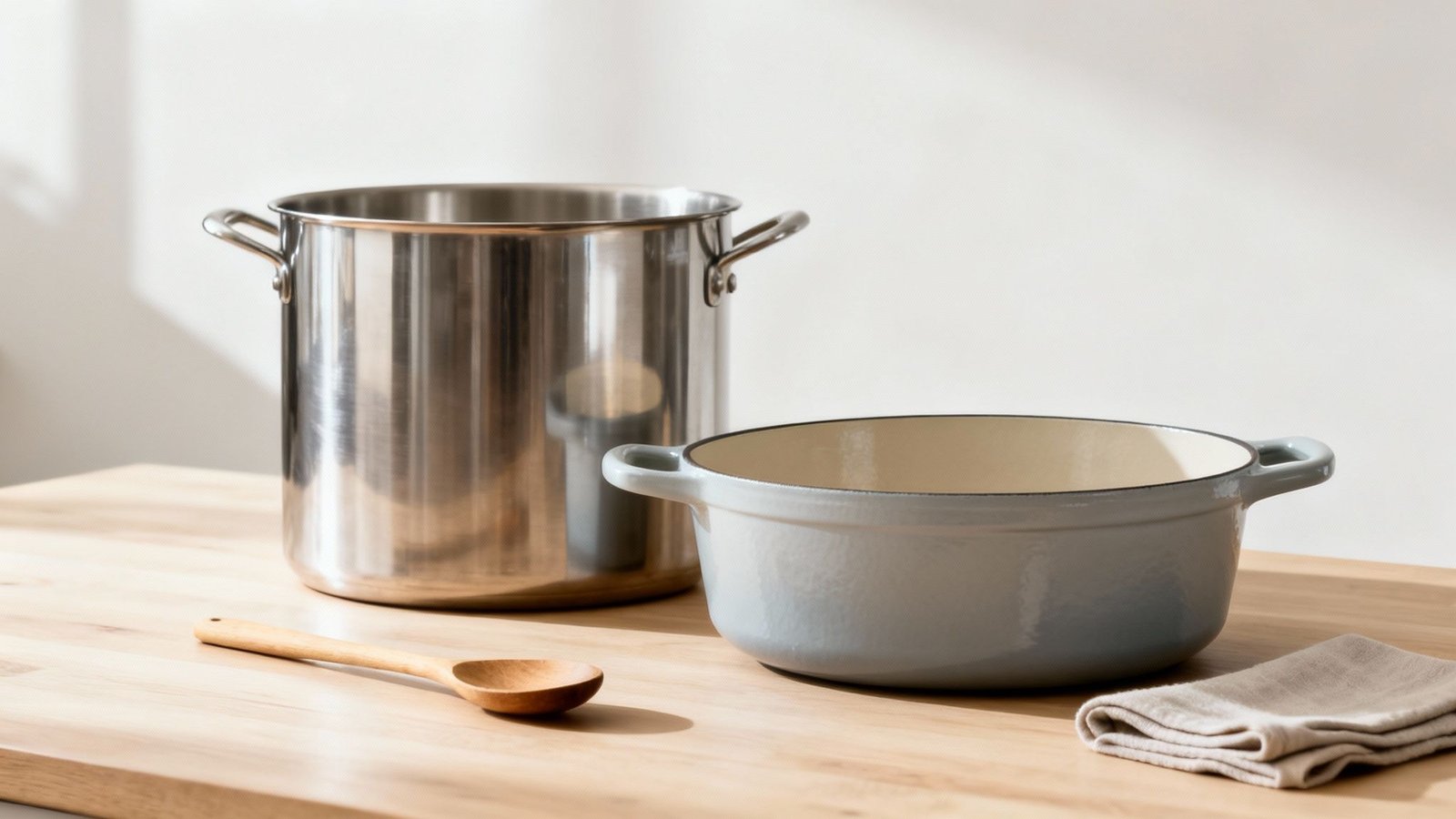
So, you’re staring at a stock pot and a Dutch oven, wondering which one deserves that precious cabinet space. It’s a classic kitchen showdown. Both are kitchen workhorses, but they’re designed for fundamentally different jobs. Choosing the right one can completely transform your cooking experience, making everything from weeknight pasta to slow-cooked Sunday roasts easier and more delicious.
A stock pot is your go-to for speed and volume—think big batches of soup or boiling pasta. A Dutch oven, on the other hand, is built for slow, even cooking that develops deep, rich flavors, perfect for braises and stews. Let’s break down which one is the right partner for your kitchen.
Understanding the Core Differences
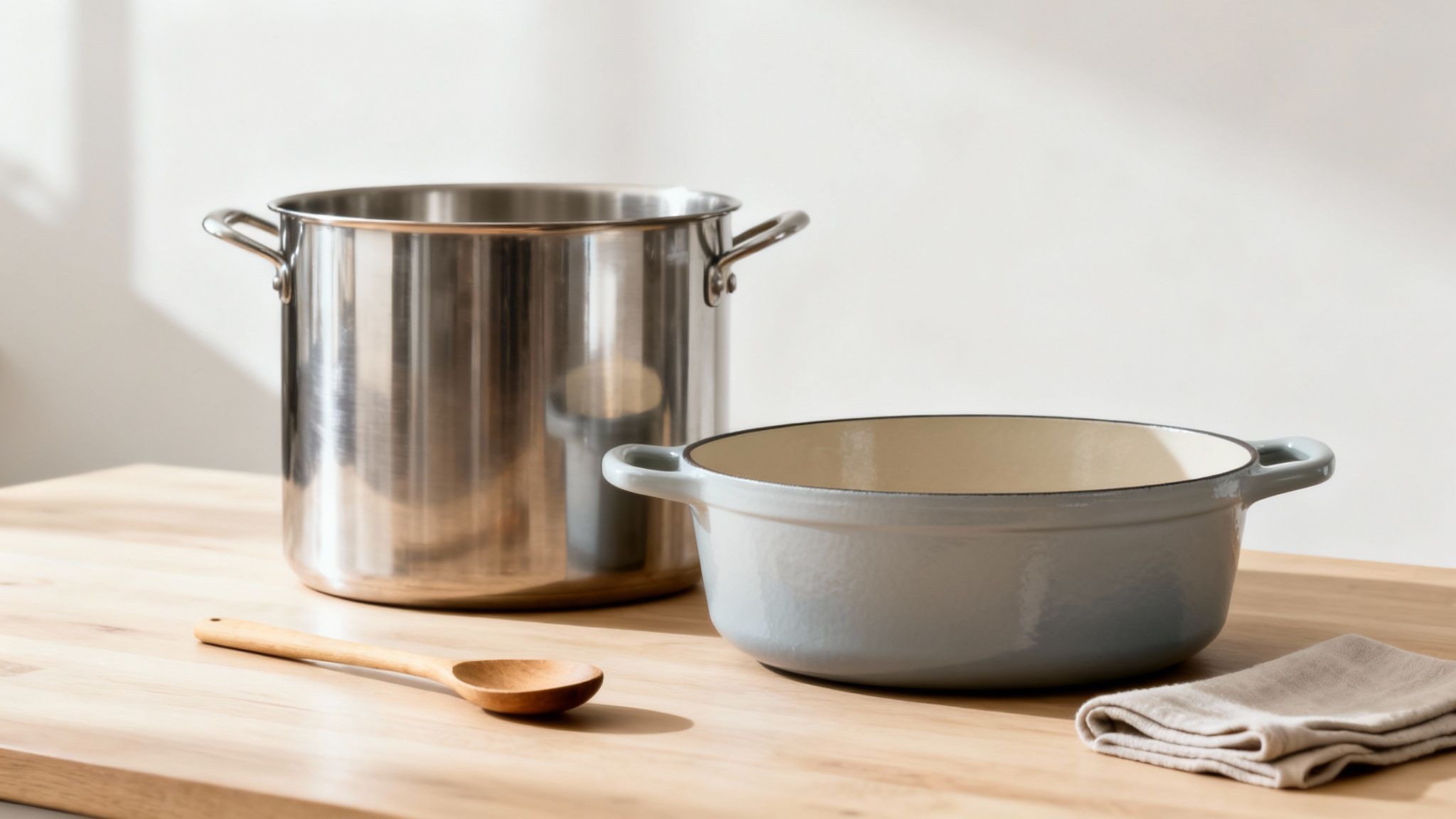
While both of these pots are large and can handle big jobs, they are fundamentally different tools. One is a specialist in liquids and rapid heating, while the other is a master of low-and-slow cooking. This difference comes down to their materials, shape, and weight, which all work together to define their role in your kitchen.
Features & Benefits: The Stock Pot
A stock pot is the marathon runner of the kitchen. It’s tall, relatively thin, and usually made from lightweight stainless steel or aluminum. Its design is engineered for one primary purpose: to bring large amounts of liquid to a boil as quickly and efficiently as possible.
- Key Feature: Lightweight Construction. Made from stainless steel or aluminum, stock pots are easy to handle, even when full.
- Benefit: This makes them perfect for everyday tasks like boiling pasta, potatoes, or making large batches of stock without straining your wrists.
- Key Feature: Tall, Narrow Shape. The design minimizes the surface area of the liquid, which reduces evaporation.
- Benefit: This is crucial when simmering broths for hours, ensuring you don’t lose all that flavorful liquid.
- Key Feature: Fast Heat Conduction. The thin walls transfer heat quickly from the burner to the contents.
- Benefit: Water boils significantly faster, saving you time on busy weeknights.
Features & Benefits: The Dutch Oven
The Dutch oven is the heavyweight champion. It’s squat, thick, and forged from heavy cast iron, often with a colorful enamel coating. Its superpower isn’t speed; it’s the incredible ability to soak up, retain, and radiate heat slowly and evenly for hours. This makes it ideal for cooks who love developing deep, complex flavors.
- Key Feature: Heavy Cast Iron Build. Its sheer mass allows it to absorb and hold heat for a very long time.
- Benefit: This provides incredibly even, consistent cooking from all sides, eliminating hot spots. It’s perfect for turning tough cuts of meat into fall-apart tender masterpieces.
- Key Feature: Tight-Fitting Lid. The heavy lid traps steam and moisture inside the pot.
- Benefit: This creates a self-basting environment that keeps roasts and stews succulent. It’s also the secret to baking artisanal bread with a perfect, crackly crust.
- Key Feature: Stovetop-to-Oven Versatility. Most Dutch ovens are designed to seamlessly move from searing on the stove to braising in the oven.
- Benefit: This makes them the ultimate tool for one-pot meals, simplifying both the cooking and cleanup process.
At a Glance: Stock Pot Vs Dutch Oven
To make it even clearer, let’s put them side-by-side. This table cuts right to the chase, highlighting the key distinctions that define each pot and its best use cases.
| Feature | Stock Pot | Dutch Oven |
|---|---|---|
| Primary Material | Stainless Steel or Aluminum | Enameled or Bare Cast Iron |
| Weight | Lightweight (approx. 3-6 lbs) | Heavy (approx. 10-15 lbs) |
| Heat Conduction | Heats up very quickly | Heats up slowly and evenly |
| Heat Retention | Poor; cools down fast | Excellent; stays hot for a long time |
| Best For | Boiling, simmering, making stock | Braising, searing, baking, stewing |
| Stovetop to Oven | Limited (often due to size/handles) | Yes, ideal for this transition |
| Price Point | Generally more affordable | Higher investment |
Seeing it all laid out like this, the unique roles they play become obvious. One isn’t better than the other—they’re just built for different culinary adventures.
Pros & Cons: Which Pot is Right for You?
Every piece of cookware has its strengths and weaknesses. Being honest about what you cook most often will help you decide which pot’s pros outweigh its cons for your specific needs.
Stock Pot
- Pros:
- Excellent for Large Volumes: Its capacity is unmatched for big batches of soup, stock, or boiling pasta for a crowd.
- Heats Up Quickly: Saves valuable time when you need to bring water to a boil fast.
- Lightweight & Easy to Handle: Simple to move from the sink to the stove, even when filled.
- Affordable: Generally much less expensive than a quality Dutch oven.
- Cons:
- Poor Heat Retention: Doesn’t hold heat well, making it less ideal for keeping food warm or for deep frying.
- Prone to Hot Spots: The thin base can lead to uneven heating and potential scorching if not watched carefully.
- Limited Versatility: Primarily a stovetop tool; most are not suitable for oven use.
Dutch Oven
- Pros:
- Superior Heat Retention: Keeps food hot for hours and maintains stable oil temperatures for frying.
- Incredibly Versatile: Excels at searing, braising, baking, stewing, and frying—a true multi-tasker.
- Even Cooking: The cast iron construction eliminates hot spots, ensuring food cooks uniformly.
- Durable: A well-cared-for Dutch oven can last a lifetime, often becoming a family heirloom.
- Cons:
- Very Heavy: Can be difficult to lift and maneuver, especially when full of hot food.
- Slower to Heat Up: Takes more time to preheat compared to a stock pot.
- Higher Price Point: Represents a significant investment in your kitchen arsenal.
- Requires More Care: Enameled versions can chip, and bare cast iron requires seasoning.
What Real Cooks Are Saying
To give you a better sense of how these pots perform in real-world kitchens, here are a few summarized impressions from home cooks.
“I finally invested in a 7-quart Dutch oven, and it’s completely changed my Sunday cooking. My pot roasts have never been more tender. It’s heavy, yes, but the results are so worth it. My only regret is waiting so long to get one.” – Paraphrased from an online review
“My 12-quart stock pot is my meal-prep hero. I use it every week for making huge batches of chili and bone broth. It heats up fast and is super easy to clean. It’s not fancy, but it does its job perfectly.” – Paraphrased from a cooking forum
“I tried making a stew in my stock pot, and the bottom scorched a bit because I wasn’t stirring constantly. I borrowed my mom’s Dutch oven for the next batch, and the difference was night and day—no sticking, and the flavor was so much deeper.” – Paraphrased from a social media comment
“While I love my Dutch oven for baking bread and braising, I find it too heavy for everyday things like boiling pasta. I ended up getting a cheap, lightweight stock pot just for that, and I’m glad I have both.” – Paraphrased from a product Q&A
Frequently Asked Questions (FAQs)
Here are answers to some common questions buyers have when deciding between a stock pot and a Dutch oven.
1. Can a Dutch oven replace a stock pot completely?
For most tasks, a Dutch oven is more versatile. However, it can’t fully replace a stock pot for boiling large quantities of water for pasta or canning, as its wider shape increases evaporation and it heats up much more slowly. It’s best to see them as complementary tools.
2. What is the most versatile size to buy first?
For a Dutch oven, a 5.5 to 7-quart round model is the sweet spot for most families, perfect for a whole chicken or a large stew. For a stock pot, a 12-quart pot is a fantastic all-rounder that can handle everything from a pound of pasta to a big batch of stock.
3. How does cleaning and durability differ?
Stainless steel stock pots are workhorses—most are dishwasher-safe and can handle heavy scrubbing. Enameled Dutch ovens require more care; they should be hand-washed to prevent the enamel from chipping. However, with proper care, a Dutch oven is a “buy it for life” item, while a cheaper stock pot may warp over time. If that’s new to you, a guide on how to season a cast iron skillet offers great tips that apply just as well to a Dutch oven.
4. Is a premium Dutch oven worth the high cost?
In most cases, yes. A premium Dutch oven offers superior heat distribution, more durable enamel that resists chipping, and better overall performance. While the upfront cost is high, its longevity and versatility make it a worthwhile long-term investment for serious cooks.
5. Can I deep fry in a stock pot?
While you technically can, it’s not ideal. A stock pot’s poor heat retention means the oil temperature will drop significantly when you add food, leading to greasy results. A Dutch oven’s heavy cast iron body maintains a much more stable temperature, which is the key to perfectly crispy fried food.
Conclusion: Making the Right Choice for Your Kitchen
Ultimately, the stock pot vs. Dutch oven debate isn’t about which pot is universally “better,” but which pot is better for you.
If you’re a cook who loves big-batch meal prepping, boiling pasta for family dinners, or simmering gallons of stock, the stock pot is an indispensable and affordable tool. Its speed and capacity are perfectly suited for these high-volume tasks.
However, if you find joy in the slow, transformative process of cooking—braising tough meats until they are tender, baking crusty artisanal bread, or developing deep, layered flavors in stews—the Dutch oven is an investment that will pay delicious dividends for years to come. Its versatility and superior heat control will open up a new world of culinary possibilities.
The ideal kitchen has both, but by considering your personal cooking style, you can confidently choose the pot that will not only meet your needs but also inspire your next great meal.
Ready to find the perfect addition to your kitchen arsenal? The experts at Reva Housing have done the research for you, with in-depth reviews and comparisons that make choosing the right cookware simple. Explore our comprehensive guides and find your next favorite pot today!
