



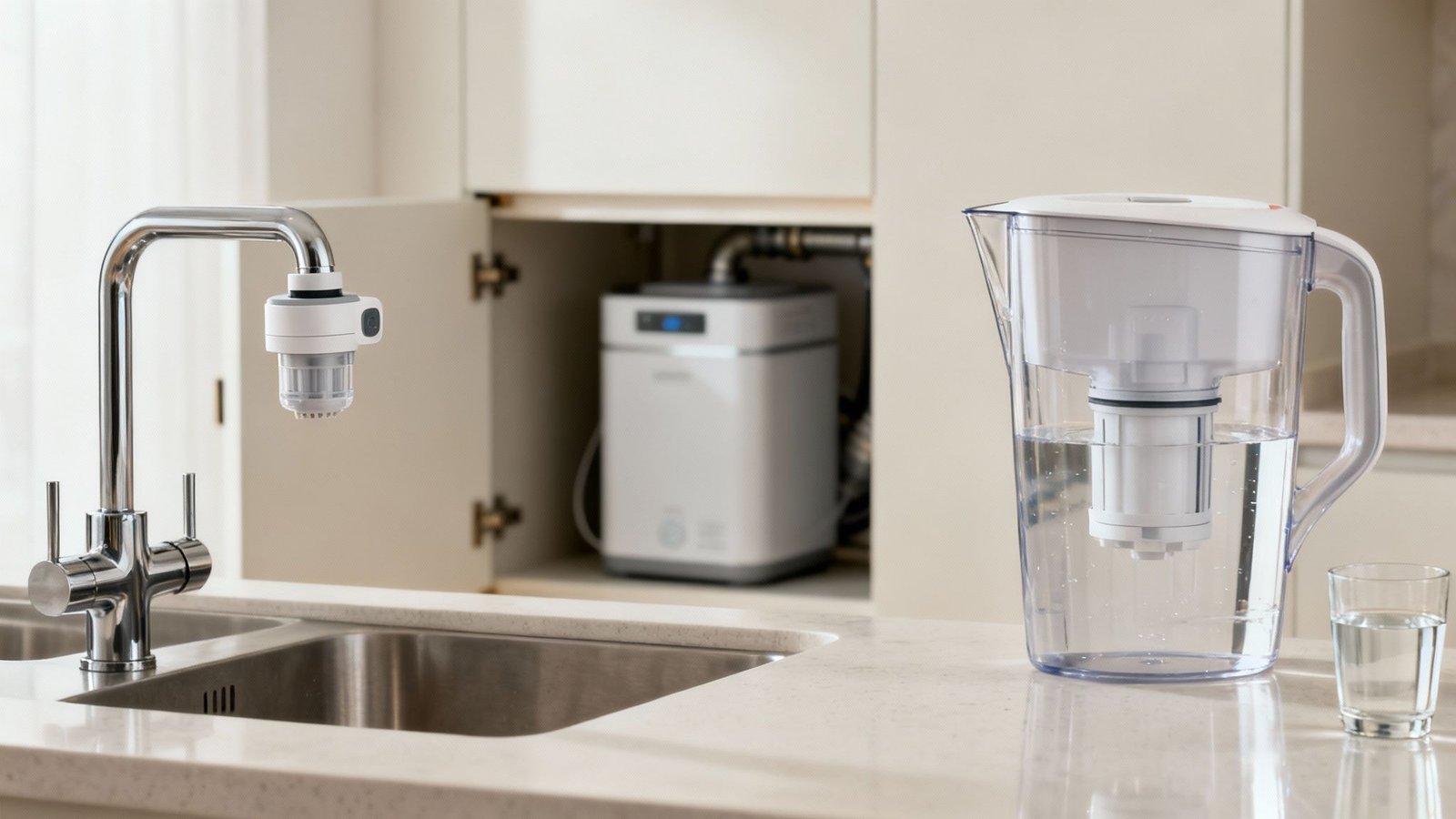
Choosing the best water filters for home really boils down to one central question: what are you prioritizing? Is it sheer convenience or is it comprehensive filtration? For most homeowners I talk to, an under-sink reverse osmosis system is the gold standard for removing the widest range of contaminants. But for pure simplicity and affordability, you really can’t beat a water filter pitcher for making your tap water taste better and cutting down on basics like chlorine.
Finding the Right Water Filter for Your Home
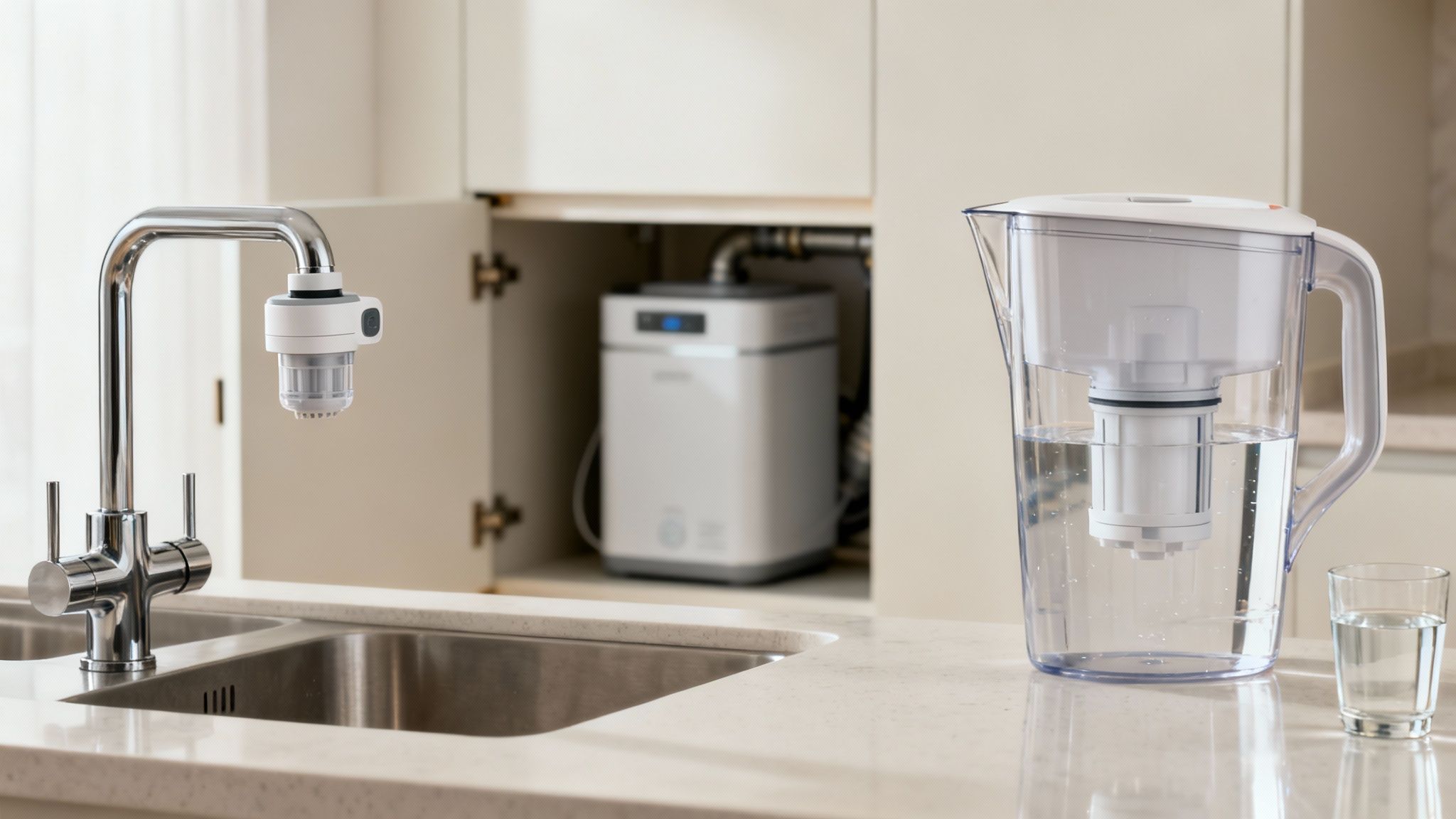
Whether it’s a weird taste from the tap, a funky smell, or a troubling report on your local water quality, the reasons to consider a home water filter are piling up. It’s no longer just about chlorine. People are rightly concerned about lead from old pipes, agricultural pesticides, and those sneaky PFAS “forever chemicals” that seem to be everywhere now. A good filter has become a key part of a healthy home.
But let’s be honest, picking the right one can feel like a chore. The market is flooded with options, and the technical jargon doesn’t help. This guide is here to cut through the noise. We’ll lay out the most popular types in plain English, so whether you’re in a tiny apartment or a rambling family house, you can find a filter that just works for you.
Understanding Your Options
Every type of filter strikes a different balance between performance, cost, and how much effort you have to put into it. Before we get into the nitty-gritty, it helps to see how they all stack up at a glance. Think of this as your cheat sheet for matching a filter to your life.
| Filter Type | Best For | Initial Cost | Contaminant Removal | Installation |
|---|---|---|---|---|
| Water Pitcher | Renters and individuals | $20 – $70 | Basic (chlorine, taste) | None |
| Faucet-Mounted | Renters and small kitchens | $30 – $60 | Moderate (lead, chlorine) | Easy DIY |
| Under-Sink | Homeowners wanting purity | $150 – $500+ | High (wide range) | Moderate DIY |
| Whole-House | Large households | $500 – $3,000+ | Varies (sediment, chlorine) | Professional |
My goal here is to give you the confidence to pick a filter that actually fits your budget, your daily routine, and your water quality goals. Once you get these core differences, you’ll be set to make sure every glass of water from your tap is as clean, safe, and refreshing as it should be.
Why Bother With a Water Filter, Anyway?
Let’s be honest: tap water in most developed countries is technically “safe.” Municipal treatment plants do a pretty incredible job of zapping the major pathogens that could make you sick. But “safe” and “pure” are two very different things.
What comes out of your faucet has likely traveled miles through aging pipes, picking up a few unwanted hitchhikers along the way.
The most obvious offender is chlorine. It’s the workhorse of water disinfection, but it leaves behind a distinct chemical taste and smell. If your morning coffee tastes a little “off” or a simple glass of water has a swimming pool vibe, chlorine is almost certainly the culprit. But beyond just taste, there are growing concerns about what else is sneaking through.
So, What’s Really in Your Tap Water?
Even after treatment, your water can contain a surprising cocktail of substances. The exact mix depends entirely on where you live—your local geology, nearby industries, and the age of your city’s pipes all play a part.
Here are a few of the usual suspects:
- Heavy Metals: Lead can still leach from old plumbing systems and service lines, posing serious health risks, especially for kids.
- Pesticides and Herbicides: Runoff from agricultural areas can find its way into the water supply.
- PFAS “Forever Chemicals”: These persistent, man-made chemicals are being detected more and more in our water sources and have been linked to a host of health problems. A startling 2023 report from the US Geological Survey found that nearly half of all Americans have PFAS in their drinking water.
- Microplastics: Tiny plastic particles from industrial waste and consumer products are now found in water systems across the globe.
Investing in a good water filter gives you a final line of defense right at the tap, ensuring the water you and your family drink is as clean as it can possibly be. This isn’t just a niche concern anymore. The global demand for water filters is expected to hit USD 25.22 billion by 2032, a massive jump driven almost entirely by health awareness. You can dig into the numbers on ResearchAndMarkets.com.
It’s More Than Just Health—It’s About Daily Upgrades
The benefits of filtered water go way beyond peace of mind. You start noticing the tangible perks in your daily routine, often in ways you didn’t expect.
Cleaner water isn’t just a health choice; it’s a quality-of-life upgrade. From the clarity of your ice cubes to the rich flavor of your morning brew, the difference is immediate and satisfying.
For instance, when you cook with filtered water, your pasta, soups, and steamed veggies aren’t absorbing that faint chlorine taste. It also cuts down on mineral buildup in appliances like kettles and coffee makers. If you’re constantly battling limescale, learning how to remove hard water stains becomes a lot less urgent when you’re filtering out the minerals causing the problem in the first place.
Ultimately, a water filter is a smart, sustainable move. It dramatically reduces—or even eliminates—your need for single-use plastic bottles, which saves money and cuts down on environmental waste. It’s a simple change that delivers a powerful combo of better health, better taste, and long-term value for any household.
So, Which Type of Home Water Filter is Right For You?
Choosing the right water filter can feel like a chore, but it really boils down to your living situation, budget, and what you’re trying to pull out of your water. There isn’t a single “best” filter for everyone; the right choice is the one that fits your life. Let’s walk through the main contenders to see which one makes the most sense for you.
First, let’s be clear on why this matters. Beyond just making your water safer, a good filter genuinely improves your day-to-day.
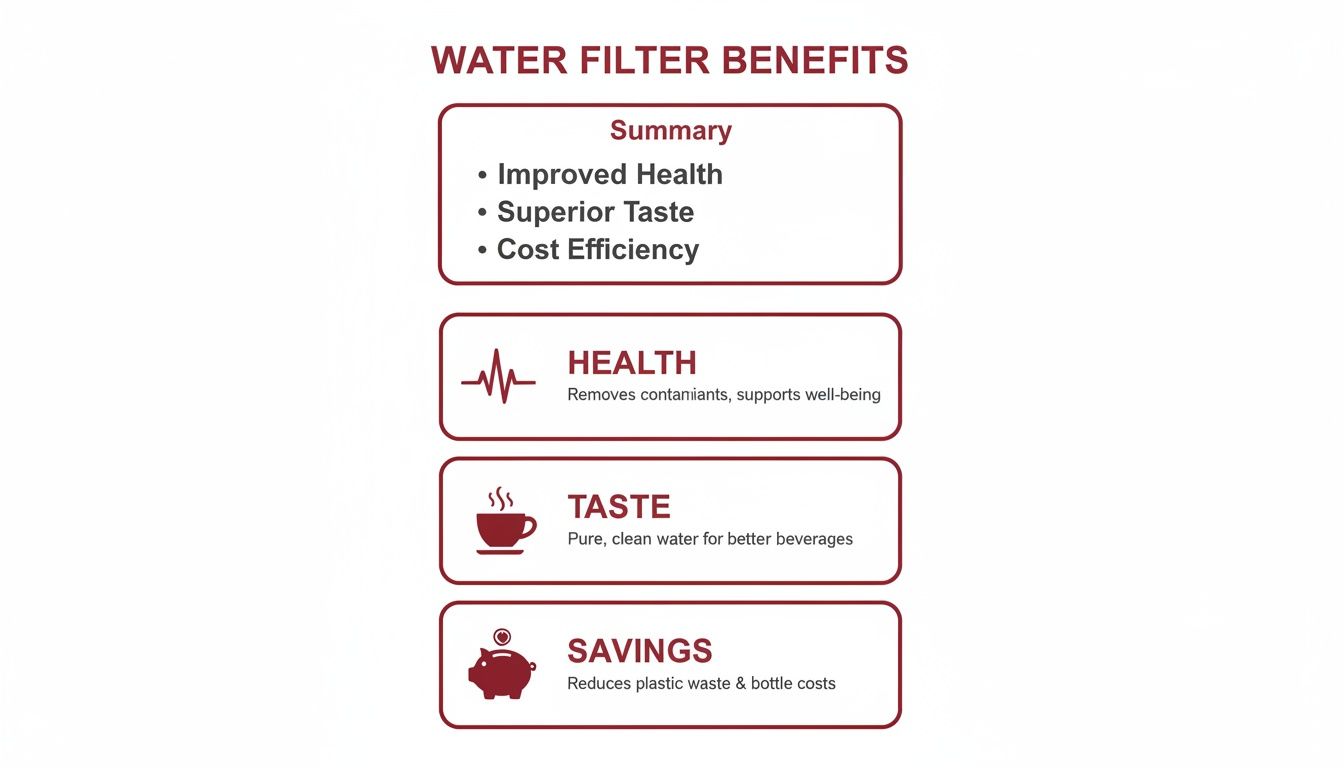
This isn’t just about removing contaminants. It’s about water that tastes crisp and clean, coffee that isn’t funky, and saving a ton of money on bottled water.
A Quick Look at Your Options
Before we get into the weeds, here’s a simple breakdown of the five main filter types. Think of this as your cheat sheet.
Home Water Filter Systems At a Glance
| Filter Type | Best For | Initial Cost | Contaminant Removal | Installation |
|---|---|---|---|---|
| Pitcher | Renters, individuals, or anyone wanting a simple, low-cost starting point. | $20 – $70 | Basic (Chlorine, Taste, Odor) | None |
| Faucet-Mounted | Renters and small families who want filtered water on demand without plumbing. | $30 – $60 | Good (Chlorine, Lead, Cysts) | 5-minute screw-on |
| Countertop | Anyone wanting better-than-pitcher filtration without permanent installation. | $80 – $300 | Better (VOCs, Heavy Metals, Pesticides) | Simple faucet hookup |
| Under-Sink | Homeowners wanting a powerful, hidden solution for drinking and cooking water. | $150 – $500+ | Best (Wide range of chemicals, PFAS, Lead) | DIY or professional help |
| Whole-House | Homeowners who want to treat all water for appliance protection and bathing. | $500 – $3,000+ | General (Chlorine, Sediment) | Professional required |
This table gives you a bird’s-eye view, but the real decision comes down to the details. Let’s dig in.
Water Filter Pitchers
For millions of people, a water filter pitcher is the first step into the world of better-tasting water. They are the definition of easy. Just fill it up, let gravity do its thing, and pour.
- What They Remove: Pitchers are great at the basics. They mainly use activated carbon to slash chlorine, which is the number one reason tap water can taste “off.” Some of the more advanced models can also tackle heavy metals like lead and mercury, but they aren’t designed for tougher stuff like bacteria or viruses.
- Upkeep: Installation is non-existent. Maintenance just means swapping out the filter cartridge every 40 to 120 gallons. For most people, that’s every two to six months.
- The Cost: You can get started for cheap, usually between $20 and $70. Keep in mind you’ll spend another $30 to $60 a year on replacement filters.
- Who It’s For: Pitchers are perfect for singles, couples, or college students. They’re a fantastic, no-commitment solution for renters who just want better-tasting water without messing with plumbing.
Faucet-Mounted Filters
A faucet-mounted filter is a nice step up in convenience, giving you clean water right from the tap. Most have a little switch to flip between filtered and unfiltered water, which is great for saving the filter life for when you’re actually drinking or cooking.
- What They Remove: These filters are usually a bit more powerful than a basic pitcher. Many are NSF-certified to remove not just chlorine but also lead, asbestos, certain pesticides, and even parasites like cryptosporidium and giardia.
- Upkeep: Installation is a breeze—it’s usually a tool-free, five-minute job of screwing the unit onto your faucet. You’ll need to replace the filter every 100 gallons or so, which works out to about every three months for a typical family.
- The Cost: The upfront cost is still very affordable at $30 to $60. The annual filter cost is similar to pitchers, running about $40 to $70.
- Who It’s For: A great pick for renters and homeowners who want instant filtered water but don’t want to give up counter space or deal with a complicated installation.
Key Differentiator: The biggest win for a faucet filter over a pitcher is speed. There’s no waiting around. Just turn on the tap and get clean water for drinking, washing veggies, or filling a pot for pasta.
Countertop Filters
Sitting next to your sink, a countertop filter connects to your faucet and acts as the middle ground between a simple pitcher and a permanent under-sink system. They’re big enough to house larger, more effective filter cartridges.
- What They Remove: This is where the filtration power starts getting serious. Countertop models can remove a much wider list of contaminants, including things like VOCs (volatile organic compounds), herbicides, pesticides, heavy metals, and sometimes even fluoride.
- Upkeep: Setup is pretty simple. You attach a diverter valve to your faucet, a task that requires zero plumbing skills. The filters last a lot longer, too, usually needing a swap every six to twelve months.
- The Cost: The initial investment is higher, from $80 to $300. But because the filters last so long, the annual cost can actually be cheaper than pitchers or faucet mounts over time.
- Who It’s For: An excellent choice for families or anyone serious about their water quality but not ready to modify their plumbing. It’s a solid upgrade for someone who has outgrown their pitcher filter.
Under-Sink Filters
If you want powerful filtration that’s completely out of sight, an under-sink system is the way to go. These units are plumbed into your cold water line and use a separate, dedicated faucet right on your sink for pure, filtered water.
- What They Remove: Under-sink filters offer some of the best filtration you can get, often using multiple stages to target specific issues. They are champs at removing a massive list of pollutants, including lead, chlorine, cysts, VOCs, asbestos, and emerging contaminants like PFAS. When you’re targeting specific health concerns, these are some of the best water filters for home use.
- Upkeep: Installation is more involved. You’ll need some basic plumbing comfort or a professional to help out. Filter changes are less frequent—maybe once or twice a year—but the process is a bit more hands-on than with simpler filters.
- The Cost: This is a bigger investment, with systems running from $150 to over $500. Annual filter costs vary, but they’re often very cost-effective per gallon because of their high capacity.
- Who It’s For: Ideal for homeowners who want a permanent, high-capacity solution for pristine drinking and cooking water. It’s the go-to choice for families who put comprehensive contaminant removal at the top of their list.
Whole-House Systems
A whole-house system, also called a point-of-entry (POE) system, is the ultimate solution. It treats every single drop of water coming into your home, right where the main water line enters. This means your showers, laundry, and every faucet get filtered water.
The market trend is interesting here. Point-of-use filters (like pitchers and under-sink models) dominated the market share in 2025 within a USD 37.7 billion industry, which is projected to hit USD 72.82 billion by 2034. This growth shows that most people prefer affordable, targeted solutions over pricey whole-house systems. With recent bottled water recalls shaking consumer trust, more people are taking control of their tap water, and today, 25% of U.S. households use these types of filters. You can read the full research about these market dynamics.
- What They Remove: The main job of a whole-house system is to remove sediment and chlorine. This improves the taste and smell of water everywhere and helps your appliances last longer. However, they typically don’t remove contaminants like lead or PFAS with the same precision as a dedicated drinking water filter.
- Upkeep: You’ll almost certainly need a professional to install it. Maintenance involves changing out large sediment filters every three to twelve months and replacing huge carbon tanks every three to five years.
- The Cost: This is the most expensive route, with initial costs from $500 to over $3,000, not including installation fees. Long-term costs are lower per gallon, but the upfront hit is substantial.
- Who It’s For: Best for homeowners with specific issues like high sediment or heavy chlorine affecting their entire home. It’s also a must-have for people in areas with very hard water who want to protect their plumbing and appliances from scale buildup.
Advanced Filtration with Reverse Osmosis and UV
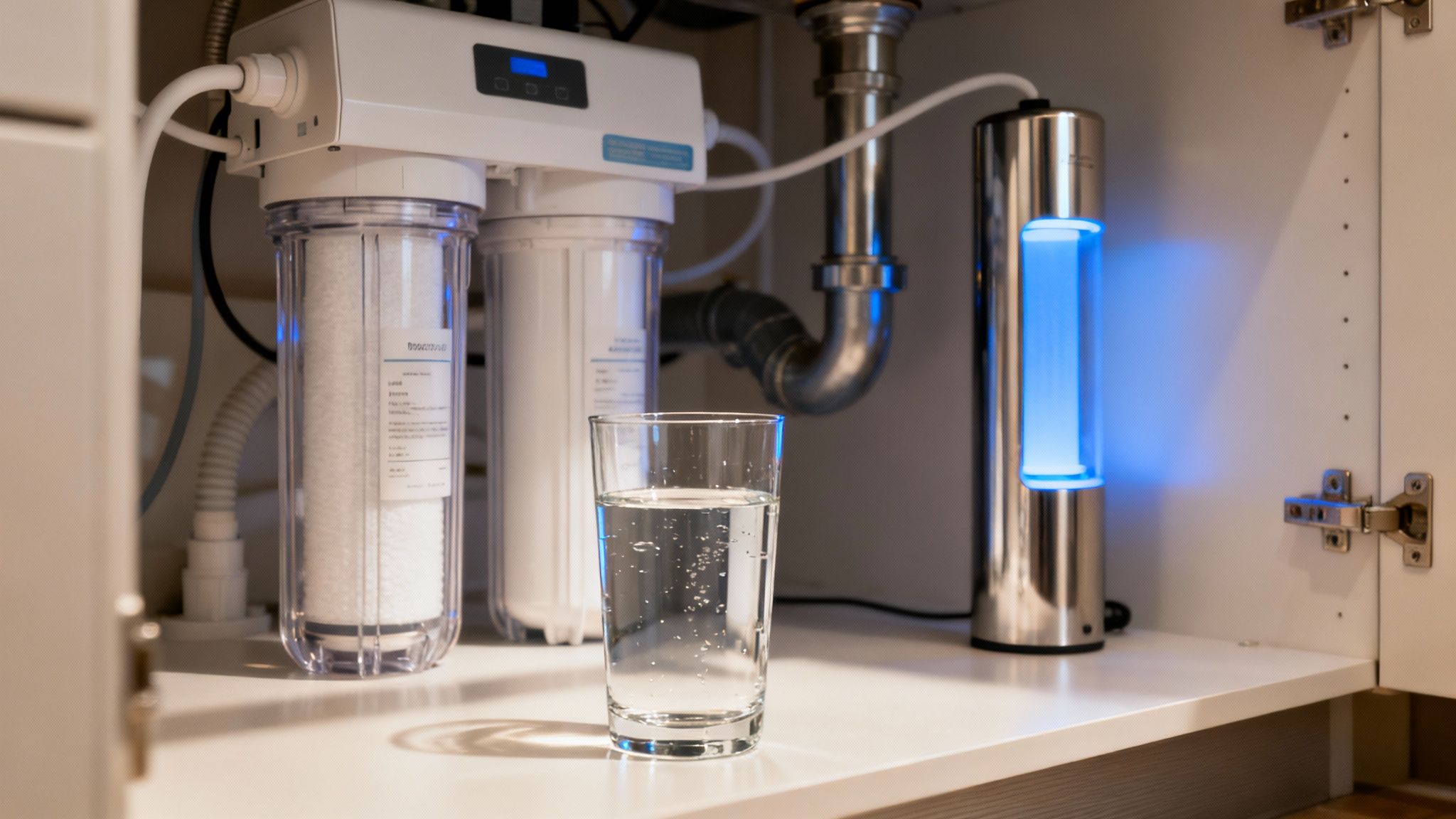
Sometimes, a standard filter just won’t cut it. When you’re dealing with more serious water quality issues, it’s time to bring in the heavy hitters: Reverse Osmosis (RO) and Ultraviolet (UV) systems. These are the pinnacle of home water treatment, designed to go after the microscopic contaminants that simpler filters leave behind. For households where maximum purity is the goal, this is where you start.
Reverse Osmosis is widely seen as the gold standard for getting rid of dissolved contaminants. It works by pushing water through a special semipermeable membrane packed with microscopic pores. Think of this membrane as a microscopic gatekeeper, letting pure water molecules pass while slamming the door on an enormous range of impurities.
The results speak for themselves. A good RO system can remove up to 99% of total dissolved solids (TDS). That’s a huge deal because it includes the really tough stuff: heavy metals like lead and arsenic, fluoride, nitrates, and even those notorious PFAS “forever chemicals.”
Understanding Reverse Osmosis Systems
RO systems are almost always installed under the kitchen sink and feed a dedicated faucet. This setup ensures the water you’re drinking and cooking with is as pure as it gets. Most units are multi-stage, featuring pre-filters for sediment and chlorine, the RO membrane itself, and a final post-filter to polish the water’s taste.
But this level of filtration isn’t without a few trade-offs, and it’s important to know what they are.
- Water Waste: The process of flushing away contaminants creates wastewater, often called brine. While modern systems are far more efficient than older ones, it’s still common for an RO unit to use several gallons of water to produce just one gallon of purified water.
- Mineral Removal: That ultra-fine membrane is so good at its job that it also strips out beneficial minerals like calcium and magnesium. Some people find this gives the water a “flat” taste. To fix this, many high-quality systems now include a remineralization filter that adds those healthy minerals back in before the water hits your glass.
Even with these points in mind, when it comes to removing the widest possible spectrum of chemical contaminants, RO is still one of the best water filters for home use you can buy.
The Role of Ultraviolet Purification
While an RO system is a champion at removing chemicals and dissolved solids, it doesn’t handle microbiological threats. That’s where Ultraviolet (UV) purification steps in. A UV system uses a specialized lamp that zaps water with a germicidal wavelength of light as it flows past.
This UV light doesn’t technically kill microorganisms; it does something much smarter. It scrambles their DNA, rendering bacteria, viruses, and nasty protozoa like Giardia and Cryptosporidium completely sterile and harmless. They simply can’t reproduce. It’s a completely chemical-free way to disinfect your water.
UV purification is a physical process, not a chemical one. It adds nothing to the water and doesn’t alter its taste or odor, making it a highly effective and safe method for microbiological control.
You’ll most often see UV purifiers used by homeowners with private well water, where the risk of bacterial contamination is much higher. That said, they also serve as an excellent final line of defense for anyone on city water who wants absolute peace of mind.
The Power Couple: RO and UV Systems
For the ultimate in water safety, many people are now combining these two technologies. An RO-UV hybrid system creates a multi-barrier defense that is unbelievably effective. The RO stages tackle all the chemicals, heavy metals, and dissolved solids, while the UV stage neutralizes any potential biological threats that might slip through.
The demand for these all-in-one solutions is exploding. Residential use already drives 70% of the water purifier market, a sector expected to hit USD 53.2 billion by 2032. RO-UV hybrids are a huge driver of that growth because they can eliminate up to 99.99% of bacteria and viruses. When the WHO reports that 2.2 billion people globally drink from contaminated sources, you can see why that matters. You can find more market insights over at FutureMarketInsights.com.
Putting these systems together creates a true powerhouse, making it one of the best water filters for a home where water purity is non-negotiable.
How to Choose the Right Water Filter for Your Needs
All the specs and comparisons are great, but they don’t answer the one question that really matters: which water filter is the right one for your home? To get there, we need to connect the dots between your unique situation and the right type of filter. This is where we turn all that information into a decision you can feel good about.
The process is simpler than you might think. It really just comes down to answering three straightforward questions about your water, your family, and your budget. Nail these, and the perfect filter will practically choose itself.
Step 1: Know What’s in Your Water
Before you can pick a filter, you have to know what you’re filtering out. Don’t just guess based on taste or smell—get the facts. The easiest way is to check your local water quality report.
Every community water supplier in the U.S. is required to provide customers with an annual Consumer Confidence Report (CCR). You can almost always find this on your local water utility’s website. This report is a goldmine, detailing contaminant levels detected in your area, from chlorine and lead to nitrates and funky disinfection byproducts.
If you’re on well water or your CCR shows concerning levels of something specific like PFAS, it’s worth investing in a more detailed home water test kit. Understanding exactly what you’re up against is the single most important step.
Step 2: Assess Your Household’s Daily Water Usage
Next up, get real about how much water your household actually uses for drinking and cooking. This will tell you what kind of capacity and convenience you really need.
- For a single person or a couple: A simple water filter pitcher or a faucet-mounted filter is probably all you need. They’re low-cost and can easily handle the daily consumption of one or two people.
- For a busy family of four or more: Let’s be honest, constantly refilling a pitcher is a chore that gets old fast. A high-capacity system like an under-sink or countertop filter makes way more sense, giving you a steady stream of clean water on demand.
- For whole-home needs: If you’re worried about chlorine drying out your skin in the shower or sediment damaging your appliances, a whole-house system is the only way to go. It treats the water at every single tap.
Think about your daily routine. Are you just filtering a glass of water here and there, or do you want filtered water for making coffee, boiling pasta, and washing vegetables? The more you use, the more a high-capacity system will feel like a lifesaver.
Step 3: Define Your Realistic Budget
Your budget is more than just the price tag on the box. You have to think about the long-term cost of ownership, which really boils down to one thing: replacement filters.
Here’s a rough breakdown of what to expect:
- Upfront Cost: This can be anything from $20 for a basic pitcher to $3,000+ for a professionally installed whole-house system.
- Ongoing Costs: This is the recurring expense you can’t forget. Pitcher filters might run you $60 a year, while an under-sink system’s annual filter set could be $100 or more.
- Installation Costs: Don’t forget to factor in installation fees. Most faucet and countertop models are easy DIY projects, but under-sink and whole-house systems often require a plumber. This is especially true for under-sink models—a bad installation can lead to leaks and a huge mess. Trust me, it’s better to budget for a pro than to deal with the headache of trying to unclog a sink filled with water from a leaky connection.
Your ideal filter is one that solves your water problems and fits comfortably within your long-term budget. A top-of-the-line system is worthless if you can’t afford to replace the filters.
Bringing It All Together With Real-World Scenarios
To make this crystal clear, let’s see how these factors play out in a couple of common situations. See which one sounds more like you.
The Renter’s Dilemma
You live in an apartment, so you can’t make any permanent changes to the plumbing. Your main goal is to get rid of that chlorine taste from the tap and get some peace of mind about potential lead.
- Recommendation: A faucet-mounted filter is your perfect match. It’s affordable, installs in minutes without any tools, and gives you instant filtered water. A high-quality water pitcher is another fantastic no-fuss option.
The Busy Family Solution
You’re a homeowner with kids, and your family goes through a ton of water for drinking, cooking, and filling up endless water bottles. You want a powerful, hidden solution that tackles a wide range of contaminants without being a constant hassle.
- Recommendation: An under-sink filter is your best bet. It delivers top-tier filtration, stays completely out of sight, and has the high capacity needed to keep up with your family’s demands.
By walking through these steps, you can cut through the noise, confidently narrow down your options, and find the best water filter for your home—a choice you’ll be happy with for years to come.
Your Top Water Filter Questions, Answered
Alright, let’s get into the questions that always come up when you’re this close to buying a filter. These are the practical, real-world details that move you from browsing to buying with confidence.
How often do I really need to change my water filter?
This is probably the number one question, and the answer is refreshingly simple: just follow the manufacturer’s timeline. They aren’t just making those numbers up; they’re based on the filter’s capacity, which is usually measured in gallons. For a typical family, that usually breaks down like this:
- Pitcher filters: Every 2-3 months.
- Faucet-mounted filters: Every 3-4 months.
- Under-sink and countertop filters: Every 6-12 months.
- Whole-house filters: The main carbon filter can go for 3-5 years, but the sediment pre-filter often needs swapping every 3-6 months.
Stretching these timelines is a bad idea. A clogged filter doesn’t just work poorly—it stops working altogether, and you’re just drinking tap water again.
Will a water filter remove healthy minerals from my water?
This depends entirely on the technology. Most standard filters (like activated carbon) are great at grabbing contaminants while letting beneficial minerals like calcium and magnesium pass through. The big exception is a Reverse Osmosis (RO) system. Its membrane is so fine that it removes almost everything—including minerals. That’s why many modern RO systems now have a remineralization stage to add them back in before the water hits your glass.
Is a more expensive filter always better?
Not at all. A higher price tag usually means you’re paying for more capacity, a longer filter life, or more complex purification stages (like an RO system). The best filter is the one that’s certified to remove your specific problem contaminants and fits your budget. A $40 faucet filter certified to remove lead is a much better choice for a renter worried about old pipes than a $1,500 whole-house system that only handles chlorine.
Can I install an under-sink or whole-house system myself?
If you’re comfortable with basic plumbing projects—like changing a faucet—then installing an under-sink filter is a totally doable DIY job. It usually takes about an hour and some basic tools. A whole-house system, on the other hand, involves cutting into your home’s main water line. For that kind of installation, it’s almost always best to hire a professional plumber to ensure it’s done right and without leaks.
Conclusion: Making the Right Choice for Your Home
Choosing the best water filter for your home isn’t a one-size-fits-all deal; it’s a personal call. We’ve walked through the ins and outs of every major type, from the simple grab-and-go convenience of a pitcher to the set-it-and-forget-it power of a whole-house system. Your perfect match really comes down to your life: how big your household is, what you’re willing to spend, and most importantly, what’s actually in your local tap water.
Remember to think about the long game—balancing the upfront cost with what it takes to keep it running. An under-sink system is a fantastic workhorse for filtration but needs a bit of installation work, while a faucet filter is an immediate, renter-friendly upgrade you can do in minutes. And don’t forget, even the best system needs a little TLC, and that includes the filter’s housing. For some tips on keeping your fixtures looking sharp, our guide on how to clean stainless steel is a great resource.
Ultimately, the goal here is to find a filter that just clicks with your routine. Use what you’ve learned in this guide to make an informed decision you feel good about. It’s an investment that pays off by boosting your home’s health, simplifying your daily habits, and giving you lasting peace of mind with every pure, great-tasting glass of water you pour.
At Reva Housing, we’re dedicated to helping you make informed decisions for a better home. Explore our comprehensive guides and reviews to find the perfect products for your lifestyle at https://revahousing.com.
