



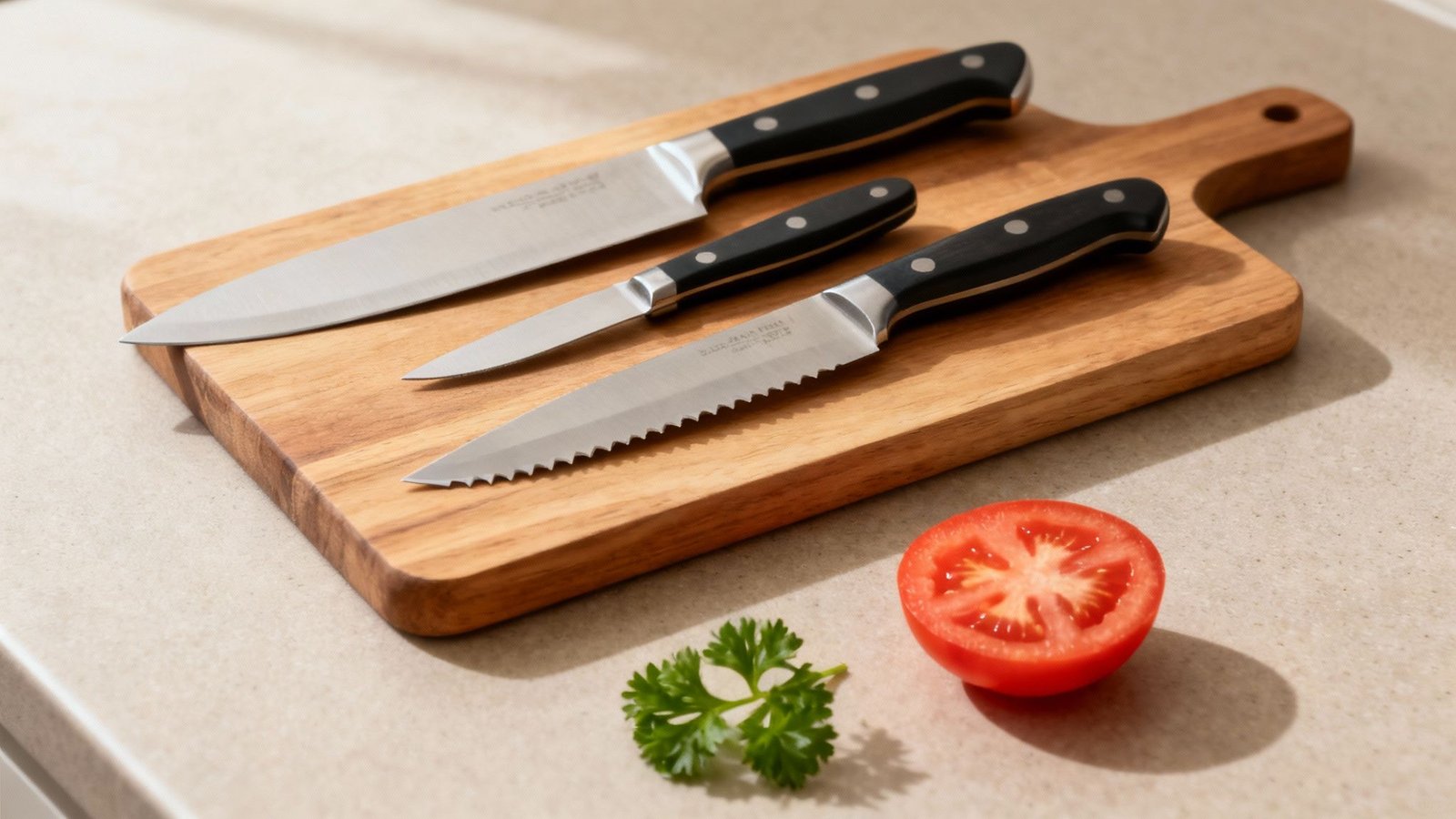
It’s incredibly tempting to go for one of those massive 15-piece knife blocks sitting on the store shelf, but here’s a little secret from my years in the kitchen: quality beats quantity every single time. The best knife set for home almost always starts with a core trio: the all-purpose Chef’s knife, the detail-oriented Paring knife, and the tough Serrated knife.
Believe it or not, these three knives can handle over 90% of everything you’ll ever need to cut.
Why the Best Knife Set for Home Isn’t the Biggest
Walking through a kitchenware aisle, it’s easy to get wowed by those sprawling knife blocks filled with a dozen different blades. They look impressive and professional, but for the average home cook, most of those specialized knives will just end up collecting dust.
Taking a minimalist approach is not only easier on your wallet but also way more practical. You’ll save a ton of precious counter space.
Think of it like building a wardrobe. You don’t start with a tuxedo and scuba gear; you start with versatile essentials you’ll wear every day. Your kitchen knives are no different—this core trio is your foundational toolkit. Once you’ve really mastered these, you can always add a specialty knife later if your cooking style truly calls for it.
The Essential Trio Explained
By focusing on just these three knives, you can afford to invest in higher-quality steel and better construction where it counts the most. This shift toward quality over quantity isn’t just a hunch; it reflects a huge consumer demand for premium kitchen gear that performs better and lasts longer.
The global kitchen knife market was valued at around $2 billion in 2024 and is actually projected to double over the next decade. The United States is leading the charge, making up 21.46% of that market. If you’re curious about the numbers, Fortune Business Insights has a deep dive into these trends.
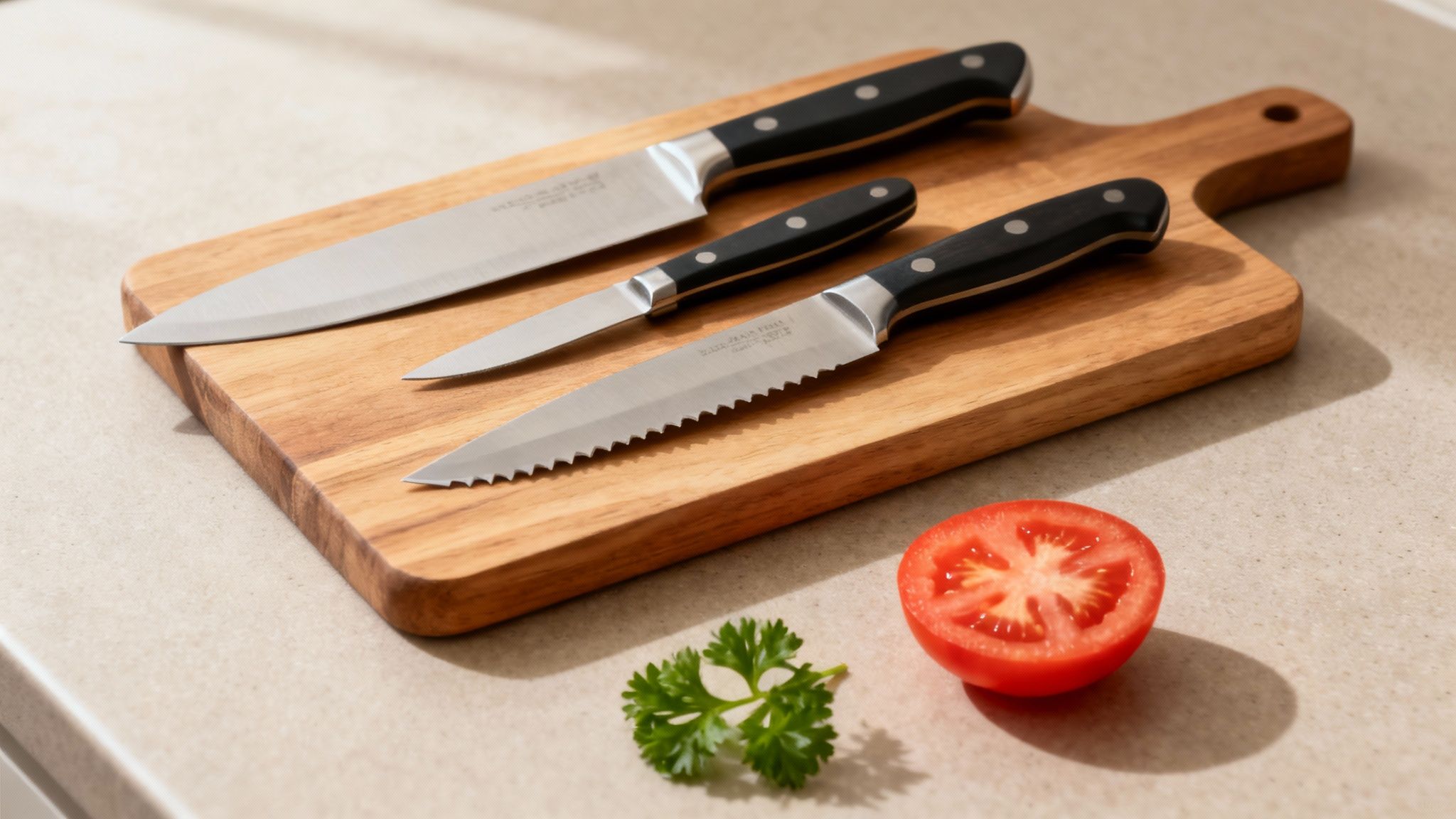
This kind of strategic investment pays off big time with better balance, blades that stay sharp longer, and a much more enjoyable experience in the kitchen. For more curated product recommendations, check out some of our editor’s picks for top-performing kitchen essentials.
The goal isn’t to own the most knives; it’s to own the right knives. A sharp, well-balanced Chef’s knife will always outperform a drawer full of mediocre, specialized blades.
Before we get into the nitty-gritty of steel and handles, let’s do a quick breakdown of what makes each of these three knives so indispensable.
Here’s a quick look at the three workhorses that will form the backbone of your culinary arsenal.
Your Kitchen’s Essential Knife Trio
This table sums up the three most crucial knives that belong in every home kitchen.
| Knife Type | Primary Function | Best For |
|---|---|---|
| Chef’s Knife (8-inch) | All-purpose workhorse for chopping, mincing, and slicing. | Dicing vegetables, slicing meat, chopping herbs, and general prep. |
| Paring Knife (3.5-inch) | Precision tasks requiring fine motor control. | Peeling fruits, trimming vegetables, deveining shrimp, and intricate work. |
| Serrated Knife (8-inch) | Slicing through tough exteriors and soft interiors. | Crusty bread, ripe tomatoes, citrus fruits, and delicate cakes. |
Mastering these three is the first and most important step to becoming more confident and efficient in the kitchen.
Understanding Blade Materials and Construction
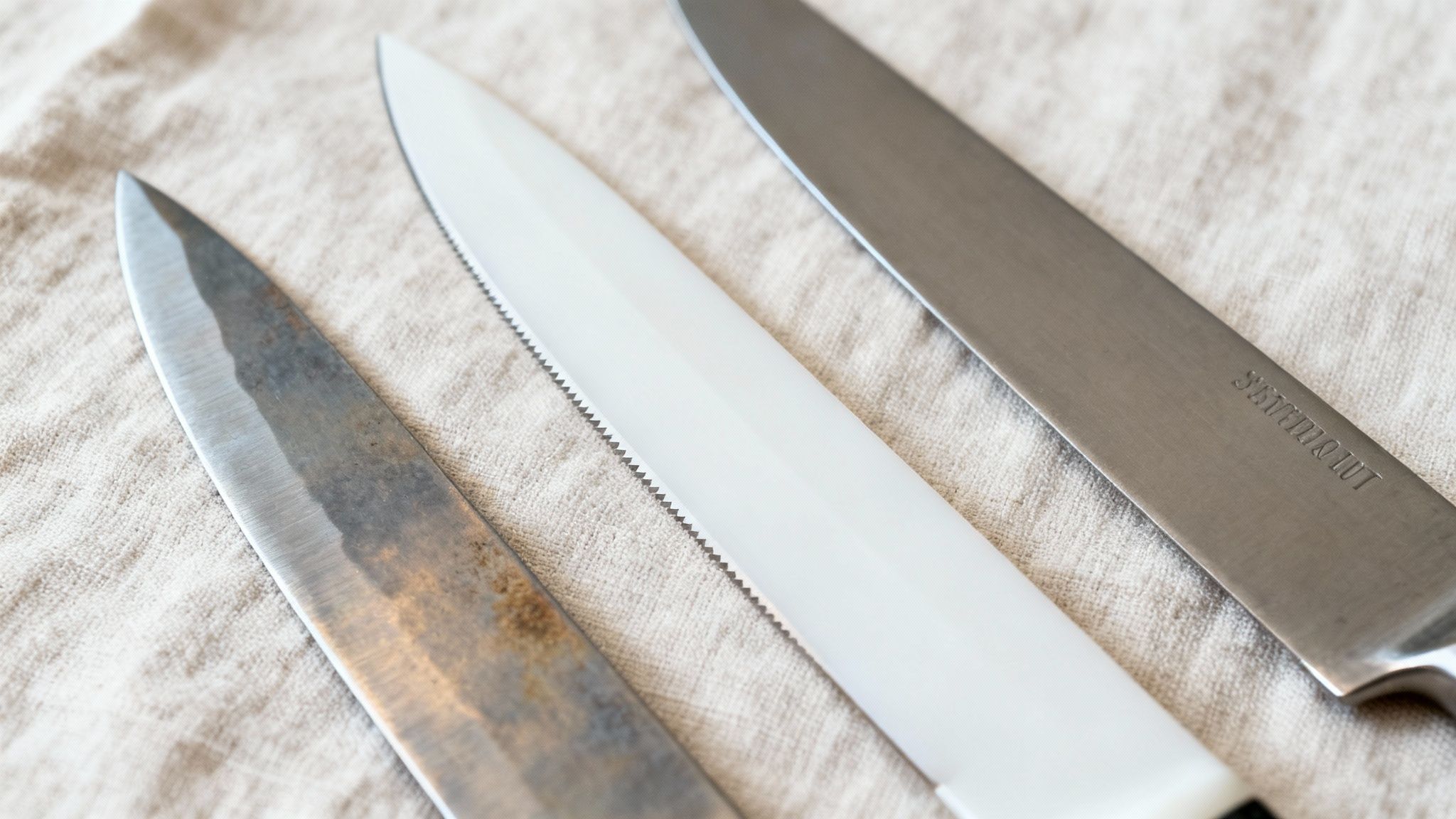
The soul of any great knife is its blade. It’s where the magic of an effortless slice happens, but trying to understand what makes a blade great can feel like a crash course in chemistry. You’ll see terms like “high-carbon” and “forged” thrown around, but what do they actually mean when you’re just trying to chop an onion without a struggle?
Let’s break it down. The material and the way the blade is made determine three critical things: how sharp it can get, how long it stays sharp, and how durable it is. Getting this part right is a huge step toward finding the best knife set for your home.
The Best Materials for Kitchen Knife Blades
Most quality kitchen knives you’ll find today are made from some form of stainless steel. But here’s the thing: not all steel is created equal. The secret ingredient that separates a good blade from a great one is carbon.
- Standard Stainless Steel: This is your basic, rust-resistant stuff. It’s affordable and super easy to care for, but it often has a tough time holding a sharp edge for very long.
- High-Carbon Stainless Steel: This is the sweet spot for most home cooks. By adding more carbon to the steel alloy, you get a blade that is much harder, allowing it to take and keep a razor-sharp edge for longer. It’s the versatile all-star of the knife world—strong, durable, and a top performer.
- Ceramic: Ceramic blades are incredibly hard and can hold an edge for what feels like forever without needing to be sharpened. Think of them as a specialist—amazingly sharp but very brittle. They can easily chip or even shatter if you drop them or try to use them to pry or twist something.
For the vast majority of households, high-carbon stainless steel offers the perfect balance of sharpness, durability, edge retention, and rust resistance. It’s tough enough for daily work and forgiving enough for the occasional mistake.
Forged vs. Stamped: Which Is Better?
Beyond the material itself, the way a knife is made has a massive impact on its performance, balance, and overall feel. There are two main ways knives are constructed: forging and stamping.
Imagine a blacksmith hammering a single piece of red-hot steel into the shape of a blade—that’s the essence of a forged knife. This process creates a thick, heavy, and incredibly strong blade. Forged knives almost always have a bolster, which is that thick junction where the blade meets the handle. This adds weight, improves balance, and acts as a handy finger guard.
A stamped knife, on the other hand, is like a cookie cutter punching blades out of a large sheet of steel. This method is much less labor-intensive, which makes stamped knives more affordable. They are typically lighter, thinner, and have a more uniform thickness from tip to end, with no bolster.
So, which one should you choose?
- Forged Knives: These are generally seen as the premium option. Their weight and balance feel substantial and controlled in your hand, which is ideal for heavy-duty chopping.
- Stamped Knives: These are often lighter and more flexible, which some cooks actually prefer for tasks that require more agility. Modern manufacturing has improved their quality significantly, making them a fantastic value.
Many reputable brands offer excellent knives made with both methods. For instance, when you explore the world of Henckels kitchenware, you’ll find both premium forged lines and high-quality stamped options.
Ultimately, the choice comes down to your personal preference for weight and balance. Don’t dismiss a stamped knife just because it’s cheaper; if it feels good in your hand, it’s the right knife for you. Plenty of professional chefs use them every single day.
How to Choose a Handle You’ll Actually Love
Let’s be honest, the blade gets all the glory. It’s sharp, shiny, and does all the impressive work. But a world-class blade means absolutely nothing if the handle feels awkward, slippery, or just plain wrong in your hand.
The handle is your direct connection to the knife—it’s where control, safety, and comfort all come together. Getting this part right is what separates a pretty good knife from the one you’ll instinctively reach for every single time you cook. Think of it like a powerful sports car; it’s useless without a great steering wheel.
The Hidden Backbone: Understanding the Tang
Before we get into sexy materials and cool designs, we need to talk about a knife’s hidden backbone: the tang. The tang is simply the part of the blade steel that extends down into the handle, and it’s responsible for the knife’s strength and balance. You’ll generally run into two types.
- Full Tang: This is the gold standard, period. The steel runs the entire length and width of the handle, usually sandwiched between two handle pieces (often called “scales”). This construction results in a stronger, better-balanced knife that feels incredibly solid and secure.
- Partial Tang: Just like it sounds, the steel only extends part of the way into the handle. These knives are usually lighter and cheaper to make, but they can’t compete with the superior balance and bomb-proof durability of a full-tang design.
If you’re investing in a set you plan to keep for years, always, always go for a full-tang knife. The improved balance means less wrist fatigue during big chopping jobs, and the rock-solid construction ensures the blade will never loosen or separate from the handle—a huge safety win.
A Feel for Materials: Comparing Handle Options
The stuff your handle is made of affects everything from its grip and weight to its looks and how much care it needs. There’s no single “best” material; it’s all about finding what fits your kitchen style and how much maintenance you’re willing to do.
Wood Handles
Classic, beautiful, and warm to the touch, wood handles offer a fantastic, comfortable grip. The downside? They’re porous. Leave them soaking in the sink, and they can swell or even crack over time. They sometimes need a little TLC, like a quick coat of mineral oil, but for those who love a traditional look, the extra effort is well worth it.
Composite Handles
This is probably the most popular choice for modern kitchen knives, and for good reason. Materials like Pakkawood (a slick wood/resin composite) or G10 (a tough fiberglass laminate) give you the best of both worlds. You get the handsome look and feel of wood, but because they’re non-porous, they’re completely water-resistant and almost indestructible. Zero maintenance required.
Stainless Steel Handles
Sleek, modern, and incredibly hygienic, stainless steel handles are a common sight in professional kitchens. They are tough as nails and a breeze to clean. The one major catch for home cooks is that they can get dangerously slippery when wet. To combat this, many designs have textured patterns or ergonomic shapes to help you keep your grip.
It’s All About Ergonomics
Beyond the tang and the material, the actual shape of the handle—its ergonomics—is what will ultimately determine how comfortable it is. A well-designed handle should nestle right into your palm without forcing your fingers into a weird, cramped position.
Look for a handle with gentle contours that support your natural grip. Some will have a little bump called a finger guard to keep your hand from sliding onto the blade, or a flared butt end (the pommel) to keep it from slipping off the back. But honestly, the only way to know for sure is to hold it. If you can, pick up a knife before you buy it. Does it feel balanced? Is your hand secure but relaxed? That’s the feeling you’re looking for. That’s the handle you’ll still love using ten years from now.
Finding a Knife Set That Fits Your Budget
The perfect knife set isn’t about shelling out the most money—it’s about hitting that sweet spot where quality, usefulness, and price all line up with how you actually cook. A great set should feel like a smart investment, not an impulse buy you’ll regret later. The trick is to avoid paying a premium for specialty knives you’ll never touch while getting the best possible steel for the blades you’ll grab every single day.
When you think about it this way, you’re in the driver’s seat. It empowers you to find the best knife set for your home without blowing your budget. It’s all about building a collection that truly serves you, whether you’re a minimalist cook, a busy parent feeding a family, or an aspiring foodie who loves a good kitchen project.
Tailoring a Set to Your Cooking Style
Before you even glance at a price tag, take a minute to think about how you cook. Your real-world kitchen habits are the best compass you have for finding the right set.
- For the Minimalist Cook: If you’re all about simplicity and efficiency, the classic trio—an 8-inch chef’s knife, a paring knife, and a serrated bread knife—is your holy grail. This core group can honestly handle 90% of kitchen tasks without cluttering up your countertop.
- For the Busy Family: On top of the essential trio, think about adding a 5- to 7-inch Santoku knife. Its shorter, wider blade is an absolute beast for rapid-fire vegetable chopping and dicing, making meal prep for a crowd feel a whole lot faster.
- For the Aspiring Foodie: If you’re the type who loves tackling ambitious recipes, start with the core three and then add one or two specialty blades that match your passion. A flexible boning knife is a game-changer for trimming meat, while a long, thin slicing knife will give you those perfect, paper-thin cuts of a roast or brisket.
This growing desire among home cooks for quality tools has seriously fueled the market. In fact, the global chef knife set market was valued at an impressive $66 million in 2025 and is projected to keep climbing. This boom is driven by a new wave of enthusiasm for cooking at home, which is great news for us—it means high-quality options are more accessible than ever. You can dig into more details about this growing market on DataInsightsMarket.com.
What to Expect at Different Price Points
Generally speaking, price tracks with the quality of the blade material, the construction method, and the overall durability. Knowing what each tier offers helps you set realistic expectations and spot the best value for your money.
A well-made, budget-friendly knife that you keep sharp will always outperform a neglected, high-end knife. Your budget sets the starting point, but how you care for your tools determines how well they perform in the long run.
For more detailed comparisons and our top picks across various price ranges, you can dive into our comprehensive guides to essential kitchenware.
Knife Set Recommendations by Budget
So, here’s a quick breakdown of what you can generally expect as you move up the price ladder. Think of this table as a cheat sheet to understand the trade-offs at each level, so you can make a decision you feel good about.
| Budget Tier | Typical Blade Material | Common Construction | Best For |
|---|---|---|---|
| Entry-Level (Under $100) | Standard Stainless Steel | Stamped with Partial Tangs | First apartments, college students, or anyone needing a functional starter set without a big commitment. |
| Mid-Range ($100 – $300) | High-Carbon Stainless Steel | Stamped or Forged with Full Tangs | The majority of home cooks who want excellent performance, durability, and a great feel for daily use. This is the value sweet spot. |
| Premium ($300+) | Premium High-Carbon Steel or Damascus | Forged with Full Tangs and Ergonomic Handles | Serious home chefs and cooking enthusiasts who demand exceptional edge retention, perfect balance, and heirloom-quality craftsmanship. |
At the end of the day, picking the right set is a personal choice. By focusing on what you actually need and understanding the value each price point offers, you can confidently choose a knife set that will be a trusted partner in your kitchen for years to come.
Keeping Your Knives Sharp and Safe for Life
A good knife set isn’t just another kitchen purchase; it’s an investment you’ll appreciate for years, maybe even decades. But just like any high-performance tool, your knives need a little TLC to stay at their best. With the right care, your blades will stay razor-sharp, safe, and ready for whatever you throw at them.
A lot of home cooks get intimidated by knife maintenance, but it really just boils down to a few simple habits. The biggest hurdle is understanding the difference between honing and sharpening. People use these terms interchangeably all the time, but they are two completely different things.
Think of it this way: Honing is like tucking in your shirt—it just straightens and realigns the existing edge. Sharpening is like buying a whole new outfit—it actually grinds away a tiny bit of steel to create a fresh, new edge.
This visual guide shows how different cooking styles, from minimalist to family-focused, influence the ideal knife set choice, which directly relates to the maintenance needs you’ll have.
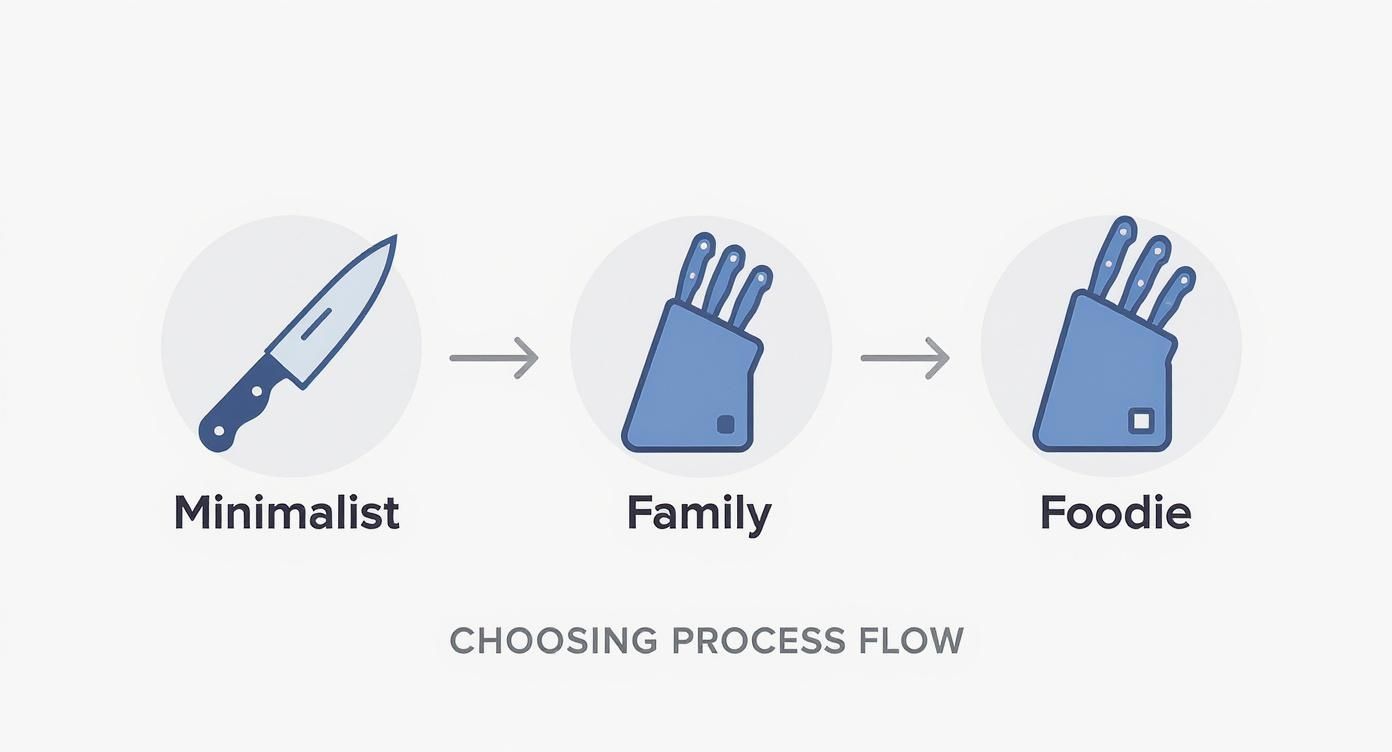
As you can see, the more ambitious your cooking gets, the more specialized your knife collection becomes. That just makes having a solid maintenance routine even more important to protect your growing toolset.
Honing Your Knives for Daily Performance
Honing is the single best thing you can do to keep your knives feeling sharp day-to-day. Every time you chop and slice, the microscopic tip of the blade can get ever-so-slightly bent or rolled out of alignment. That long metal rod that comes with most knife sets—the honing steel—is designed to gently push that edge right back into a straight line.
Honing doesn’t actually remove any metal; it just realigns what’s already there. You should get in the habit of honing your main knives pretty often, maybe after every two or three uses. It literally takes 10 seconds and makes a massive difference in performance.
Here’s a simple, safe way to use a honing steel:
- Set the Tip: Plant the tip of the honing steel firmly on a cutting board or a folded towel. This keeps it from slipping.
- Find the Angle: Hold your knife with the heel of the blade against the steel at roughly a 15-20 degree angle. A good way to picture this is to start at 90 degrees (straight up), cut that in half to 45, then cut it in half again.
- Glide the Blade: Gently sweep the knife down the steel, from the heel all the way to the tip. Use light, even pressure.
- Alternate Sides: Do the same thing on the other side of the blade. Repeat this about 5-8 times per side, and you’re done.
The Golden Rules of Cleaning and Storage
How you clean and store your knives will have a huge impact on how long they last. Follow these simple rules, and you’ll protect your investment and keep your blades in pristine shape.
Rule 1: Never, Ever Use the Dishwasher
I can’t say this enough. The dishwasher is a death sentence for good knives. The intense heat, harsh detergents, and the way everything gets jostled around will dull blades, cause tiny chips, crack handles, and trap moisture that leads to rust. Always—always—hand wash your knives with warm, soapy water and a regular sponge.
Rule 2: Dry Immediately and Thoroughly
Don’t let your knives air dry in the dish rack. As soon as you wash them, wipe them down with a dry towel. This is non-negotiable for high-carbon steel blades, as it’s the only way to prevent water spots and the beginnings of rust.
Rule 3: Store Them Safely
Just tossing your sharp knives into the silverware drawer is a recipe for disaster. It’s dangerous for your fingers and absolutely terrible for the blades, which get nicked and dulled as they bang against other metal utensils. Proper storage is a must.
- Knife Blocks: The classic countertop solution. They keep blades separated and well-protected.
- Magnetic Strips: These are fantastic space-savers that mount on your wall. They keep your knives visible and easy to grab while preventing any moisture from getting trapped.
- In-Drawer Inserts: If you prefer to keep your counters clear, these organizers have dedicated slots that keep your blades safely separated inside a drawer, protecting both the edges and your hands.
Common Myths About Kitchen Knives Busted
The world of kitchen knives is absolutely filled with old wives’ tales and just plain confusing advice. These myths can send you down the wrong path, causing you to waste money on things you don’t need or—even worse—handle your tools in a dangerous way. It’s time to set the record straight and bust a few of the biggest ones out there.
By cutting through the noise, you can focus on what actually matters when choosing and caring for the best knife set for your home. This will help you make confident decisions, steer clear of common mistakes, and invest wisely in tools that will serve you well for years.
Debunking Dangerous Advice
One of the most stubborn and dangerous myths is that a dull knife is somehow safer than a sharp one. This is 100% false. Think about it: a sharp knife bites into food with almost no effort, giving you total control over every slice.
A dull knife, on the other hand, forces you to push down—hard. That pressure makes it far more likely to slip off the slick skin of a tomato or a tough butternut squash, leading to a serious injury.
Myth: A dull knife is a safe knife.
Fact: A sharp knife is a safe knife. It does the work for you, requiring less force and drastically reducing the risk of a dangerous slip.
Myths About Knife Sets and Maintenance
Another common belief is that you need a massive, 15-piece knife block to be a serious home cook. In reality, a core set of three or four high-quality knives can handle pretty much every task you’ll ever face in the kitchen. Quality always, always trumps quantity.
Just as misleading is the idea that truly great knives never need to be sharpened. Every single knife, no matter how expensive or well-made, will eventually lose its edge with use. Regular honing helps maintain that edge for a while, but all blades will eventually require sharpening to bring them back to life. Believing otherwise is a fast track to working with dull, unsafe tools.
Finally, while kitchen knives are a huge market, it’s just one slice of a much bigger industry. The global knife market, including all types, hit $4.2 billion in revenue in 2023 and is expected to climb to $5.4 billion by 2027. This growth just goes to show the widespread demand for quality cutting tools in every field, reinforcing that good steel and proper care are universal principles. You can find more insights about this expanding market on news.market.us.
Got Questions About Knife Sets? We’ve Got Answers.
Stepping into the world of kitchen knives can feel a little overwhelming. Suddenly you’re faced with terms like “honing,” “forged,” and “high-carbon stainless steel,” and it’s easy to get lost. We get it. That’s why we’ve put together some quick, straightforward answers to the questions we hear most often from home cooks just like you.
Think of this as your cheat sheet. No fluff, just practical advice to help you cut through the noise and feel confident in your choice.
If I Can Only Buy One Knife, What Should It Be?
Hands down, an 8-inch Chef’s knife. It’s the undisputed MVP of the kitchen. This single blade is so versatile it can handle roughly 90% of everything you need to do—dicing onions, mincing herbs, slicing chicken, you name it. It’s the workhorse, the cornerstone of any collection, and the one knife you’ll reach for day in and day out.
How Often Do I Really Need to Sharpen My Knives?
This is where a lot of people get confused. You only need to truly sharpen your knives—which means grinding away metal to create a brand-new edge—once or twice a year, depending on how much you cook.
What you should be doing far more often is honing. Honing doesn’t remove metal; it just realigns the microscopic teeth on the blade’s edge. A few quick passes on a honing steel before you start cooking keeps your knife feeling sharp and effective.
Honing is for daily maintenance; sharpening is for a total reset. A quick 10-second honing session will make a world of difference and dramatically extend the time between professional sharpenings.
What’s the Deal with Ceramic Knives? Are They Any Good?
Ceramic knives are interesting, but they come with some serious trade-offs. On the plus side, they are incredibly hard, which means they can hold a razor-sharp edge for a ridiculously long time without needing any attention.
The downside? That hardness makes them extremely brittle. Drop one, and it might shatter. Try to cut through a chicken bone or a frozen block of food, and it could easily chip. For the average kitchen, a good high-carbon stainless steel knife offers a much better balance of sharpness, durability, and easy maintenance.
Should I Buy a Full Set or Just Individual Knives?
For anyone just starting out or setting up a new kitchen, a small, curated 3-to-5-piece set is almost always the best value. It gives you the core essentials without loading you up with specialty blades you’ll never touch.
Once you get comfortable with the basics, you can start adding individual knives that suit your specific cooking style. It’s a much more thoughtful—and economical—way to build a collection that truly works for you.
We’ve all been there, standing in the aisle (or scrolling online) wondering where to even begin. To make things even simpler, here are some rapid-fire answers to other common questions.
Quick Answers to Common Knife Questions
| Question | Short & Sweet Answer |
|---|---|
| What does “full tang” mean? | The blade’s metal runs all the way through the handle. It’s a sign of a well-balanced, durable knife. |
| Are serrated knives only for bread? | Mostly, yes. They’re also great for slicing through delicate-skinned foods like tomatoes or citrus. |
| Can I put my good knives in the dishwasher? | Please don’t! The high heat and harsh detergents can damage the blade and handle. Always wash by hand. |
| What’s the best way to store my knives? | A magnetic strip, in-drawer organizer, or a traditional knife block are all great options to protect the blades. |
| Do I need a Santoku if I have a Chef’s knife? | Not really. They perform similar jobs, but some people prefer the Santoku’s shape for chopping vegetables. |
Hopefully, that clears a few things up! Choosing the right tools is the first step toward making cooking feel less like a chore and more like a joy.
At Reva Housing, our goal is to give you in-depth, practical guides that help you make your house a home. To find the perfect tools for your kitchen, check out more of our expert reviews.
Discover more expert kitchenware guides and reviews at Reva Housing.
