


Choosing the right pressure washer comes down to one simple question: What do I need to clean? The best machine isn’t the most powerful one on the shelf; it’s the one that matches its power to your specific projects.
Whether that’s gently washing your car or blasting a winter’s worth of grime off the driveway, figuring out your main tasks makes the choice between electric and gas models a whole lot clearer. This friendly guide will walk you through everything you need to know, from understanding power ratings to picking essential accessories, so you can make an informed decision with confidence.
Finding the Right Pressure Washer for Your Projects
Staring at a wall of pressure washers can feel overwhelming, but finding the perfect one is simpler than you think. It’s not about buying the biggest, baddest machine—it’s about matching the tool to the job.
Are you erasing grime from your deck, giving your car a professional shine, or prepping siding for a fresh coat of paint? We’ll cut through the noise and focus on what really matters. The first and most important decision you’ll make is between an electric and a gas model, and that choice is driven entirely by the scale of your cleaning jobs.
This simple decision tree can help you visualize whether your typical projects fall into the “Small Jobs” or “Big Jobs” category.
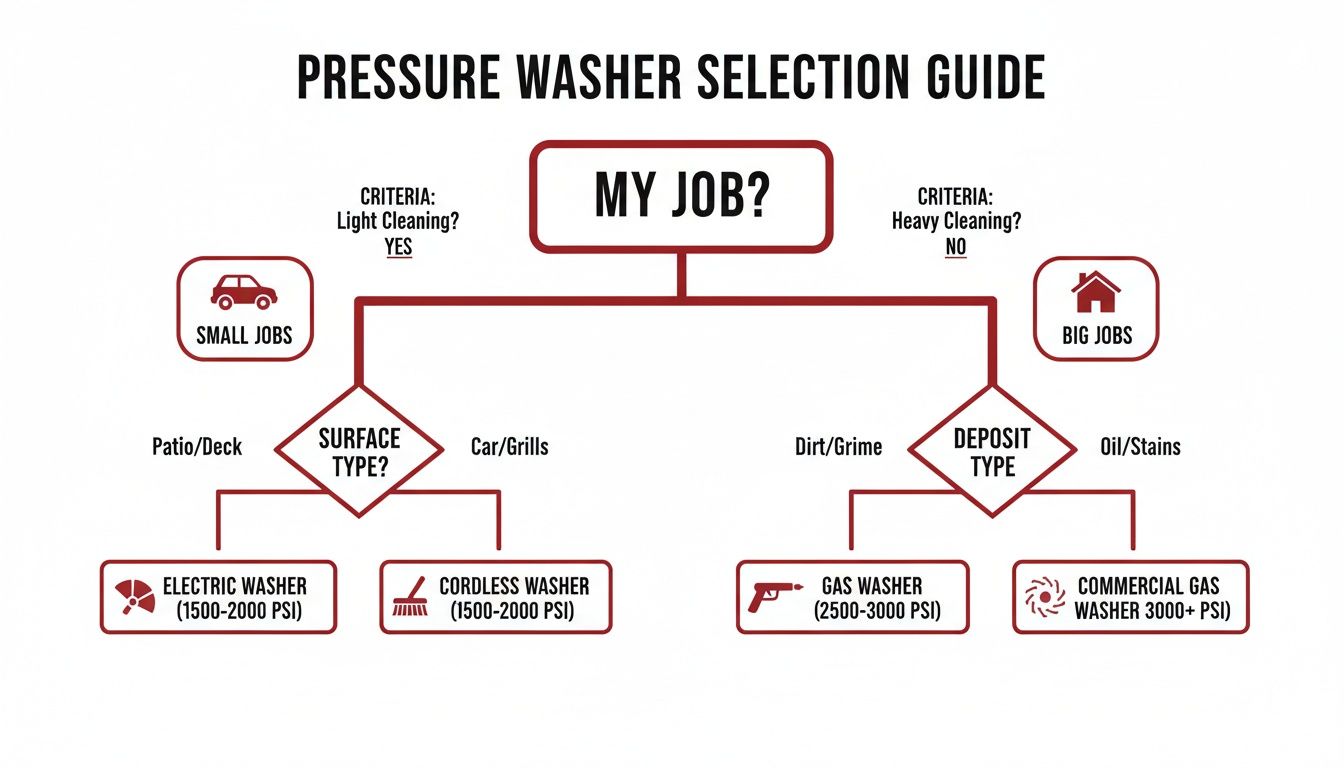
As you can see, smaller and more frequent tasks like cleaning cars or patio furniture point you toward electric models. On the other hand, larger, tougher jobs like deep-cleaning driveways or stripping old paint from siding are best left to the heavy-duty power of gas machines.
Why Your Cleaning Needs Come First
Before you get lost in the weeds comparing PSI and GPM, just take a minute. Jot down the top three to five cleaning projects you plan to tackle this year.
Are you mainly trying to maintain your beautiful outdoor living space ideas, or are you facing down years of built-up grime on concrete? Answering that question first is the most critical step you’ll take.
The global pressure washer market was valued at USD 3.24 billion in 2025 and is projected to grow to USD 3.4 billion in 2026. This growth is largely driven by the residential and DIY segment, as more of us are taking on cleaning cars, gardens, and houses ourselves.
What does that mean for you? It means homeowners now have access to a wider range of competitive, feature-rich models than ever before. You can dive deeper into these market trends and their impact on consumer choices over at Fortune Business Insights.
By starting with a clear picture of your needs, you can confidently navigate the options and pick a pressure washer that will serve you well for years to come, turning daunting chores into deeply satisfying projects.
Understanding What PSI and GPM Really Mean
Walk down the pressure washer aisle, and you’ll get hit with two acronyms from every box: PSI and GPM. At first, they just look like a jumble of letters and numbers meant to measure “power.” But here’s the secret: they measure two totally different things, and getting the balance right is the key to picking a machine that actually works for you.
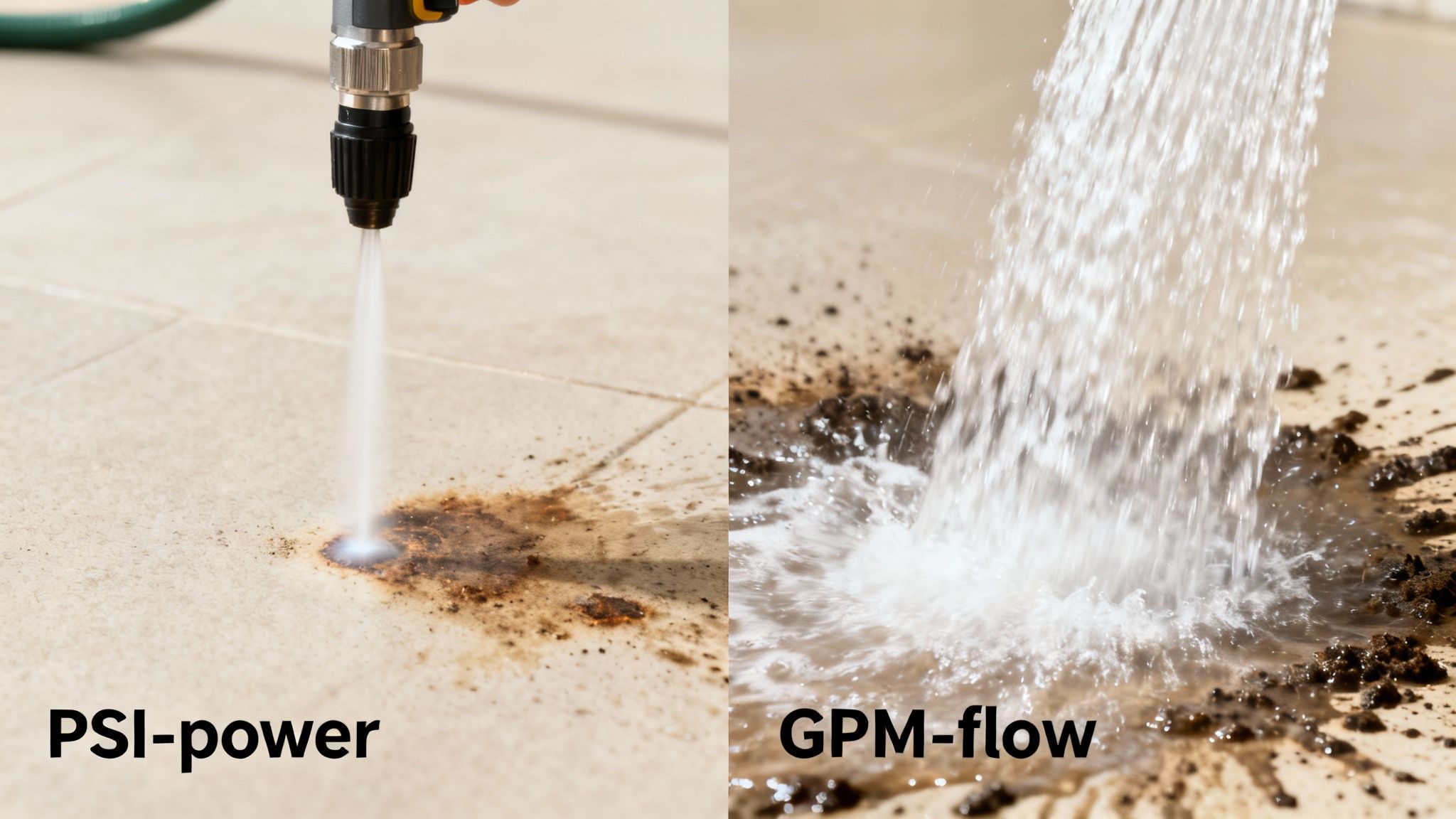
Think of it this way: PSI is the punch, and GPM is the rinse. One without the other is pretty useless. You need both to get the job done right. Let’s break down what these numbers actually mean when you’re staring down a dirty driveway.
Key Functions & Benefits
- PSI (Pounds per Square Inch): This is the raw, concentrated force of the water hitting a surface. It’s the brute strength that breaks the bond between stubborn grime and whatever you’re cleaning. A higher PSI means more focused power to strip peeling paint or blast caked-on mud.
- GPM (Gallons Per Minute): This is all about volume—how much water the machine is moving. If PSI is the force that lifts the dirt, GPM is the big wave that carries it all away. A higher GPM means you can clean a large area much faster.
- Cleaning Units (CU): To get a true sense of a pressure washer’s overall work rate, the pros use a simple calculation: PSI x GPM = Cleaning Units (CU). This single number helps you compare the true cleaning capability of different machines. A higher CU means faster, more effective cleaning.
Pros & Cons of High PSI vs. High GPM
- High PSI (Pros): Excellent for stripping stubborn material like paint, gum, or deep-set stains from hard surfaces like concrete.
- High PSI (Cons): Can easily damage softer surfaces like wood siding, car paint, or brick if not used carefully.
- High GPM (Pros): Drastically speeds up cleaning time on large surfaces like driveways and patios by washing away debris more quickly.
- High GPM (Cons): Uses more water, which can be a consideration in some areas. It is less effective at breaking up tough grime without adequate PSI.
The Great Debate: Electric vs. Gas Pressure Washers
Choosing your pressure washer’s power source is probably the biggest decision you’ll make. It’s the fork in the road that determines everything else—from raw cleaning power and where you can use it, to how loud it is and how much tinkering it needs.
There’s no single “best” choice here. Forget that. The real question is what’s right for your projects, your property, and your patience for maintenance. This isn’t about which is better in a vacuum; it’s about which one is the right tool for the job you have in mind.
Customer Impressions
Here’s what real homeowners often say about their choices:
- Electric User (Sarah, a suburban homeowner): “I absolutely love my little electric pressure washer. It’s so light and quiet—I can clean the patio furniture on a Saturday morning without waking up the whole neighborhood. It doesn’t have the power for deep oil stains on the driveway, but for 90% of my jobs, it’s perfect and zero hassle.”
- Gas User (Mark, who owns a large property): “For my long driveway and dirty farm equipment, a gas model was a no-brainer. The power is incredible, and I love that I’m not tied to an extension cord. The trade-off is the maintenance; it’s loud and needs oil changes, but for the serious cleaning I do, it’s totally worth it.”
Electric vs. Gas Pressure Washer Showdown
To help you see the differences side-by-side, I’ve put together a quick comparison table. Think of this as your cheat sheet for deciding which power source truly fits your needs.
| Feature | Electric Pressure Washer | Gas Pressure Washer |
|---|---|---|
| Power Output | Ideal for light to medium-duty tasks (1300-2300 PSI). | Best for medium to heavy-duty jobs with high power (2000-4000+ PSI). |
| Portability | Very lightweight and easy to move, but limited by cord length. | Heavier and bulkier, but offers complete freedom from outlets. |
| Noise Level | Significantly quieter, comparable to a vacuum cleaner. | Very loud, similar to a lawnmower; hearing protection is recommended. |
| Maintenance | Minimal; requires occasional nozzle cleaning and proper storage. | Requires regular oil changes, spark plug checks, and fuel management. |
| Upfront Cost | Generally more affordable, with many excellent options under $250. | Higher initial investment, often starting around $300 and going up. |
| Best For | Cars, patio furniture, small decks, siding, and general home use. | Large driveways, paint stripping, oil stains, and commercial cleaning. |
The global mobile pressure washer market, valued at USD 1,760 million in 2021, is projected to hit USD 2,245 million by 2027, highlighting a growing demand for portable options like battery-powered units for small, on-the-go tasks. You can dig deeper into these trends by checking out the latest mobile pressure washer market research.
How to Match the Right Power to Your Cleaning Job
Using a pressure washer that’s too powerful is an easy way to cause permanent damage. On the flip side, one that’s too weak will just leave you tired, frustrated, and staring at a half-cleaned driveway. This is where we stop talking theory and get into what actually works. Let’s translate those PSI and GPM numbers into real-world tasks so you can match the right machine to your to-do list.
Think of it like cooking: you wouldn’t use a blowtorch to melt butter. For the same reason, you don’t need a 4,000 PSI gas beast to wash your car. The secret is knowing how much power is just enough to get the job done efficiently without gouging your deck or stripping paint.
Light-Duty Tasks Around the Home (1300-2000 PSI)
For the most common cleaning jobs you’ll tackle, a light-duty pressure washer is your best friend. These tasks need finesse over brute force, making them a perfect match for the control and lower pressure of most electric models.
- Washing Cars and Trucks: Gently lifting road grime without damaging the clear coat.
- Cleaning Outdoor Furniture: Safely rinsing plastic, wicker, and metal patio sets.
- Washing Windows: Using a wide-angle spray to clean glass from a safe distance.
Tackling Medium-Duty Projects (2000-3000 PSI)
When you step up to tougher, more resilient surfaces, you need more power. This is the sweet spot for most homeowners, covering the big annual cleaning projects that keep a property looking sharp.
- Cleaning Wood Decks and Fences: Stripping away green algae and mildew before re-staining.
- Washing Vinyl or Fiber Cement Siding: Removing a season’s worth of dirt and pollen.
- Brightening Walkways and Small Patios: Lifting ground-in dirt from concrete or paver stones.
Conquering Heavy-Duty Cleaning Jobs (3000+ PSI)
Heavy-duty jobs demand maximum power. For this level of work, a gas pressure washer is really the only practical option.
- Deep-Cleaning Large Driveways: Erasing years of dirt, tire marks, and oil stains from concrete.
- Stripping Paint or Stain: Prepping decks, fences, or siding for a complete refinish.
- Cleaning Heavy Equipment: Blasting mud and grease off farm or construction machinery.
It’s worth noting that North America holds about 38% of the global market share, with a real focus on premium, high-performance units well-suited for these heavy-duty jobs. You can dive deeper into these trends in the pressure washer market report from MarketsandMarkets.
Your Secret Weapon: The Nozzle
The nozzle at the end of the wand is what truly shapes the water stream and controls the cleaning force. Mastering these turns a single machine into a versatile cleaning arsenal. For more cleaning tips, check out our guide on how to clean your fire pit safely and effectively.
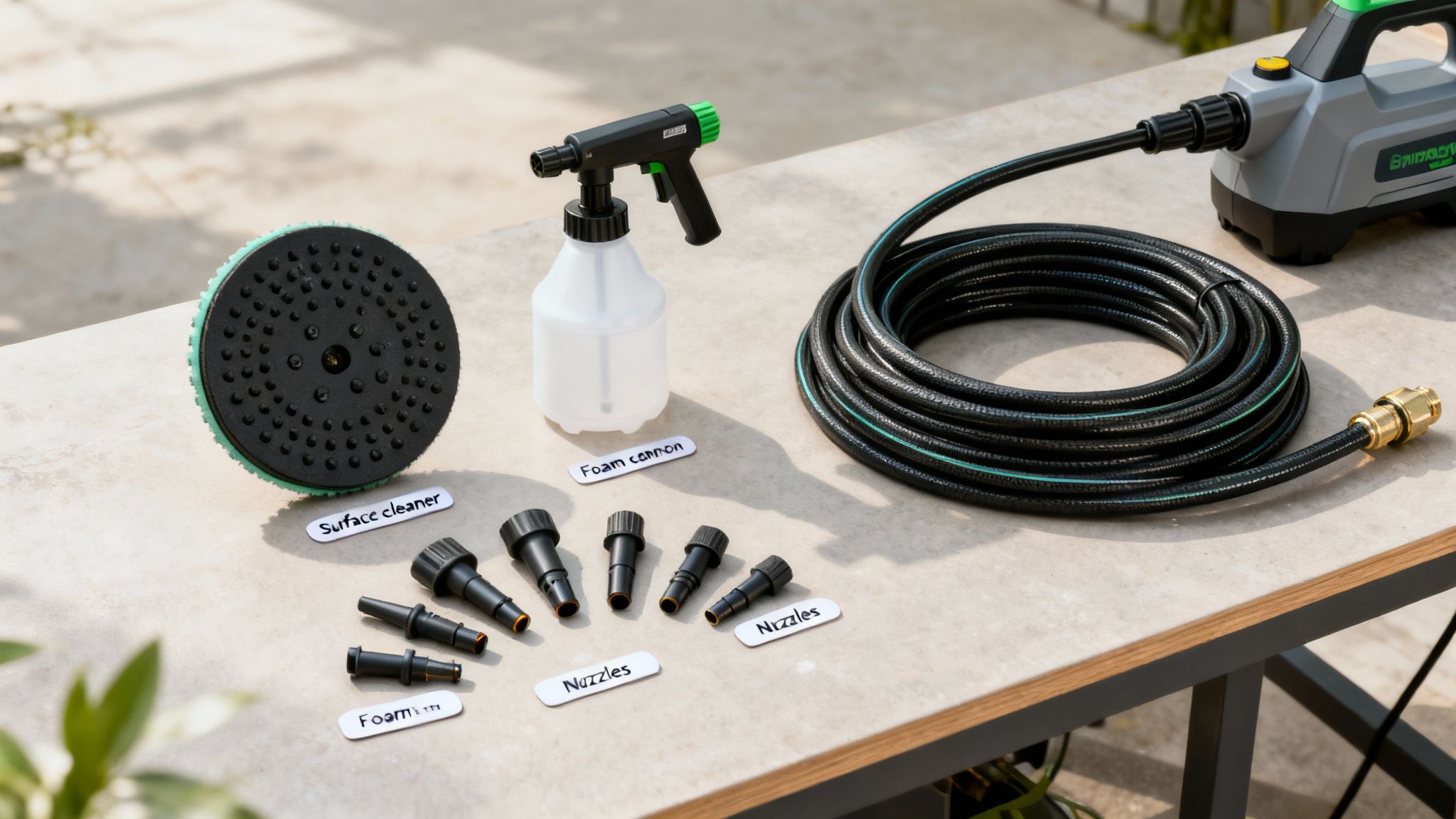
Key Features and Attachments You Will Actually Use
Once you’ve hammered out the big questions—gas or electric, how much PSI—the smaller details start to feel a lot more important. The right features and attachments can be the difference between a frustrating Saturday chore and a surprisingly satisfying project.
Think about the actual experience of using the thing. A model with big, beefy wheels is a lifesaver when you’re dragging it across a bumpy lawn. On-board storage for nozzles and the power cord might seem like a tiny detail, but it’s what keeps you from losing those critical little parts in a cluttered garage. These are the thoughtful touches that separate a good machine from a great one.
Core Features That Make a Real Difference
When you’re comparing models, it’s easy to get fixated on the big PSI number. But trust me, you should be looking at the practical features you’ll interact with every single time you use the machine.
- Durable Pump: Look for an axial cam or triplex pump. They’re far more durable than the cheap wobble pumps found in bargain-bin units. A brass pump head is also a huge sign of quality.
- Flexible High-Pressure Hose: A cheap, stiff plastic hose will constantly fight you. A flexible, steel-braided rubber hose is a total game-changer, making control much easier.
- On-Board Storage: Integrated holders for the hose, wand, nozzles, and power cord prevent clutter and loss of essential parts.
Game-Changing Attachments Worth the Investment
The right attachments can turn your pressure washer from a simple blaster into a specialized cleaning machine.
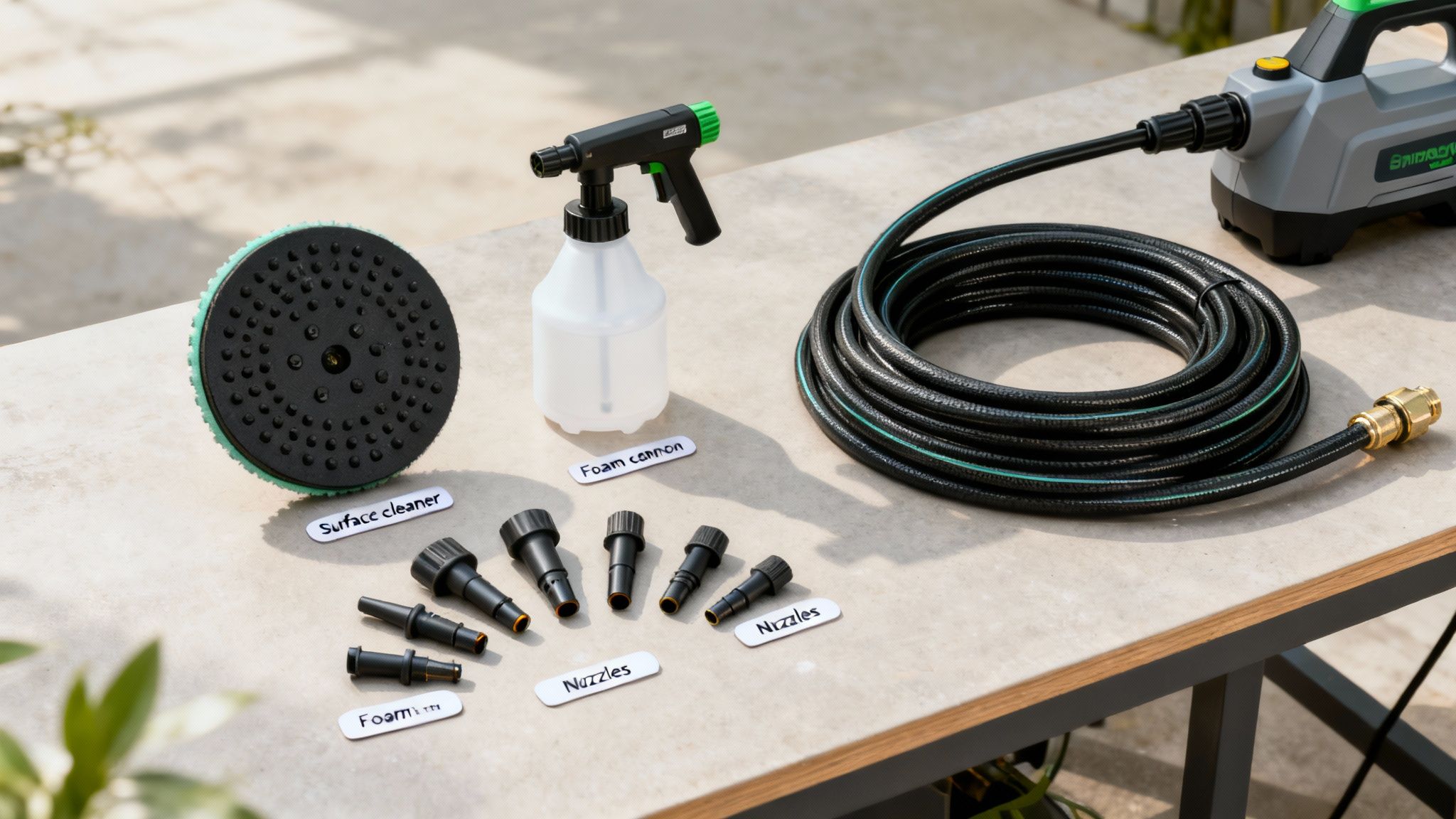
- Surface Cleaner: This spinning, circular accessory cleans large flat areas like driveways fast and evenly, eliminating ugly “zebra stripes.”
- Foam Cannon: A must-have for car enthusiasts, it blankets your vehicle in thick suds to break down dirt and prevent swirl marks.
- Extension Wand: A telescoping wand is invaluable for safely cleaning second-story siding or gutters without a ladder.
You can often find high-quality attachments by exploring product lines from the best garden tool brands.
Frequently Asked Questions
Here are answers to some of the most common questions buyers have before choosing a pressure washer.
Can I use hot water in my pressure washer?
No, unless you’ve specifically purchased a commercial-grade hot water unit. Standard residential pressure washers are designed for cold water only. Running hot water through them will damage the pump and internal seals, leading to permanent failure.
What kind of maintenance is required?
Electric models are low-maintenance; just keep nozzles clean and drain the unit before winter to prevent freezing. Gas models require regular oil changes, spark plug checks, and fuel management, similar to a lawnmower.
Is it worth paying more for a higher-end model?
For frequent use, yes. A higher price tag often means a more durable pump (like a brass triplex pump), a more reliable engine or motor, and better-quality accessories like a flexible hose and sturdy frame. These upgrades lead to a longer lifespan and a much better user experience.
Do I need to use special pressure washer soap?
While water alone works for many jobs, detergents formulated for pressure washers are essential for lifting grease, oil, and stubborn grime. Never use household soaps or bleach, as they can damage the pump’s internal components. Always apply soap using the low-pressure black soap nozzle.
How important is the warranty?
A good warranty (typically 1-3 years on the machine and sometimes longer on the engine/motor) provides peace of mind. It shows the manufacturer stands behind their product and protects you from defects in materials or workmanship. Always check what is covered before you buy.
Conclusion: Making Your Final Choice
Choosing the right pressure washer doesn’t have to be complicated. By focusing on your specific cleaning projects, you can confidently decide between the convenience of an electric model for everyday tasks and the raw power of a gas machine for heavy-duty jobs. Remember to balance PSI and GPM to find a machine with the right cleaning power for your needs, and don’t overlook practical features and attachments that can make your work faster and easier.
Ready to turn your research into reality? At Reva Housing, we provide in-depth, real-world reviews to help you find the perfect tools for your home and garden. Explore our guides and make your next purchase with complete confidence.
Learn more at https://revahousing.com.
