




Picking the right size refrigerator can feel like a high-stakes puzzle, but it doesn’t have to be. Let’s cut through the noise and start with a simple, tried-and-true guideline.
Start with a Quick Size Estimate
Before you get lost in different models and features, the first step is figuring out a ballpark capacity. The industry standard, measured in cubic feet (cu. ft.), is a great starting point for connecting your household size to a specific fridge capacity.
A good rule of thumb is to plan for 4-6 cubic feet of storage for each adult in your household. A single person might be perfectly happy with a 10-12 cubic foot model, while a couple will probably feel more comfortable in the 14-18 cubic foot range.
Think of this initial estimate as your foundation. It’s the number you’ll build on as you start layering in other real-world factors that will ultimately lead you to the perfect fit.
Refrigerator Size Quick Reference Chart
To make it even easier, here’s a quick chart that breaks down the general recommendations. This gives you a solid visual guide to start with.
| Household Size | Recommended Capacity (Cubic Feet) | Best For |
|---|---|---|
| 1-2 People | 10-18 cu. ft. | Singles, couples, or as a secondary fridge |
| 3-4 People | 19-25 cu. ft. | Small to average-sized families |
| 5+ People | 26+ cu. ft. | Large families or those who buy groceries in bulk |
This chart is your shortcut to a smarter search. It helps you immediately narrow down your options to a manageable list.
Key Factors That Refine Your Choice
Of course, it’s not just about counting heads. Once you have your baseline number, it’s time to get practical and think about how you actually live. Three main things will help you zero in on the perfect size:
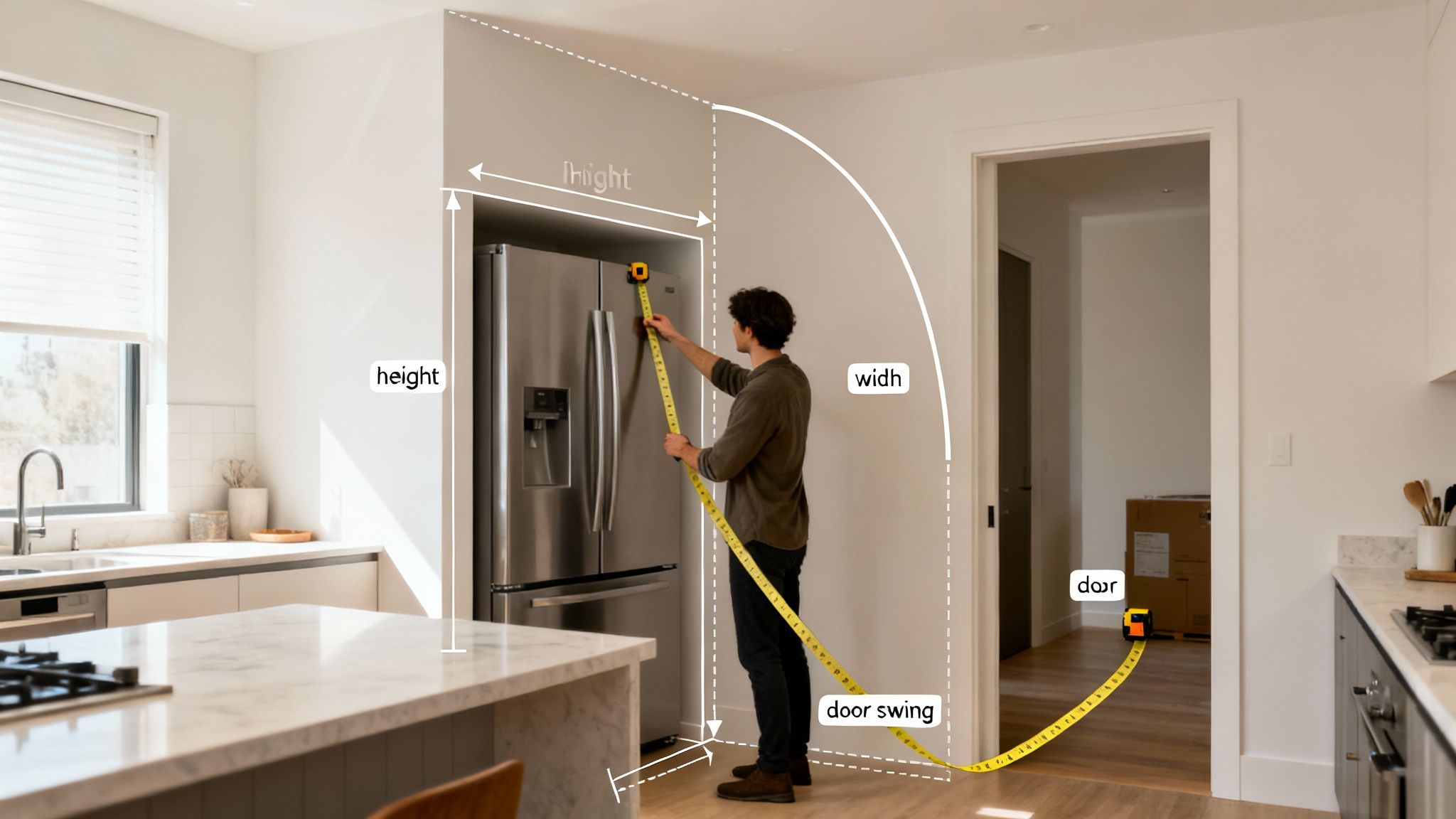
- Your Kitchen’s Physical Space: This is non-negotiable. You have to measure the height, width, and depth of your cutout, but don’t forget to account for ventilation space and how far the doors will swing open.
- Your Family’s Shopping Habits: Are you a bulk-shopper who hits up Costco once a month, or do you prefer making quick, frequent trips for fresh ingredients? Your answer has a huge impact on your storage needs.
- Different Refrigerator Styles: A French door and a side-by-side model with the same exact cubic footage will feel completely different inside. The layout dramatically changes what you can actually fit.
These factors are what turn a good guess into the right decision—a fridge that fits your home and your lifestyle.
Choosing the right size is all about balancing capacity with practicality. The average American family of four usually lands on a 20-25 cubic foot model. It’s the sweet spot for handling weekly groceries without constantly having to play food Tetris.
This real-world preference hits that perfect middle ground between having enough storage and not overwhelming the kitchen. While the global market is always evolving—something you can read more about on sites like Gminsights.com—the best choice always comes back to your own habits.
Ultimately, it comes down to this: measure your space, count the people in your home, and pick a size that stops you from cramming shelves full or paying to cool empty space.
How to Measure Your Space to Avoid Costly Mistakes
It’s easy to fall in love with a sleek, new refrigerator online or in the showroom. But that dream can turn into a delivery-day nightmare if it doesn’t actually fit. Trust me, the single most important thing you can do before you even start browsing is grab a tape measure. This isn’t just about the nook where the fridge will live; it’s about the entire journey from the delivery truck to its final spot in your kitchen.
Think of it this way: your refrigerator needs a little personal space—some “breathing room”—to work properly. The components in the back generate heat, and without enough airflow, the fridge has to work overtime. That leads to higher energy bills and can shorten the life of your appliance. A few careful measurements now will prevent a whole lot of frustration later.
This whole process really boils down to three key things: your family’s needs, the fridge’s capacity, and the physical space in your kitchen.
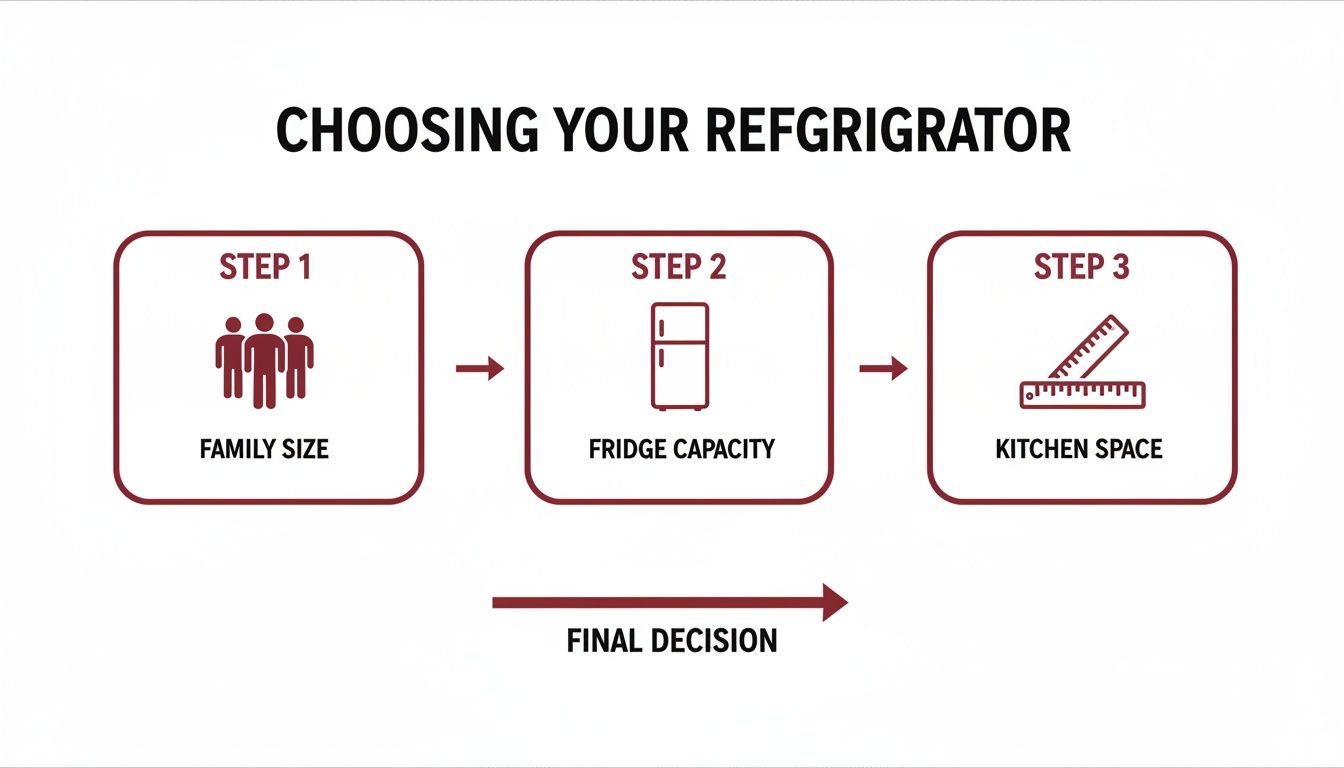
Getting these three elements right is the secret to finding the perfect appliance for your home.
Measuring the Refrigerator’s Home
First up, let’s measure the spot where your new fridge will live. You’ll need to measure the three dimensions of the cabinet cutout or the designated area.
- Height: Measure from the floor to the bottom of any cabinets hanging overhead.
- Width: Measure the space from side to side—wall to cabinet, or between two cabinets.
- Depth: Measure from the back wall out to the front edge of your countertops.
Once you’ve got those numbers, you have to factor in clearance for ventilation. This isn’t optional; it’s essential for the fridge to run efficiently.
- Top Clearance: Leave at least 1 inch of open space above the fridge.
- Back Clearance: Plan for 1-2 inches behind it so air can circulate.
- Side Clearance: You’ll need a minimum of ⅛ to 1 inch on each side, especially if one side is against a wall.
Pro Tip: Don’t just go by general rules. Always, always check the manufacturer’s spec sheet for the exact model you want. These clearance needs can vary, and getting them right is crucial for both performance and your warranty.
Don’t Forget the Door Swing
This is the one measurement everyone forgets, and it can be a massive headache. A refrigerator door that can’t open all the way is a daily frustration—you won’t be able to pull out the crisper drawers or grab things from the door shelves.
To check this, open your current refrigerator door to a 90-degree angle and measure how far it sticks out. Now, look at its path. Will it smack into a wall, a kitchen island, or another appliance? If you’re considering a French door model, you have to account for both doors swinging open. If your space is tight, some models with slimmer doors can save you up to 3 inches of precious clearance.
Charting the Delivery Path
Okay, your new fridge fits the nook. But can it get to the nook? This is where a lot of homeowners get into big trouble. You have to measure every single doorway, hallway, and tight corner on the path from your front door to the kitchen.
Start outside and work your way in, measuring the width and height of:
- All exterior and interior doorways
- Hallways (especially any sharp corners)
- Stairwells (check the width and the ceiling height on landings)
- Any other tight turns or funky architectural features
Compare these numbers to the refrigerator’s dimensions—and don’t forget to account for the packaging! The delivery box can add several inches to every side. If the path looks too narrow, the delivery team might have to remove the appliance doors or even your home’s door hinges. Figuring this out ahead of time will save you from a major installation-day crisis. Taking these steps ensures your answer to “what size refrigerator do I need” accounts for every last inch of your home.
Translating Cubic Feet into Your Family’s Lifestyle
So, you see a refrigerator listed at 22 cubic feet, but what does that number actually mean when you’re staring down a full grocery cart? It’s easy to get lost in the specs, but the real trick is connecting those abstract numbers to your actual life.
Think of it this way: one cubic foot is roughly the size of a standard paper grocery bag. It’s a helpful starting point, but how you use that space is what truly matters.
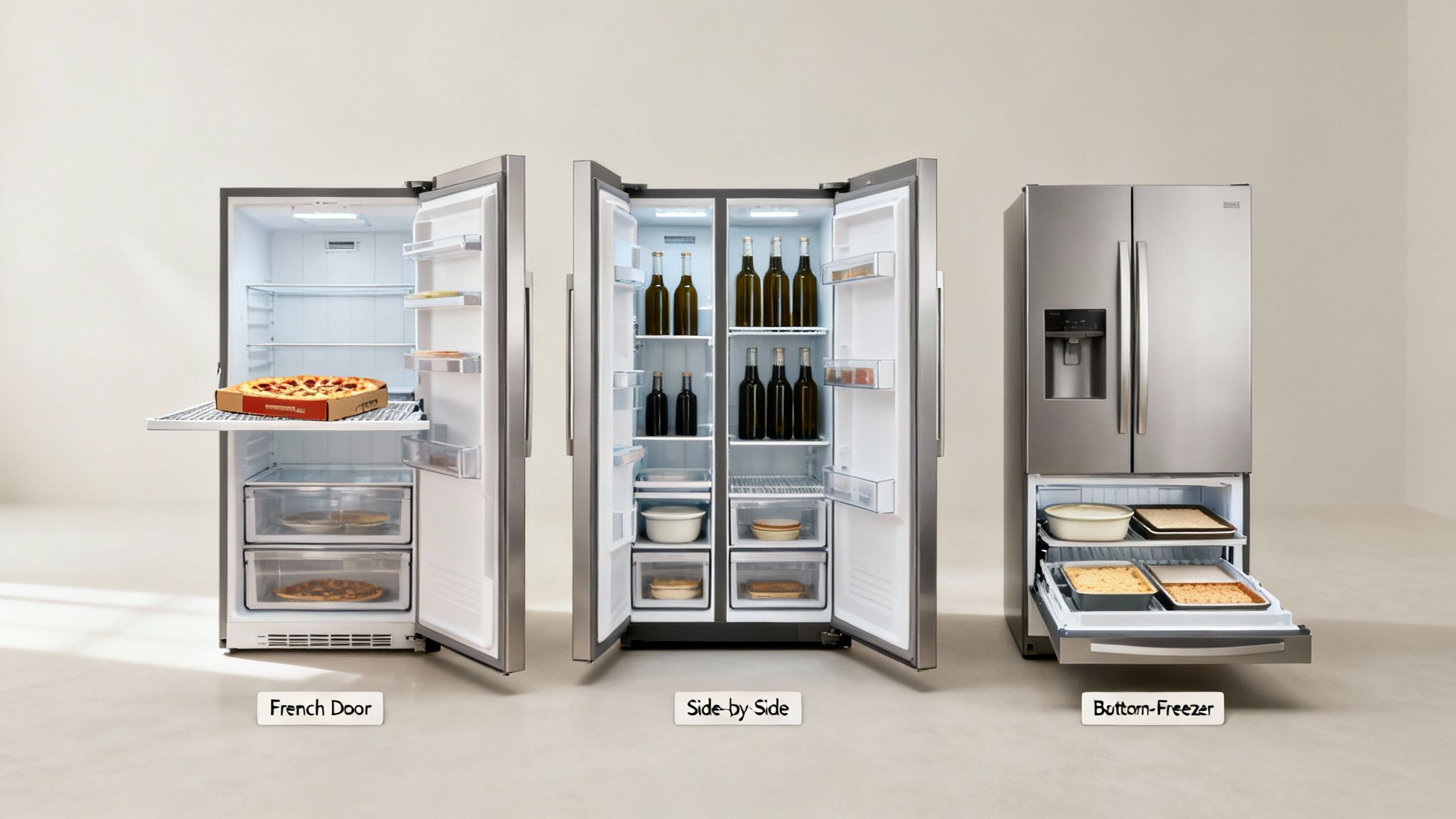
Your shopping habits are the single most important factor here. The “right” capacity isn’t a one-size-fits-all solution; it’s a direct reflection of how you eat, shop, and live.
The Bulk Shopper vs. The Fresh Food Fanatic
Imagine two completely different households. One thrives on monthly warehouse club runs, stocking up on family-size packs of meat, frozen pizzas, and cases of drinks. The other prefers hitting the farmer’s market twice a week for fresh produce and artisanal cheeses.
- The Bulk Shopper: This family needs serious freezer space and deep, wide shelves to handle big boxes and containers. A larger capacity fridge, probably 25 cubic feet or more, is essential to avoid a constant, frustrating game of grocery Tetris. Without it, those great bulk deals just become a storage nightmare.
- The Fresh Food Fanatic: This household prioritizes refrigerator space over the freezer. They need excellent crisper drawers with humidity controls and flexible shelving for odd-shaped vegetables and small containers. A model in the 18-22 cubic foot range might be perfect, since they aren’t storing food for weeks on end.
Figuring out which camp you fall into is the first step toward seeing beyond the cubic foot number.
Real-World Scenarios and Sizing
Let’s get more specific. Your daily routines create unique storage demands. See if any of these sound familiar.
The Meal-Prepping Professional:
If your Sundays are spent cooking for the week, your fridge is probably jammed with stacks of identical glass containers. You need long, uninterrupted shelves that can hold multiple containers side-by-side and enough height to stack them. A French door or bottom-freezer model in the 20-24 cubic foot range usually offers the best layout for this organized lifestyle.
The Growing Family:
This is the land of juice boxes, yogurt cups, leftover pizza, and produce that needs to be seen or it will be forgotten. Door-in-door features are a lifesaver for grabbing snacks without letting all the cold air out. For this crew, adjustable shelves and gallon-sized door bins are non-negotiable. For a family of four or more, you should be looking at models that are 22 cubic feet and larger.
Key Takeaway: Choosing the right size refrigerator is directly tied to how we live and eat. Household size is a primary driver of capacity needs, with singles often finding 10-14 cubic feet sufficient, while couples who enjoy bulk shopping trips might need 18-22 cubic feet to comfortably store their finds.
This link between lifestyle and appliance size is shaping the entire industry. As our habits evolve, so do refrigerators, with smarter features becoming more common. You can get a better sense of where things are headed from industry reports that explore these refrigerator market trends.
Visualizing Your Needs
Before you pull the trigger, try this simple exercise. The next time you get home from a big grocery run, open your current refrigerator. What’s driving you crazy?
- Is there never enough room for tall items like wine bottles or milk cartons?
- Are you constantly struggling to fit wide things like sheet pans or pizza boxes?
- Is the freezer a chaotic mess where food goes to be forgotten for months?
Answering these questions gives you a real-world checklist for your new fridge. If you’re always wishing for more freezer space, maybe a side-by-side is the answer. If you can never find the condiments, a model with better door storage should be your priority. This little self-audit is the best way to answer “what size refrigerator do I need” with a solution that actually solves your daily problems.
How Refrigerator Style Affects Your Usable Space
When you’re trying to figure out what size refrigerator you need, it’s easy to get tunnel-vision on the total cubic feet. But here’s a little secret from the world of kitchen design: not all cubic feet are created equal. The style of the refrigerator completely changes how that space is organized and, more importantly, how much you can realistically cram inside.
Think of it this way: a 22 cubic foot French door model and a 22 cubic foot side-by-side might have the same number on the sticker, but in the real world, they feel like two totally different appliances. One layout might be perfect for storing a giant sheet cake, while another is a master of vertical freezer organization. Understanding these differences is the key to choosing a fridge that doesn’t just fit your kitchen cutout, but actually fits your life.
Refrigerator Style vs. Usable Space Comparison
Let’s break down how different styles use their space. Each design comes with its own set of trade-offs, and what works for a family that buys in bulk might not be ideal for a couple who loves to entertain.
| Style | Typical Capacity Range (cu. ft.) | Storage Pros | Storage Cons | Best For Kitchens |
|---|---|---|---|---|
| French Door | 20-30+ | Wide, uninterrupted shelves for large items like platters and pizza boxes. | The bottom freezer drawer can become a disorganized “black hole.” | With islands or tighter walkways, as the doors have a smaller swing radius. |
| Side-by-Side | 20-28 | Excellent vertical freezer organization with lots of shelves. Easy access to everything. | Both fridge and freezer sections are narrow, making it hard to fit wide items. | That need an in-door ice/water dispenser and have families who need organized freezer access. |
| Top-Freezer | 15-22 | Generally the most budget-friendly and energy-efficient option. | You have to bend down constantly to get things from the main fridge compartment. | Where budget is a key factor or for secondary/garage fridges. |
| Bottom-Freezer | 18-25 | Fresh food is at eye level, which is super convenient for daily use. | Freezer space can be less organized if it’s a swing-door style instead of a drawer. | Where easy access to fresh food is the top priority. |
As you can see, the “best” style really depends on what you’re storing. A French door model is a host’s dream, while a side-by-side can bring order to a chaotic freezer.
French Door Refrigerators
French door models have taken over the market, and it’s easy to see why. You get two doors for the fridge on top and a big pull-out freezer drawer below.
- Storage Pros: The main selling point is that massive, wide-open refrigerator space. You get full-width shelves perfect for awkwardly shaped items like deli platters, pizza boxes, or baking sheets. The split doors also require less swing clearance, a huge plus if you have a kitchen island.
- Storage Cons: That bottom freezer drawer can be a real pain. It’s basically a giant bin, and smaller items have a bad habit of sinking to the bottom, never to be seen again. It takes real discipline to keep it tidy.
Side-by-Side Refrigerators
A side-by-side splits the unit right down the middle, with a vertical freezer on one side (usually the left) and the fridge on the other.
- Storage Pros: These models are champions of freezer organization. With a stack of shelves and door bins, you can see everything at a glance. No more digging for that bag of frozen peas! They are also the style most likely to have a through-the-door ice and water dispenser.
- Storage Cons: The trade-off for all that organization is width. Both compartments are quite narrow, which makes storing anything bulky—like a Thanksgiving turkey or a large casserole dish—a serious game of Tetris.
Top-Freezer and Bottom-Freezer Models
These are the classic, no-nonsense workhorses of the kitchen. A top-freezer puts the frozen stuff up high, while a bottom-freezer prioritizes easy access to fresh food.
- Storage Pros: Both styles are generally easier on the wallet and more energy-efficient. A bottom-freezer gives you a wide fridge space, almost like a French door but with a single door, while a top-freezer means you never have to bend down for ice cream.
- Storage Cons: With a top-freezer model, you’ll be bending over to get to your crisper drawers and anything on the bottom shelf. Bottom-freezers that have a swinging door instead of a pull-out drawer can be just as disorganized as their top-freezer counterparts.
This variety is mirrored in global trends. In the US, where bulk shopping is common, multi-door models are popular because their clever designs can add 20-30% more usable space. Elsewhere, compact top-freezer units are still the standard, fitting different kitchen sizes and shopping habits. You can dig into these global refrigerator market dynamics to see how design trends evolve worldwide.
The Counter-Depth Question
One last style choice to throw into the mix is the counter-depth refrigerator. These are specifically designed to be shallower than standard models, so they sit almost perfectly flush with your kitchen cabinets. The result is a clean, built-in look.
A counter-depth refrigerator trades a bit of interior capacity for a significant aesthetic upgrade. You might lose 4-6 cubic feet of storage compared to a standard-depth model of the same width, but you gain a more integrated and seamless kitchen design.
The trade-off is pretty straightforward: you sacrifice some depth for a much more streamlined kitchen. It’s a hugely popular option for modern kitchen remodels where looks are just as important as function. If you’re leaning this way, make sure you understand exactly what a counter-depth refrigerator is and how the smaller interior might affect your grocery habits. For many, the cleaner lines are easily worth it.
Balancing Size with Energy Use and Smart Features
When you’re trying to figure out what size fridge you need, it’s easy to get sucked into the “bigger is always better” mindset. But a larger refrigerator isn’t just a bigger box—it’s a bigger commitment to your daily electricity bill. The real sweet spot is finding the right balance between capacity, energy efficiency, and modern features.
A massive, feature-packed fridge might look like the ultimate kitchen upgrade, but if it’s half-empty most of the time, you’re literally paying to cool air. This is where the balancing act comes in. Sometimes, a slightly smaller, more thoughtfully designed model gives you more practical value than a cavernous, energy-guzzling one.
Understanding Energy Efficiency
The quickest way to get a read on a refrigerator’s efficiency is to look for the Energy Star label. An Energy Star certified refrigerator is, on average, 9% more energy-efficient than models that just meet the minimum federal standard. That might not sound like a huge number, but it really adds up over the lifespan of the appliance.
Think of it this way: an older, oversized, or less efficient model can quietly tack on hundreds of dollars to your energy bills over its lifetime. It’s a slow drain on your wallet that’s easy to miss. Always check the bright yellow EnergyGuide label on the appliance; it gives you an estimated yearly operating cost, offering a real number you can use to compare different models.
Choosing an efficient model is a long-term investment. While a more efficient refrigerator might have a slightly higher upfront cost, the savings on your utility bills often pay back that difference over the appliance’s life.
Since you’ll be running this appliance 24/7 for a decade or more, efficiency should be a huge priority. For a deeper dive into appliance longevity and what to expect, our guide on how long kitchen appliances last offers some valuable context for making a durable choice.
When Smart Features Outweigh Sheer Size
This is where modern refrigerators really start to shine. Smart, innovative features can make a moderately sized fridge feel much larger and more functional, letting you get more out of less space.
- Door-in-Door Compartments: This feature gives you a separate outer door for the things you grab most often, like drinks and condiments. You can snag what you need without opening the main compartment, which prevents a ton of cold air loss and cuts down on the energy needed to cool the fridge back down.
- Flexible Shelving and Bins: Keep an eye out for adjustable, slide-in, or flip-up shelves. This kind of flexibility allows you to customize the interior on the fly to fit tall items like wine bottles or bulky things like a big pot of soup, which effectively maximizes your usable space.
- Convertible Drawers: Some higher-end models come with drawers that have their own independent temperature controls. This means you can switch a drawer from a standard fridge setting to a soft-freeze or deep-freeze, giving you incredible versatility based on what you need for the week.
These features aren’t just flashy gimmicks; they are practical solutions that help you organize better and use your refrigerator’s capacity more effectively. By choosing a model with smart design elements, you might find that a 22 cubic foot fridge with great features serves your family better than a basic 26 cubic foot model. It’s all about working smarter, not just bigger.
Your Final Checklist Before You Buy
You’ve done the hard work, scouted the options, and you’re this close to picking the perfect refrigerator. Before you pull the trigger, let’s run through one last sanity check.
This isn’t just a recap; it’s your insurance against delivery-day drama. Think of it as the final walkthrough to make sure the fridge that looks amazing in the showroom will actually fit—and function—in your life.
The Measurement Checklist
Okay, this is the most critical part. Grab that tape measure one last time. Having these numbers written down on your phone or a piece of paper will make shopping, whether online or in-store, so much easier.
- Height of the Space: Measure from the floor to the bottom of your overhead cabinets. No guessing!
- Width of the Space: Go from wall to countertop, or measure the opening between two cabinets.
- Depth of the Space: Run your tape from the back wall to the front edge of your counters.
- Breathing Room: Remember to add 1-2 inches of clearance for the back and top, and at least ⅛ inch on the sides for ventilation.
- The Delivery Gauntlet: Measure the width of every single doorway, hallway, and tight corner from your front door all the way to the kitchen.
Quick pro tip: Don’t forget to compare your numbers to the refrigerator’s cased dimensions (that means with the packaging on). You can usually find this on the manufacturer’s spec sheet online. This tiny step can save you from a massive installation headache.
Your Lifestyle and Needs Review
With the physical fit locked in, let’s do a quick gut-check on your lifestyle needs. Is the capacity and style really the right match for you?
- Household Size: Does the capacity still line up with our 4-6 cubic feet per adult rule of thumb?
- Shopping Habits: Will this fridge comfortably hold everything after a big Costco run? Or is it better suited for someone who grabs fresh ingredients every couple of days?
- Style Functionality: Seriously, will that French door layout actually solve your pizza box problem? Does the freezer have the kind of organization you need, or will it just become a new version of the black hole you already have?
Nailing this final check helps you feel confident in your choice. It’s also the perfect moment to think about when to buy. To snag the best deal, you might want to learn more about the best time to buy appliances, since prices can swing pretty dramatically throughout the year. Taking these last few steps ensures your new refrigerator is a perfect fit in every single way.
Got Questions? Let’s Settle Those Final Fridge Doubts
Even after you’ve measured everything twice and compared every style, a few nagging questions always seem to surface just before you hit “buy.” It’s totally normal. Let’s walk through those final what-ifs so you can make your choice with complete confidence.
Think of this as the final gut check. Answering these common questions will help you lock in your answer to “what size refrigerator do I need?” and feel great about it for years to come.
Is It Better to Buy a Slightly Bigger Fridge?
This is the classic dilemma, and the short answer is usually yes—but only if you have the physical and budgetary room for it. Thinking a little bigger than you need right now is often a smart long-term play. Life has a way of changing; families grow, you start hosting holiday dinners, or you get really into meal prepping.
That little bit of extra capacity can be a real lifesaver down the road. That said, don’t go wild. A half-empty fridge is just an energy hog, cooling space you’re not even using and driving up your utility bills. A good rule of thumb is to go up by 2-4 cubic feet from what you think you need if you’re on the fence. Any more than that is probably overkill.
A very common regret I hear from appliance shoppers is that they underestimated their storage needs. It’s almost always better to have a little extra room you don’t use than to constantly play fridge Tetris because it’s too small.
How Much Space Do I Really Lose with a Counter-Depth Model?
The sleek, built-in look of a counter-depth fridge is a huge draw, but that seamless design comes at the cost of interior space. When you compare a counter-depth model to a standard-depth one with the exact same height and width, you can expect to give up between 4 to 6 cubic feet of total capacity.
Most of that lost space comes from the depth of the shelves. For a lot of people, it’s a trade-off they’re happy to make for a cleaner kitchen layout. In fact, the shallower depth can actually be a bonus—it makes it much easier to see and grab things from the back, so that jar of pickles from 2021 doesn’t get lost in the abyss.
How Can I Be 100% Sure It Will Fit Through My Door?
This is the number one reason for delivery day horror stories. To be absolutely certain your new fridge will make it inside, you need to compare the narrowest point of your delivery path to the fridge’s dimensions with the doors taken off.
Here’s how the pros do it:
- Find the “Depth Without Doors” Spec: Pull up the manufacturer’s spec sheet online for the model you want. This number is your golden ticket.
- Measure Your Doorways: Grab a tape measure and find the width of your narrowest doorway. Be precise: measure from the door jamb on one side to the edge of the actual door on the other (not the wall behind it).
- Compare the Numbers: As long as your doorway measurement is bigger than the fridge’s “depth without doors,” you’re good to go. Delivery teams are masters at popping doors off to squeeze through tight spots.
This one simple check is the difference between a smooth delivery and a massive headache. Taking a few extra minutes to confirm these details will ensure your new appliance gets installed without a hitch.
At Reva Housing, we believe an informed choice is the best choice. Explore our in-depth guides and reviews to find the perfect appliances for your home at https://revahousing.com.
