



Choosing the right stand mixer comes down to one simple question: what do you bake, and how often? It’s a crucial first step, like picking the perfect tool for a big project. Get it right, and your mixer becomes an indispensable partner in the kitchen. Get it wrong, and it can quickly become a source of frustration.
For someone who pulls out the mixer for the occasional batch of cookies or a single loaf of bread, a 4.5 to 5-quart model is your sweet spot. But if you’re a serious weekly baker tackling double recipes for a bigger family, you’ll want the muscle and capacity of a 6 to 8-quart machine.
Find Your Perfect Mixer Size Instantly
Walking into the mixer aisle can feel a little overwhelming. You’re hit with a wall of different sizes, slick designs, and power ratings. It’s easy to get lost in the tech specs before you even start.
But here’s the secret: the most important factor isn’t just the wattage or even the brand. It’s about finding a machine that actually fits your real-world baking habits. A mixer that’s too small for your giant sourdough batches will struggle, straining its motor and leaving you with subpar dough. On the other hand, using a massive professional-grade mixer for a tiny batch of frosting is just plain inefficient.
The key is to be honest with yourself. Are you an occasional baker who enjoys making a dozen cookies on a whim? Or are you a dedicated bread maker who kneads multiple loaves every single weekend? Nailing that down is how you find the perfect fit.
Your Quick Guide to Mixer Sizing
To make this a whole lot easier, we put together a simple decision tree. This little guide connects your baking frequency and style directly to the ideal mixer capacity, so you can quickly see which category you fall into.
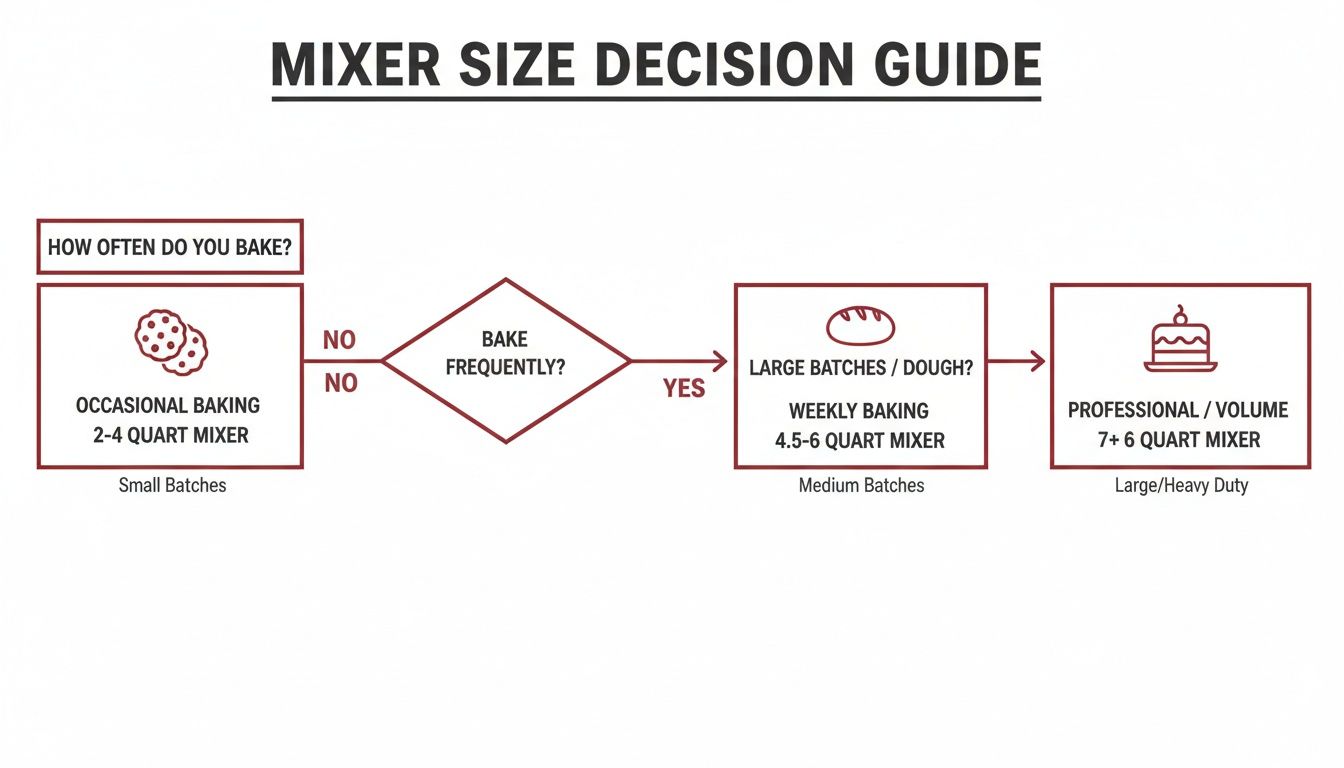
This flowchart cuts through the noise. It shows how casual, smaller-scale baking lines up perfectly with compact models, while more frequent or ambitious projects demand the larger, more powerful machines.
To put it another way, here is a quick reference chart to help you match your baking style to the right mixer size.
Mixer Size Quick Reference Chart
| Your Baking Style | Household Size | Typical Batch Size | Recommended Mixer Size (Quarts) |
|---|---|---|---|
| The Casual Creator | 1–2 people | 1 dozen cookies, 1 cake, 1 loaf of bread | 4.5–5 Quarts |
| The Weekend Warrior | 2–4 people | 2 dozen cookies, double batch of dough | 5–6 Quarts |
| The Batch Baker | 4+ people | Multiple loaves, large holiday batches | 6–7 Quarts |
| The Home Pro | Large family or small business | Bulk recipes, dense doughs, frequent use | 7–8 Quarts |
This chart is a great starting point for seeing where your needs land on the spectrum, from casual baking to near-professional output.
Why Sizing Up Is Often Smart
We’ve all heard the story. You buy a mixer that’s perfect for your current needs, but a year later you find yourself making double batches of bread for the holidays or whipping up dozens of cupcakes for a school fundraiser. Suddenly, that “perfectly-sized” mixer feels incredibly cramped.
A slightly larger mixer provides room to grow. Opting for a size up from what you think you need today prevents future buyer’s remorse and protects the motor from the strain of consistently overfilled bowls.
Think of it as a long-term investment in your baking journey. For those of you who are really diving deep into the world of baking, exploring the features of the best stand mixers for baking can offer even more clarity on how different models handle various tasks. Ultimately, a bigger bowl and a tougher motor open the door to more ambitious recipes without forcing you to buy a whole new appliance down the road.
Translating Bowl Size into Real-World Batches
So, you’ve looked at the chart and have a mixer size in mind. Now, let’s talk about what that number—say, 5 quarts—really means when you get it into your kitchen. It’s a classic rookie mistake to assume a 5-quart bowl is meant to mix 5 full quarts of batter. That’s a recipe for an overflowing mess and a strained motor.
Think of it like pouring a cup of coffee. You never fill the mug right to the brim, do you? You need that little bit of extra space for cream, or just to avoid sloshing hot coffee everywhere. A mixer bowl is exactly the same. It needs “headspace” for the ingredients to aerate, combine, and move around without climbing the walls. This is what we call its effective capacity.
The Golden Rule of Mixer Capacity
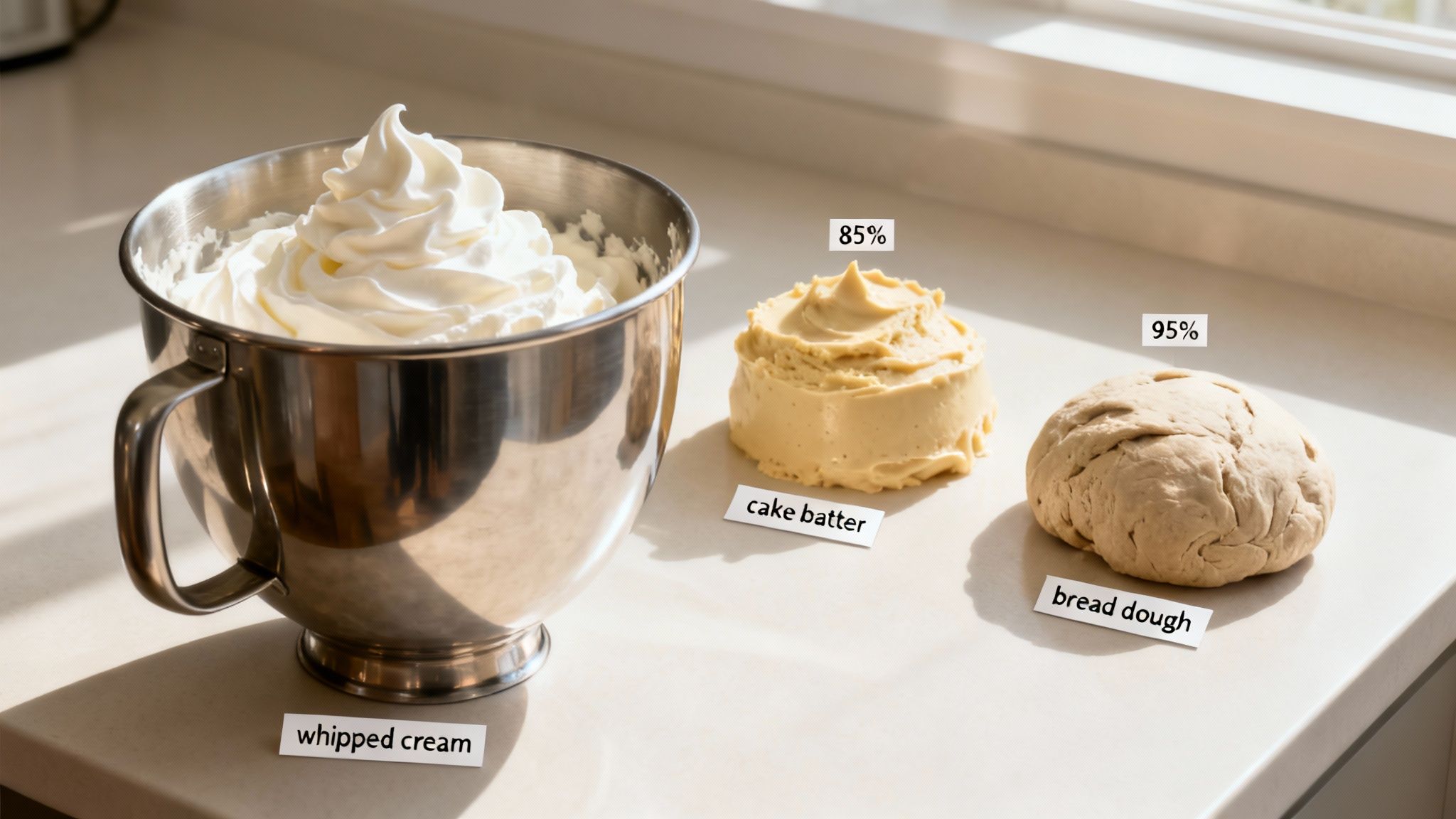
What you’re making completely changes how much you can cram into that bowl. Lighter mixtures need room to expand, while heavy doughs are all about putting the motor to the test. To get the best results without burning out your machine, experienced bakers stick to a few general guidelines.
- For light, airy mixtures like whipped cream or egg whites, you only want to fill the bowl about 75% of the way. These ingredients literally grow as you mix them, trapping air. Overfill the bowl, and you’ll smother them before they ever reach their fluffy peak.
- For thick batters like cake mix or cookie dough, you can push it a little further, filling it up to around 85%. This leaves just enough room for the beater to move freely and make sure every last bit of flour is incorporated.
- For heavy, dense doughs like bread or pizza, you can go up to about 95% capacity. This seems high, but dense dough doesn’t expand much during the initial mix. The real challenge here isn’t volume—it’s the serious strain the dough puts on the motor.
Flour Power and Why It Matters
Here’s another term you’ll run into: flour power. It’s the maximum amount of flour a mixer can handle in a single go, and for bread bakers, it’s a much more useful number than the bowl’s quart size. Why? Because a double batch of heavy, sticky sourdough demands way more from the motor than a light, airy meringue, even if they take up a similar amount of space.
When you see a mixer’s capacity listed as “up to 9 cups of flour,” that’s a direct signal of its muscle for bread making. It tells you exactly how much dense dough the motor can knead without getting bogged down or overheating.
Thinking in terms of flour power helps you see past the quart number on the box and understand how the machine will actually perform with your go-to recipes. It’s the difference between buying a mixer that just looks big enough and one that can truly keep up with your baking ambitions.
It’s the same logic you’d use for other kitchen gear. You wouldn’t just grab any pot; you’d consult a Dutch oven size guide to match the pot to the recipe’s volume and what you plan to cook. This kind of thoughtful approach makes sure your equipment works with you, ready for whatever you feel like creating next.
Understanding the Power Behind the Performance
While the bowl size tells you how much you can mix, the motor dictates how well you can mix it. The motor is the heart and soul of your stand mixer—it’s the engine that delivers the raw strength needed for everything from delicate meringues to stubborn, dense bread doughs. Getting this part right is absolutely critical.
When you start comparing models, one of the first specs you’ll see is wattage. It’s easy to assume that a higher wattage automatically means a more powerful machine, but that’s only half the story. Wattage measures how much energy a motor pulls from the wall, not the actual power it delivers to the bowl.
Think of it this way: one car might burn a ton of gas to get up a hill, while a more efficient car climbs the same hill just as easily using far less fuel. Mixer motors are no different. The real secret to a mixer’s strength isn’t just wattage; it’s the type of motor doing the work.
The Two Types of Mixer Motors
Generally, mixer motors fall into two camps: Alternating Current (AC) and Direct Current (DC). Knowing the difference is the key to picking a machine that won’t let you down when you need it most.
- AC (Alternating Current) Motors: These are pretty common in household appliances and are often found in older or more budget-friendly mixers. They can get the job done, but their power can sometimes fluctuate when you put them under a heavy load.
- DC (Direct Current) Motors: These are the real workhorses. DC motors deliver consistent, direct power, maintaining their speed and strength even when faced with the toughest jobs. They also tend to be more energy-efficient and run quieter.
So, why should you care? Imagine you’re kneading a stiff whole-wheat dough. An AC motor might start to strain, slow down, or even get hot as the dough fights back. A DC motor, on the other hand, delivers steady, unwavering torque—the rotational force that keeps that dough hook moving consistently through the mass.
Torque is the true measure of a mixer’s kneading power. A well-engineered DC motor with lower wattage can easily outperform a higher-wattage AC motor because it delivers more consistent torque. That means no straining and a perfect knead every time.
This is why a 325-watt DC motor can often feel more powerful and capable than a 500-watt AC motor when you’re making bread. It’s not about how much power it uses; it’s about how efficiently it delivers that power right where you need it—in the bowl.
Matching Motor Power to Your Recipes
The right motor for you really depends on what you love to bake. Not every recipe demands a high-torque engine, so let’s break down which tasks require more muscle.
Tasks Requiring Lower to Moderate Power:
- Whipping cream or egg whites
- Mixing thin cake and brownie batters
- Making simple frostings and buttercreams
- Mixing a standard batch of chocolate chip cookie dough
These are the everyday tasks, and pretty much any modern stand mixer can handle them without breaking a sweat.
Tasks Requiring High Power and Torque:
- Kneading dense bread doughs (think sourdough, whole wheat, or rye)
- Mixing large, double batches of stiff cookie dough
- Working with thick, heavy mixtures like fruitcakes or bagels
- Using power-hungry attachments like a meat grinder or grain mill
If your baking dreams involve any of these heavy-duty jobs, making a DC motor a priority is a smart move. It’s the best way to ensure your machine has the endurance to perform without struggling or risking burnout. Choosing the right motor is just as important as the bowl size, and it’s what will make your mixer a reliable kitchen partner for years to come.
Choosing Between Tilt-Head and Bowl-Lift Designs
Okay, so we’ve talked bowl size and motor power, but there’s another huge piece of the puzzle: the mixer’s actual design. How you physically interact with your mixer every day matters just as much as its specs. This isn’t just about picking a size; it’s about picking a style that fits your kitchen and your workflow.
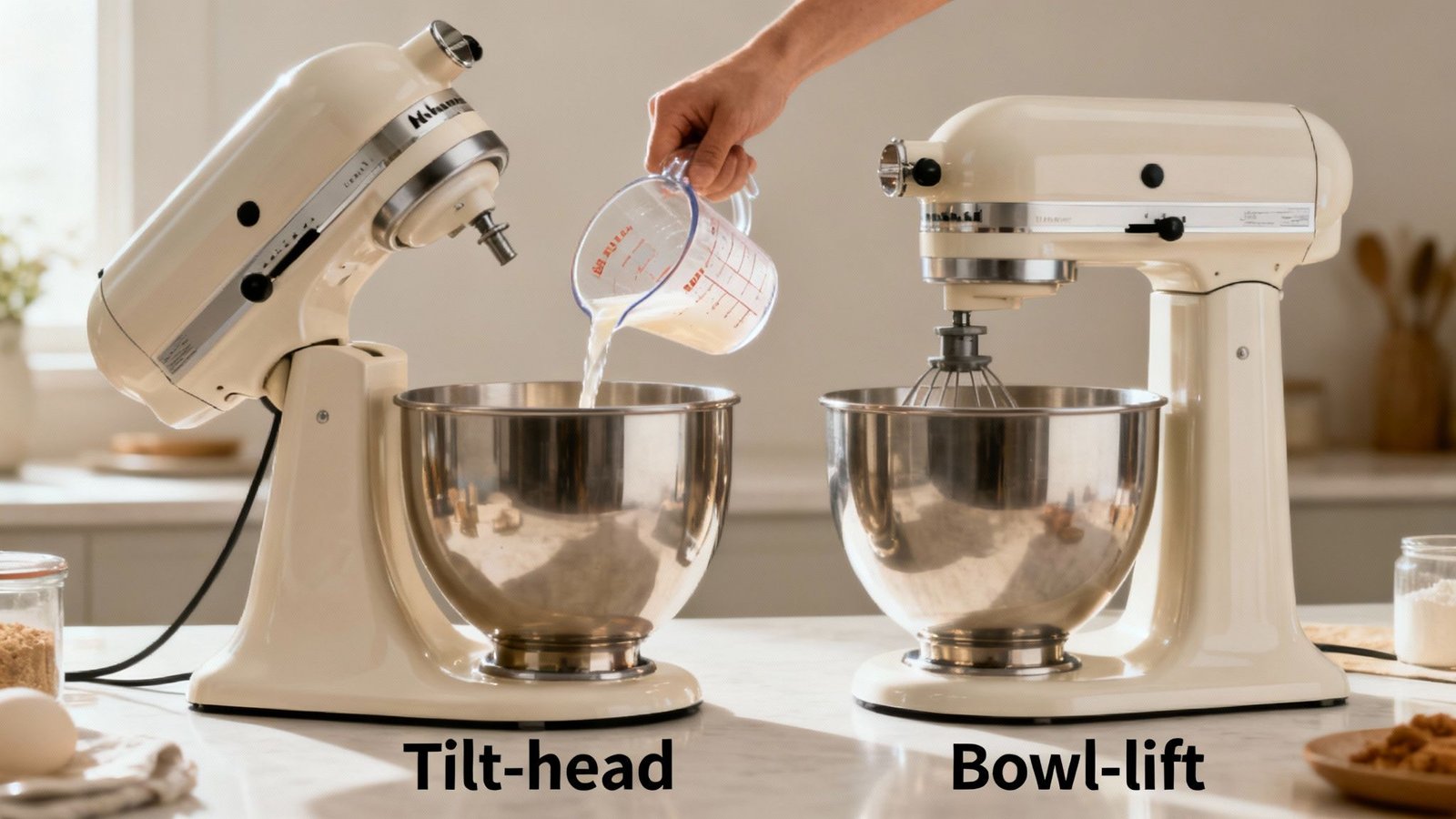
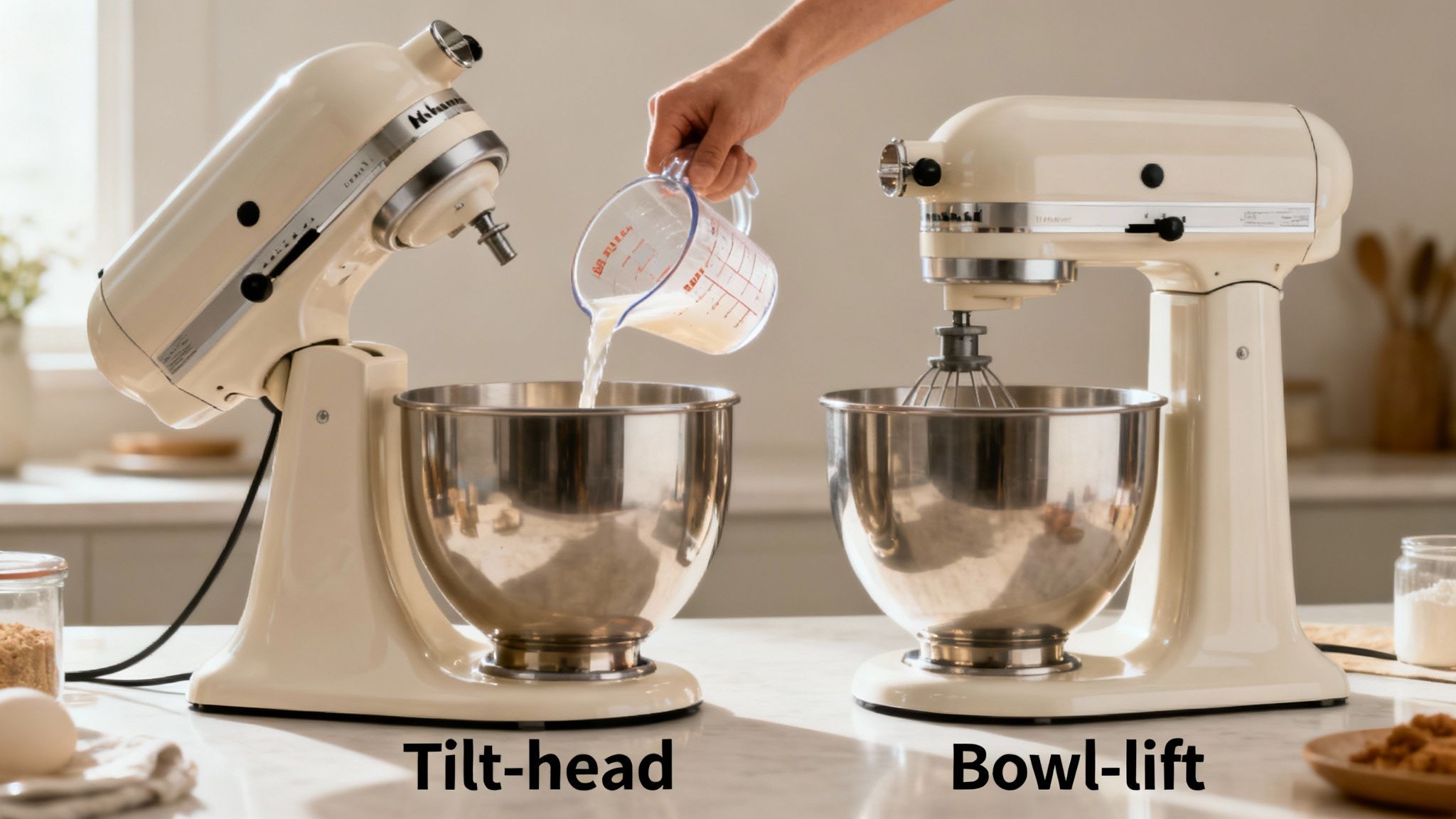
When it comes to stand mixers, you’ve got two main camps: tilt-head and bowl-lift. The names give you a pretty good hint about how they work. A tilt-head model has a hinge that lets you tip the motor head back to get to the bowl. A bowl-lift, on the other hand, keeps its head firmly in place while you use a lever to crank the bowl up to meet the beater.
This one difference changes everything—from how you add chocolate chips mid-mix to whether the machine will even fit under your cabinets. Let’s get into the nitty-gritty of how these two styles really stack up in a real-world kitchen.
The Convenience of Tilt-Head Mixers
For most home bakers, the tilt-head mixer is the friendly, familiar face of stand mixers. Their biggest selling point is pure, simple accessibility.
When you tilt the head back, the bowl is completely open. This makes it a breeze to toss in ingredients, scrape down the sides, or swap from the paddle to the whisk without any awkward maneuvering. It’s just easier. Another big plus is their footprint; tilt-head models are usually shorter and lighter, which means they’re more likely to tuck away nicely under standard kitchen cabinets.
- Best for: Casual bakers, whipping up small batches of cookies, and kitchens where counter space is at a premium.
- Typical Size Range: You’ll usually find these in the 3.5 to 5-quart range.
But that convenient hinge can also be a point of weakness. If you’re wrestling with a really dense, heavy bread dough, you might notice the head bounce or shudder a tiny bit at the hinge point. It’s not a big deal for 99% of recipes, but for serious bread makers, it’s something to keep in mind.
The Stability of Bowl-Lift Mixers
If tilt-head mixers are the friendly daily drivers, bowl-lift mixers are the heavy-duty workhorses. These things are built for power and stability, period.
The head is totally stationary, and the bowl locks onto a pair of burly arms. This rock-solid design means there’s zero wobble or bounce, no matter how tough the dough. All of the motor’s power goes directly into the bowl, letting you mix massive or dense batches without breaking a sweat. It’s why you almost always see this design on the larger, more powerful models.
Bowl-lift models are engineered for bakers who regularly tackle large or demanding recipes. Their stability ensures maximum efficiency and longevity when working with everything from double batches of cookie dough to artisanal bread.
You do lose that wide-open access to the bowl, but adding ingredients while it’s running is still pretty straightforward—you just pour them in from the top. The main trade-offs are size and heft. Bowl-lift mixers are taller and much heavier, and they often won’t fit under cabinets. You’ll need to give them a permanent home on your counter.
Tilt-Head vs. Bowl-Lift: Pros and Cons
So, how do you decide? It really comes down to your baking habits and your kitchen space. Here’s a quick side-by-side look to help you weigh the pros and cons of each design.
Tilt-Head Mixers
- Pros: Easy to add ingredients and scrape the bowl; smaller footprint fits under most cabinets.
- Cons: Can have minor head wobble with very heavy doughs; typically smaller capacities.
Bowl-Lift Mixers
- Pros: Extremely stable for tough jobs; larger capacity and more powerful motors.
- Cons: Taller and heavier, often requiring dedicated counter space; less direct access to the bowl.
Ultimately, there’s no single “best” choice, only the best choice for you. A tilt-head offers amazing convenience for everyday tasks, while a bowl-lift provides the raw power and stability needed for more ambitious baking projects.
Common Mistakes to Avoid When Buying Your Mixer
Picking out a new stand mixer is exciting. It’s easy to get swept up in a sleek design or a great sale, but a few common mistakes can turn that dream appliance into a source of long-term frustration. Let’s walk through the most frequent regrets home bakers have so you can choose a machine you’ll love for years to come.
The single biggest misstep? Underestimating your own ambition. So many people buy a mixer that’s perfect for their current needs, only to find it groaning and struggling a year later when the holiday baking season kicks into high gear. Suddenly, that double batch of stiff gingerbread dough has the motor whining, and you’re wishing you had more power.
Honestly, choosing a mixer that’s slightly larger than you think you need is often the smartest move you can make. It prevents unnecessary wear on the motor and saves you from having to buy a whole new machine when your hobby inevitably grows.
Buying Too Small and Regretting It Later
This is the classic “buy small, regret later” scenario, and it happens all the time. In fact, many home bakers admit they wish they had gone bigger with their first mixer. The main reason was feeling completely overwhelmed during festive seasons when recipes get scaled up two or three times. A mixer that handled a single loaf of bread just fine can’t always keep up with those massive holiday batches.
Choosing a mixer is about planning for your most ambitious baking day, not just your average Tuesday. Think about holiday cookie exchanges, family birthday cakes, and weekend bread projects.
A mixer that’s constantly pushed to its limit simply won’t last. Think of it as an investment in your own creativity—and in the appliance’s longevity. A little extra capacity and power goes a long way.
Focusing on Aesthetics Over Function
It’s tempting. That perfect color that matches your kitchen backsplash is hard to resist. But while how it looks on your countertop matters, it should never overshadow how it actually works. A beautiful mixer with a weak motor or a clunky design will quickly become a very expensive decoration.
Before you fall in love with a particular shade, make sure the machine checks the essential boxes:
- The right motor type (AC vs. DC) for the kinds of doughs and batters you make most.
- A design (tilt-head vs. bowl-lift) that fits your space and how you like to work.
- Sufficient capacity for those big-batch recipes you know you’ll want to tackle.
For a deeper look into balancing features with your needs, our comprehensive kitchen appliance buying guide offers practical advice on making smart purchasing decisions.
Ignoring Attachments and Future Potential
A stand mixer is so much more than just a mixer; it’s a versatile power hub for your kitchen. Many people completely overlook the incredible world of attachments that can transform it into a pasta maker, a meat grinder, or even an ice cream machine.
When you buy a mixer, you’re also buying into its entire ecosystem of accessories. Failing to consider this is a huge missed opportunity. Before you make a final decision, take a quick look at the attachments available for the models you’re considering. Even if you don’t plan to buy them today, knowing you have the option to expand your culinary toolkit later adds immense long-term value.
Frequently Asked Questions
Choosing a stand mixer can feel like a huge commitment, and you probably have a few lingering questions. Let’s tackle some of the most common ones that pop up, so you can feel completely confident in your final decision.
Can I get away with a big mixer for a small recipe?
Technically, yes, but it’s not always ideal. Think of it like trying to whisk a single egg in a giant stockpot. The beaters on a large mixer are designed to perfectly sweep the bottom and sides of their matching large bowl. With tiny amounts, the beater might not make enough contact to mix things properly. Some brands offer smaller accessory bowls, but if you mostly make small batches, a 4.5 to 5-quart mixer will serve you better.
How much counter space do I really need?
Before you buy, grab a tape measure. A tilt-head model needs vertical clearance (at least 17-20 inches) to tip the head back under cabinets. A bowl-lift model is taller to begin with and often needs a dedicated, open spot on the counter. Always compare the mixer’s dimensions to your available space, and remember they are heavy (20-30 lbs), so plan for storage if it won’t live on the counter.
How do I know if a mixer can handle bread dough?
Look for a mixer with a DC (Direct Current) motor. Wattage can be misleading; it measures power used, not power delivered. A DC motor provides consistent torque—the twisting force needed to knead heavy dough without straining or slowing down. Also, check the manufacturer’s “flour power” rating, which tells you the maximum amount of flour it can handle, a great indicator for bread bakers.
Are attachments interchangeable between different sizes or brands?
No, attachments are almost always size- and brand-specific. A beater from a 5-quart mixer won’t fit a 7-quart bowl. However, accessories that use the front power hub (like pasta makers or meat grinders) are often universal across a single brand’s models. For example, most KitchenAid hub attachments fit any of their mixers, regardless of size.
Making the Right Choice for Your Kitchen
Ultimately, the answer to “what size mixer do I need?” is deeply personal. It’s a balance of your current baking habits, future aspirations, and kitchen space. By honestly assessing how you’ll use it—from casual cookies to ambitious bread-making—and understanding the key differences in size, power, and design, you can make an informed decision. Choosing wisely means investing in a reliable kitchen partner that will support your culinary creativity for years to come.
At Reva Housing, our goal is to provide trustworthy, readable guidance that turns research into confident, well-informed purchases. Explore our in-depth reviews and comparisons to find the perfect tools for your home and kitchen. https://revahousing.com
