



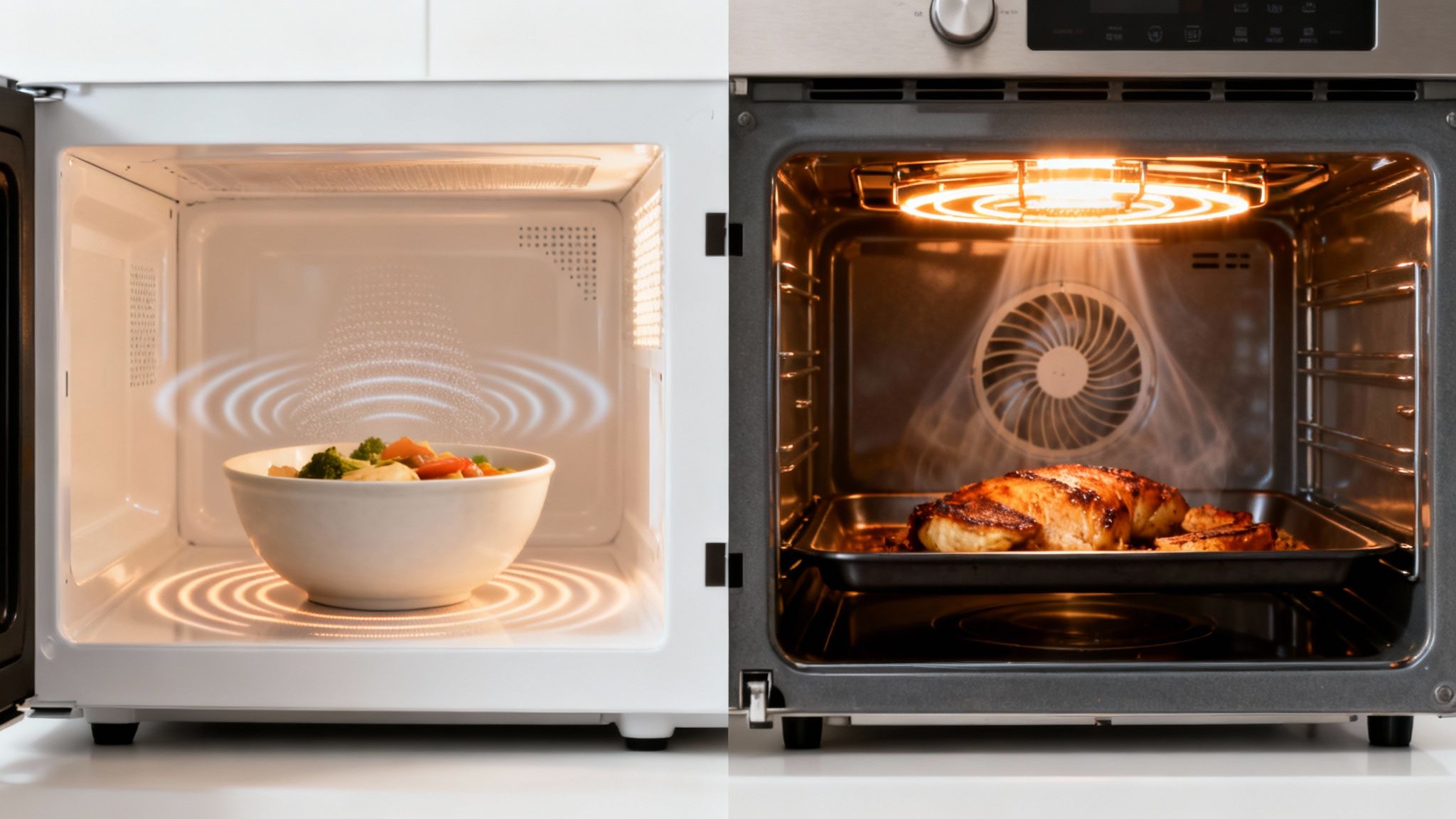
So, you’re trying to pick between a microwave and a convection oven? At its core, the choice often boils down to one simple trade-off: speed versus quality. A microwave is the undisputed champion of reheating last night’s takeout in minutes, while a convection oven is your go-to for achieving that perfect, golden-brown, evenly baked finish you’d expect from a traditional oven.
But what if you didn’t have to choose? In today’s kitchen, hybrid appliances are changing the game, and understanding the differences between these countertop powerhouses is key to finding the perfect fit for your cooking style.
Which Countertop Appliance Is Right for Your Kitchen?
Choosing the right appliance can feel like a bigger deal than it should. You’re not just buying a machine to heat your food; you’re investing in a kitchen partner that needs to fit your cooking style, your schedule, and the precious real estate on your countertop. The microwave vs. convection oven debate is a classic for a reason, but now there’s a third player in the game that’s shaking things up: the convection microwave.
This guide will cut through the noise and get straight to the differences that matter. We’ll look at how they work, what they cook best, and all the practical stuff that will help you decide. Whether you’re a busy professional grabbing meals on the go, a home baker obsessed with the perfect crumb, or someone who just wants one appliance that can do it all, you’re in the right place.
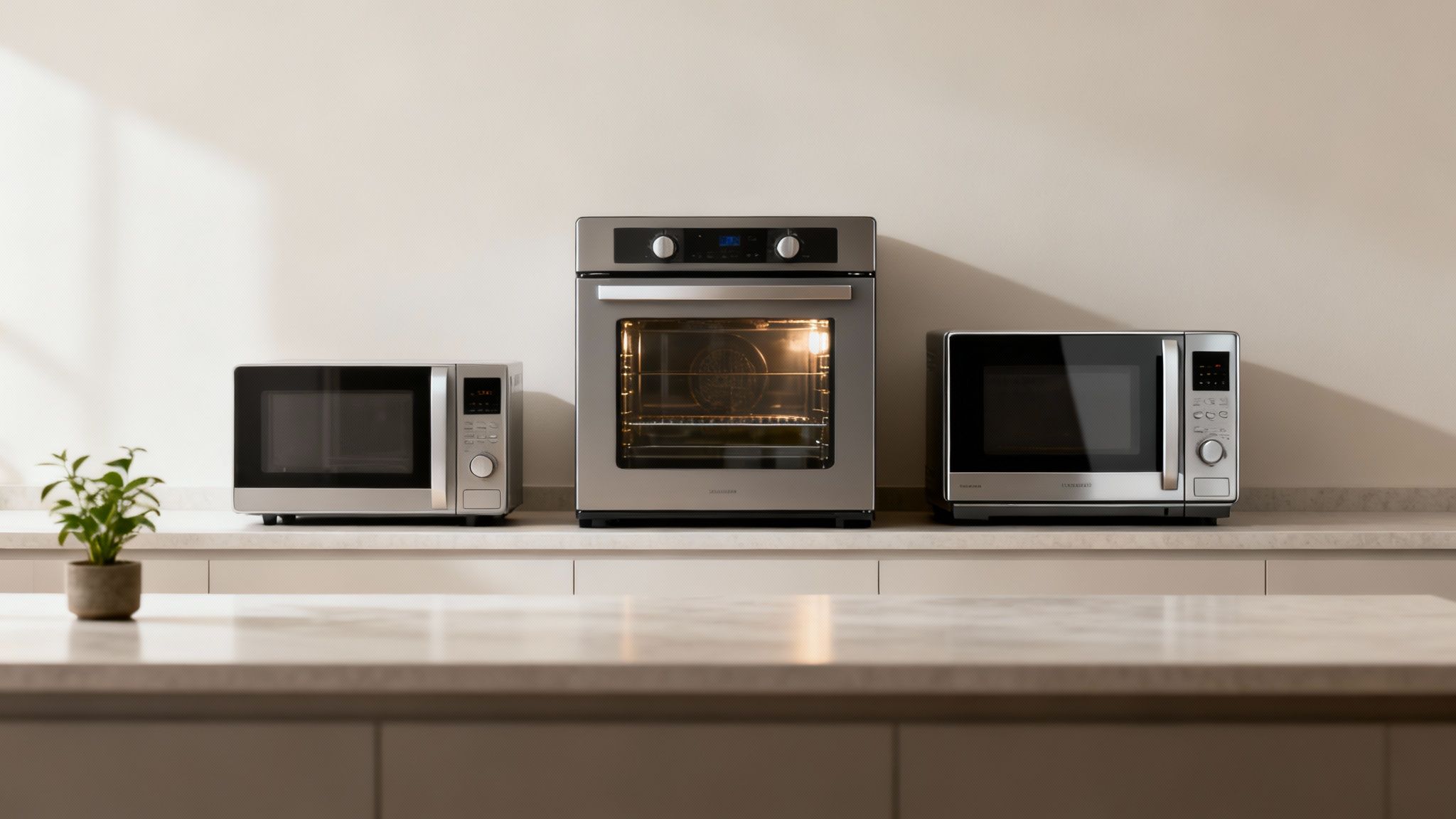
It’s no secret that the microwave is a fixture in most kitchens—in fact, a whopping 90% of American households own one. They’re practically indispensable. Lately, though, convection microwaves have been gaining serious traction, offering a hybrid magic that zaps food for speed while circulating hot air for that crispy, roasted finish. If you’re curious about the latest trends, you can read more about the growing microwave market to see how our cooking habits are shaping kitchen tech.
Quick Decision Guide: Microwave vs. Convection Oven at a Glance
Before we get into the nitty-gritty, let’s start with a high-level look at what sets these two appliances apart. Think of this as your cheat sheet for making a quick gut-check decision.
| Feature | Microwave Oven | Convection Oven |
|---|---|---|
| Primary Function | Heats food incredibly fast using electromagnetic waves. | Bakes, roasts, and browns food with circulated hot air. |
| Best For | Reheating leftovers, defrosting frozen items, steaming veggies, popcorn. | Baking cookies, roasting a chicken, getting pizza crispy, broiling. |
| Cooking Result | Quick and convenient, but can sometimes leave food soggy or rubbery. | Evenly cooked with a golden-brown finish and crispy textures. |
| Cookware | Only microwave-safe materials (glass, ceramic). Absolutely no metal. | Any oven-safe materials (metal, glass, ceramic). |
This table lays out the fundamental differences pretty clearly. A standard microwave is a master of convenience, built for speed above all else. A convection oven, on the other hand, is an artist, focused on perfecting texture and flavor. The right choice for you really hinges on what you need most in your day-to-day cooking routine.
Understanding How Each Appliance Cooks Food
To really get to the bottom of the microwave vs. convection oven debate, we need to look under the hood. While both boxes heat your food, the way they do it couldn’t be more different, leading to completely different results. Think of it like boiling a potato versus roasting it—both cook the potato, but the texture and flavor are in two different universes.
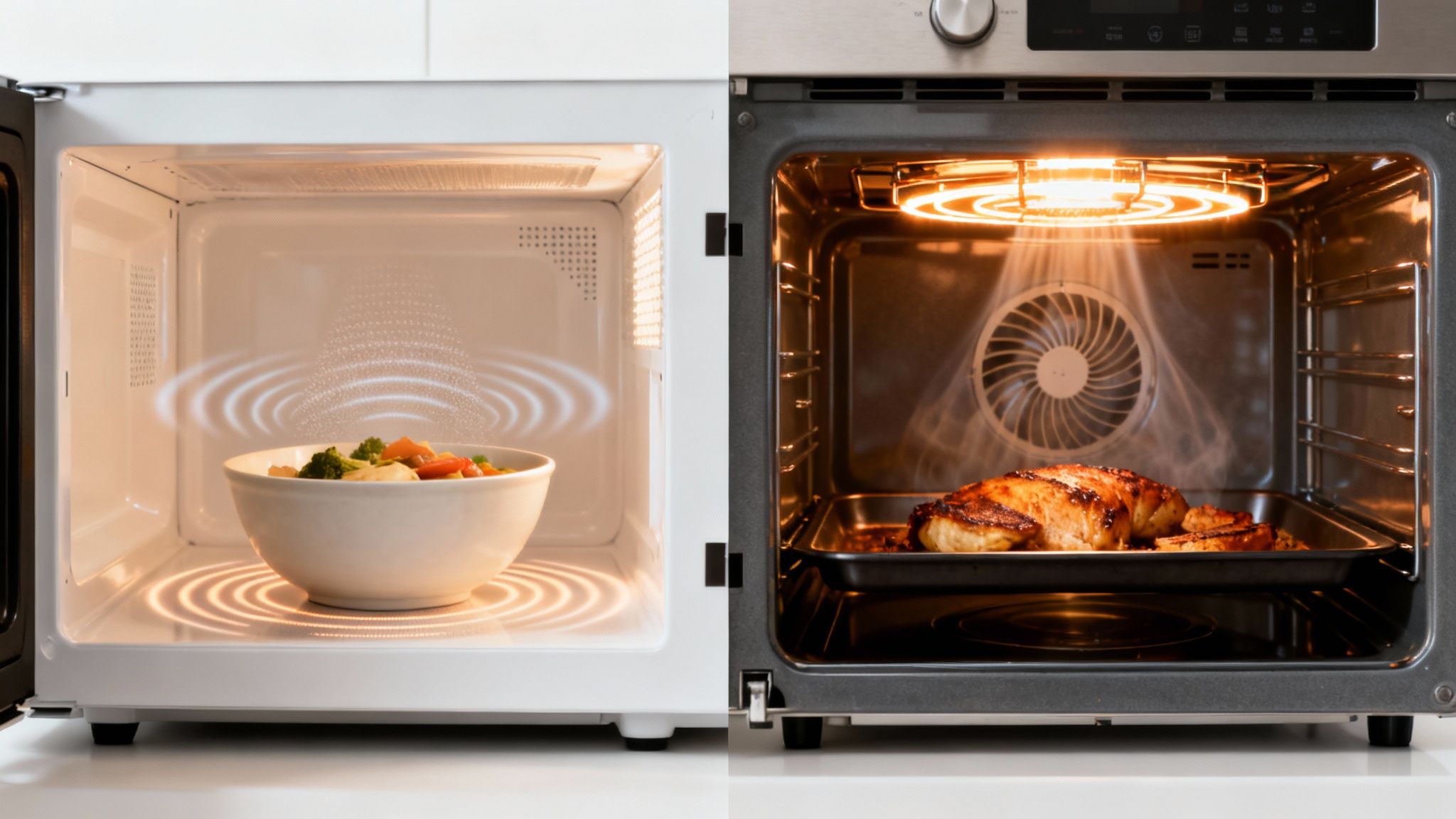
This fundamental difference in heating tech is exactly why one appliance is a speed demon for reheating leftovers, while the other is a master of getting things brown and crispy. Let’s break down what’s actually happening inside each one.
The Microwave Method: Exciting Molecules from Within
A microwave oven doesn’t use what we think of as “heat” at all. Instead, it generates high-frequency electromagnetic waves called microwaves.
These waves zip through your food and cause the water molecules inside to vibrate like crazy. All that friction creates intense heat, cooking the food from the inside out.
It’s an incredibly fast and efficient way to cook, which is why your leftovers are ready in just a couple of minutes. But this method has a major downside: it essentially steams your food. With no external dry heat, a microwave can’t create the chemical reactions needed for browning, crisping, or caramelizing.
This leads to some well-known microwave frustrations:
- No Browning: Food comes out cooked, but often pale and unappealing.
- Soggy Textures: Forget crisping up pizza or pastries; they usually turn soft and chewy.
- Uneven Cooking: You’ll often find “hot spots” where the microwaves were concentrated, leaving other parts of your food lukewarm.
A microwave’s greatest strength is also its biggest weakness. The internal heating that makes it so fast also prevents it from achieving the golden-brown crust and crispy texture that defines so many classic dishes.
The Convection Oven Method: A Whirlwind of Hot Air
A convection oven, on the other hand, works a lot like a traditional oven but with a game-changing upgrade: a fan.
This fan constantly blows hot air all around the oven cavity. So, instead of heat just radiating from stationary heating elements, your food is surrounded by a consistent, moving current of hot air.
This one simple change makes a massive difference in how food cooks. The constant air movement strips away the cooler pocket of air that naturally surrounds food, letting heat penetrate faster and more evenly.
This process, known as convection, is what delivers:
- Superior Browning: The dry, circulating air is perfect for the Maillard reaction, giving roasted meats and baked goods that beautiful, even golden-brown finish we all love.
- Crispier Textures: It’s fantastic at wicking moisture away from the surface of food, which means crispier chicken skin, perfectly roasted vegetables, and crunchy pizza crusts.
- Faster Cooking Times: Because it transfers heat so efficiently, a convection oven can cook food up to 25% faster than a regular oven at the same temperature.
- Even Results: The moving air gets rid of hot spots, so you can bake multiple trays of cookies at once and have them all come out perfectly uniform without needing to rotate the pans.
The main takeaway here is that convection cooking uses dry, moving heat to cook from the outside in. It’s definitely slower than microwaving, but it gives you far more control over the final texture and appearance of your food, making it the clear winner for baking, roasting, and broiling.
A Side-By-Side Performance Comparison
Moving from the technical specs to your actual kitchen counter, let’s get into how these appliances really perform day-to-day. This is where the difference between a microwave and a convection oven stops being theoretical and becomes something you can taste.
One is all about speed and convenience, getting food on the table in minutes. The other is a master of texture and flavor, turning out dishes with that perfect golden-brown finish. We’ll break down how they stack up on common kitchen tasks so you can see which one is the right tool for the jobs you do most.
Cooking Speed: Unsurprisingly, the Microwave Wins
When you’re staring down the barrel of a ticking clock, the microwave is in a class of its own. It zaps water molecules from the inside out, cooking or reheating food in a tiny fraction of the time it takes a convection oven.
- Reheating Leftovers: A plate of last night’s pasta is hot and ready in 2-3 minutes in a microwave. That same plate needs 15-20 minutes in a convection oven, and that’s after preheating.
- Defrosting: Need to thaw a pound of ground beef, like, now? A microwave’s defrost setting can get it done in under 10 minutes. A convection oven can technically do it, but it takes way longer and you risk cooking the outside while the inside is still frozen solid.
- Steaming Veggies: Microwaves are champs at steaming vegetables quickly. It’s so fast, in fact, that it often preserves more of those delicate, water-soluble vitamins than boiling.
But that incredible speed comes with a trade-off: texture. The rapid heating process often leaves food soggy, rubbery, or unevenly cooked—a far cry from crispy.
Food Texture and Browning: The Convection Oven’s Domain
For any dish where a golden-brown finish and crispy texture are the goal, the convection oven is the undisputed champion. It was literally designed for this.
For a golden-brown, crispy finish on roasted foods, a convection oven’s circulating air is unmatched.
That circulating hot air is what creates the Maillard reaction—the wonderful chemical process responsible for the delicious browning on everything from roasted chicken to freshly baked cookies. A microwave just can’t compete here.
To make this crystal clear, here’s a quick rundown of how each appliance handles common cooking jobs. This table really highlights the strengths and weaknesses of each.
Cooking Task Performance: Microwave vs. Convection Oven
| Cooking Task | Microwave Oven Performance | Convection Oven Performance | Best For |
|---|---|---|---|
| Roasting Chicken | Cooks the meat fast but leaves the skin pale and rubbery. A textural nightmare. | Creates a crispy, golden-brown skin while keeping the meat perfectly juicy and tender. | Convection Oven |
| Baking Cookies | Impossible. The dough will just melt into a hot, uneven, and sad puddle. | Bakes evenly, producing cookies with those perfect crisp edges and a chewy center. | Convection Oven |
| Reheating Pizza | Turns the crust soft and soggy. The cheese often gets tough and chewy. | Revives the crust to its original crispiness and melts the cheese like it just came out of the pizzeria’s oven. | Convection Oven |
| Heating Soup | Heats a bowl of soup to piping hot in under 3 minutes. Quick, easy, and efficient. | Takes significantly longer and you’ll need to make sure you’re using an oven-safe bowl. | Microwave Oven |
The difference is stark. While a microwave is a reheating specialist, a convection oven is a finishing artist, delivering far superior browning, crisping, and baking results. The technology is so effective that it’s often compared to other popular kitchen gadgets; our guide on air fryers vs convection ovens explores these subtle but important differences in greater detail.
The Rise of the Hybrid: The Convection Microwave
And now, this is where things get really interesting. The convection microwave is a hybrid that combines the lightning speed of microwave tech with the browning power of a convection fan. For anyone who wants the best of both worlds without buying two separate appliances, this is a powerful solution.
When you use the “combi-mode,” the appliance uses microwaves to cook food quickly from the inside while the convection element simultaneously browns and crisps the outside. This slashes cooking times for roasts and bakes. For instance, a whole chicken that takes over an hour in a traditional oven can be perfectly cooked and browned in just 30-40 minutes in a convection microwave.
Heat Distribution and Evenness
One of the biggest performance differences comes down to how evenly each appliance cooks. Microwaves have a reputation for creating “hot spots,” leaving some parts of your food scalding hot while other areas are still lukewarm. The rotating turntable is meant to fix this, but let’s be honest, it’s not a perfect system.
Convection ovens, on the other hand, are built for even cooking. The fan is the key—it circulates hot air throughout the entire oven, killing off hot spots and delivering consistent results every time. This is absolutely critical for baking, where even heat is the difference between a perfectly risen cake and a lopsided disaster.
Analyzing Cost, Energy Use, and Kitchen Space
Cooking performance is one thing, but the practical side of owning a new appliance is just as important. Your budget, the long-term energy costs, and the actual physical space you have in your kitchen are often the real deciding factors. These are the details that determine which appliance isn’t just better, but truly the right fit for your home.
The Initial Investment
Your upfront cost can swing pretty dramatically depending on what you choose. A simple, no-frills microwave is easily the most wallet-friendly option out there. It’s a perfect pick for students, a first apartment, or anyone who just needs a straightforward way to heat things up.
On the other hand, a dedicated countertop convection oven usually asks for a bigger investment, as these are built for more serious cooking. Sitting at the top end of the price range are the combination convection microwaves, which makes sense given they pack dual functionality and more complex tech into one box.
Long-Term Energy Consumption
Looking past the price tag, the energy bill tells the rest of the story. For quick jobs, microwaves are the undisputed champions of efficiency. They use far less energy to reheat last night’s leftovers than any kind of oven ever could.
But the tables turn when you’re cooking for longer. A convection oven might draw more power each minute, but its efficiency over time is impressive. By constantly circulating hot air, it can cook food up to 25% faster than a conventional oven, which often means it uses less total energy to prepare a full meal.
- Microwave: Extremely efficient for quick tasks like reheating, defrosting, or steaming vegetables.
- Convection Oven: Often more efficient for longer cooking jobs like baking or roasting because it gets the job done faster.
A microwave wins the energy battle for any task under five minutes. For anything longer, a convection oven’s speed can actually lead to lower energy use and a smaller electricity bill.
Kitchen Footprint and Installation
Finally, let’s talk space. In a small apartment or a kitchen already tight on counter space, every square inch is precious. A standard countertop microwave typically has a smaller footprint, making it the go-to for crowded kitchens.
Countertop convection ovens can be quite a bit bulkier, and if you opt for a built-in model, you’re looking at professional installation and dedicated cabinet space. For over-the-range models, proper ventilation isn’t just a nice-to-have; it’s critical for handling heat and cooking fumes. If you’re going that route, understanding the process of installing a proper vent hood is a must to keep your kitchen safe and comfortable.
Ultimately, you have to find the right balance between what you spend now, what you’ll save later, and the space you have to work with. A cheap microwave might save you money today, but if you’re an avid baker or roaster, a convection oven could provide much better value over time.
How to Choose the Right Appliance for Your Needs
Picking between a microwave, a convection oven, or a hybrid model isn’t just about features; it’s about figuring out which one actually fits your life. The right appliance for you really comes down to your cooking habits, how much kitchen space you have, and what your daily routine looks like. Let’s break down a few common scenarios to see which machine would serve you best.
This decision tree gives you a quick visual on how things like budget, space, and cooking priorities should guide your choice.
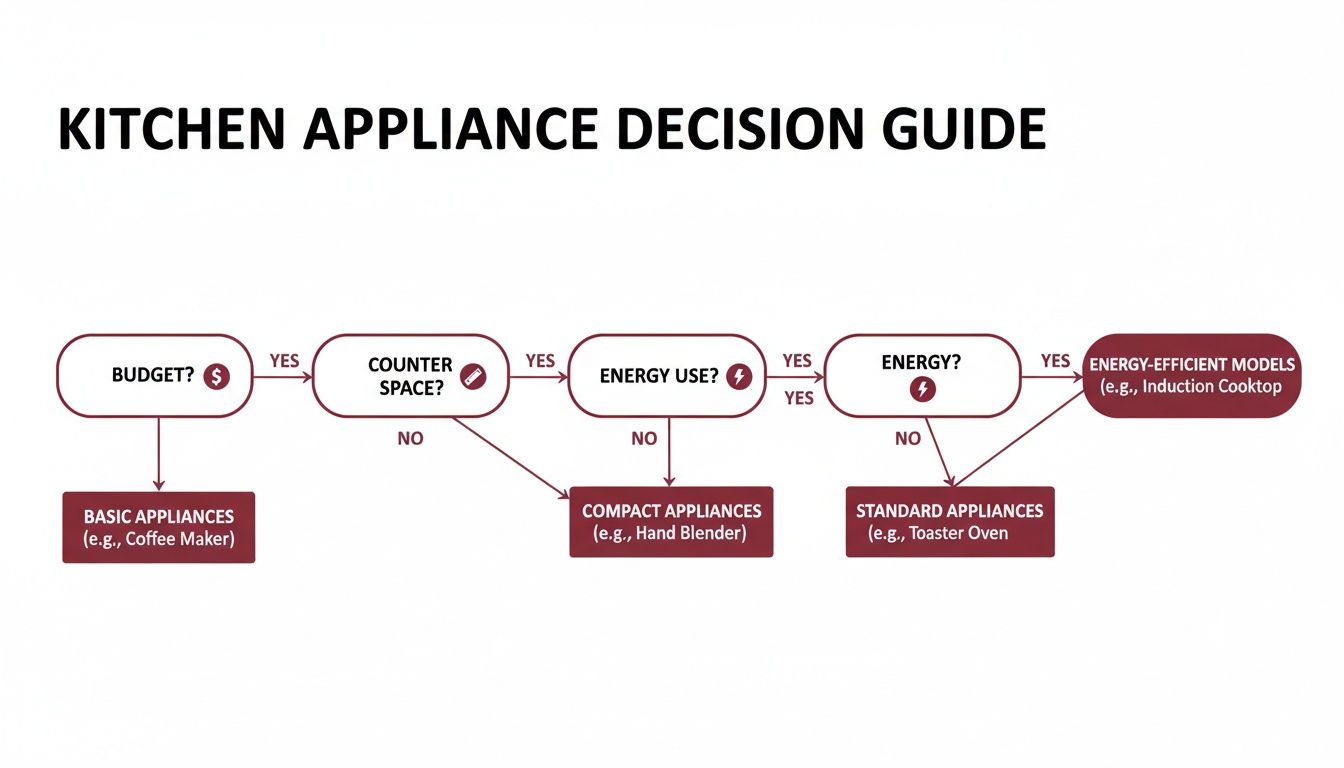
As you can see, if you just need something fast and simple on a tight budget, a standard microwave is the no-brainer. But if baking and roasting are your jam, you’re looking squarely at a convection model.
For the Busy Student or Young Professional
If your idea of “cooking” is reheating last night’s takeout, nuking popcorn for movie night, or defrosting a frozen burrito, a standard microwave is your undisputed champion. It’s built for speed and simplicity, which is exactly what you need when convenience is everything.
You care more about getting a meal on the table in under five minutes than you do about a gourmet finish. Counter space is probably precious, and you’re keeping a close eye on your budget. A simple, compact microwave hits all these points without adding any extra cost or complexity to your kitchen.
For the Passionate Home Baker and Roaster
Do you live for the smell of freshly baked bread? Is a perfectly roasted chicken your Sunday ritual? If that sounds like you, then a dedicated convection oven isn’t just a nice-to-have; it’s essential. That circulating hot air is the only way to get the even browning and crispy skin that separates good from great.
You prioritize the final result over pure speed. You don’t mind preheating the oven and waiting a bit longer for something truly delicious. A microwave just can’t create that beautiful browning—the Maillard reaction—that makes roasted and baked foods so good. For your kind of cooking, a convection oven is the only real choice.
For the Versatile Family Cook in a Compact Space
This is where things get interesting and the hybrid models really start to shine. If you’re in an apartment, dealing with a small kitchen, or just need a solid second oven for holiday cooking, the convection microwave is a brilliant solution. It gives you the best of both worlds in one machine.
You’re the type of cook who needs flexibility. One day you’re just reheating soup for a quick lunch (microwave mode), but the next you’re baking a small batch of muffins or roasting vegetables (convection mode). Even better, the combo-mode uses both technologies at once to roast a whole chicken in almost half the time, delivering both speed and a beautifully browned finish.
The convection microwave is the ultimate problem-solver for the modern kitchen. It bridges the gap between the speed of a microwave and the quality of an oven, making it ideal for anyone who refuses to compromise on function, even with limited space.
Choosing the right appliance is a big decision, and our comprehensive kitchen appliance buying guide has even more tips to help you feel confident in your choice.
Ultimately, the microwave vs. convection oven debate is settled by looking at what’s usually on your plate. If it’s mostly reheated leftovers, stick with a microwave. If it’s home-baked cookies and roasted meats, you need a convection oven. And if you want the freedom to do both without cluttering your counter, the convection microwave is your answer.
Still on the Fence? Let’s Clear Things Up.
Even after laying out all the features and performance specs, you probably still have a few questions floating around. That’s completely normal. Choosing a major kitchen appliance isn’t something you do every day, and getting straight answers can be the final nudge you need.
We’ve pulled together the most common questions people ask when they’re stuck between a microwave and a convection oven. Let’s get you the clarity you need to feel great about your choice.
Can a Convection Microwave Completely Replace a Regular Oven?
For a lot of homes, the answer is a big, confident yes. A good convection microwave can absolutely handle most of your daily baking, roasting, and browning without breaking a sweat. They’re a fantastic fit for smaller homes, apartments, or even as a second oven when the holidays get chaotic.
But let’s be real about the limitations. The biggest one is size. You’re not going to be roasting a 20-pound Thanksgiving turkey in there, nor will you be able to bake three trays of cookies at once like you could in a full-sized oven. And for the serious bakers out there, some purists feel that a dedicated oven offers slightly more stable and consistent heat for really delicate pastries.
The bottom line? It’s a stellar replacement for daily cooking and smaller households, but it might not fully satisfy the needs of someone who hosts large gatherings or does professional-level baking.
What Kind of Cookware Can I Actually Use?
This is a critical one, because using the wrong pan can seriously damage your appliance. The rules change depending on which mode you’re using, so pay close attention here.
- Standalone Convection Oven: Simple. Treat it just like your big oven. Any oven-safe cookware is fair game—metal, glass, ceramic, you name it.
- Convection Microwave (the hybrid): This is where you need to be mindful.
- Convection-Only Mode: Use oven-safe materials like metal baking sheets or glass dishes. Just keep plastics out of there.
- Microwave or Combo Mode: This is a strict no-metal zone. Stick to microwave-safe materials only, like glass, ceramic, or certain plastics made for microwave use.
Most hybrid models will come with a metal rack meant for convection cooking and a glass turntable for microwaving. Always swap them out for the right mode to stay safe and get the best results.
Is a Convection Oven Healthier Than a Microwave?
Honestly, neither one is inherently “healthier” than the other. The healthiness of your food comes down to what you’re cooking and how you’re preparing it. Each appliance just has different strengths.
Microwaves cook incredibly fast, which can be a good thing for preserving heat-sensitive nutrients in vegetables. For instance, steaming broccoli in a microwave often holds onto more Vitamin C than boiling it on the stove does.
Convection ovens, on the other hand, use dry, circulating heat that’s perfect for roasting and baking. This method lets fat drip away from meats and helps you get a crispy texture without having to deep-fry anything. That old myth about microwaves “nuking” all the nutrients out of your food has been thoroughly debunked by scientists.
How Does Cleaning Differ Between Models?
This is a practical detail that really matters in your daily life. A standard microwave is usually the easiest to clean. The old trick of heating a bowl of water with lemon juice for a few minutes still works like a charm—the steam loosens up all the gunk, making it easy to wipe away.
A convection oven or a convection microwave, however, is a bit more work. Since they use high, dry heat, food splatters can get baked right onto the interior walls, fan, and heating elements, just like in a traditional oven. You’ll need to be more diligent about cleaning it with proper oven cleaners to keep grease and grime from building up. To make life easier, many newer convection models come with stainless steel interiors or even specialized self-cleaning cycles.
At Reva Housing, we write in-depth, conversational guides to help you make smarter decisions for your home. You can find more of our expert reviews and comparisons at https://revahousing.com.
