



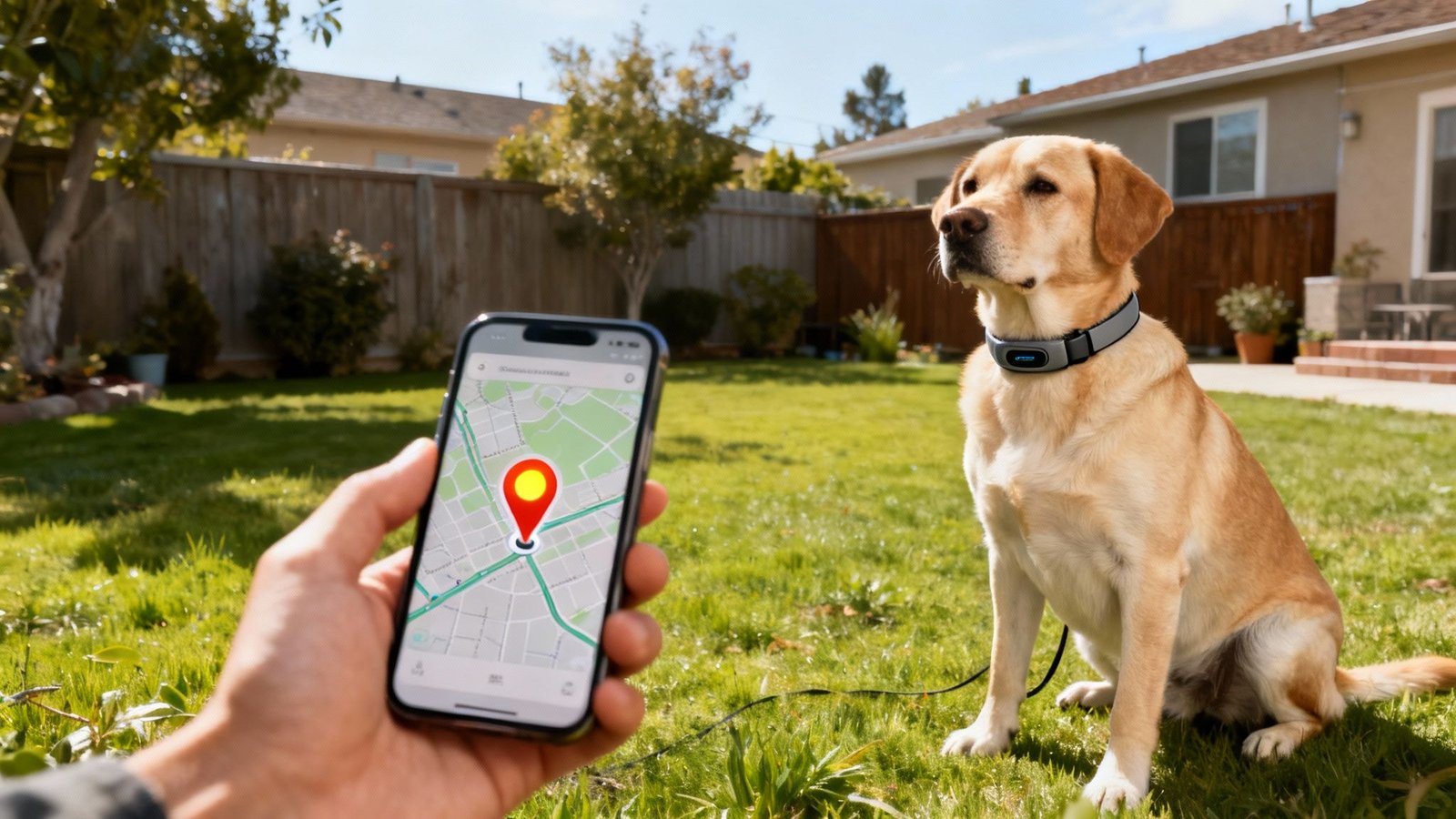
Losing a pet is a nightmare scenario for any owner. When it comes to finding the best GPS pet tracker, it all boils down to one make-or-break feature: real-time, unlimited range tracking. This is where market leaders like Tractive and Fi shine, using a mix of GPS and cellular networks to make sure you can find your pet whether they’ve slipped out the back gate or wandered miles from home.
Keeping Your Pet Safe with GPS Tracking
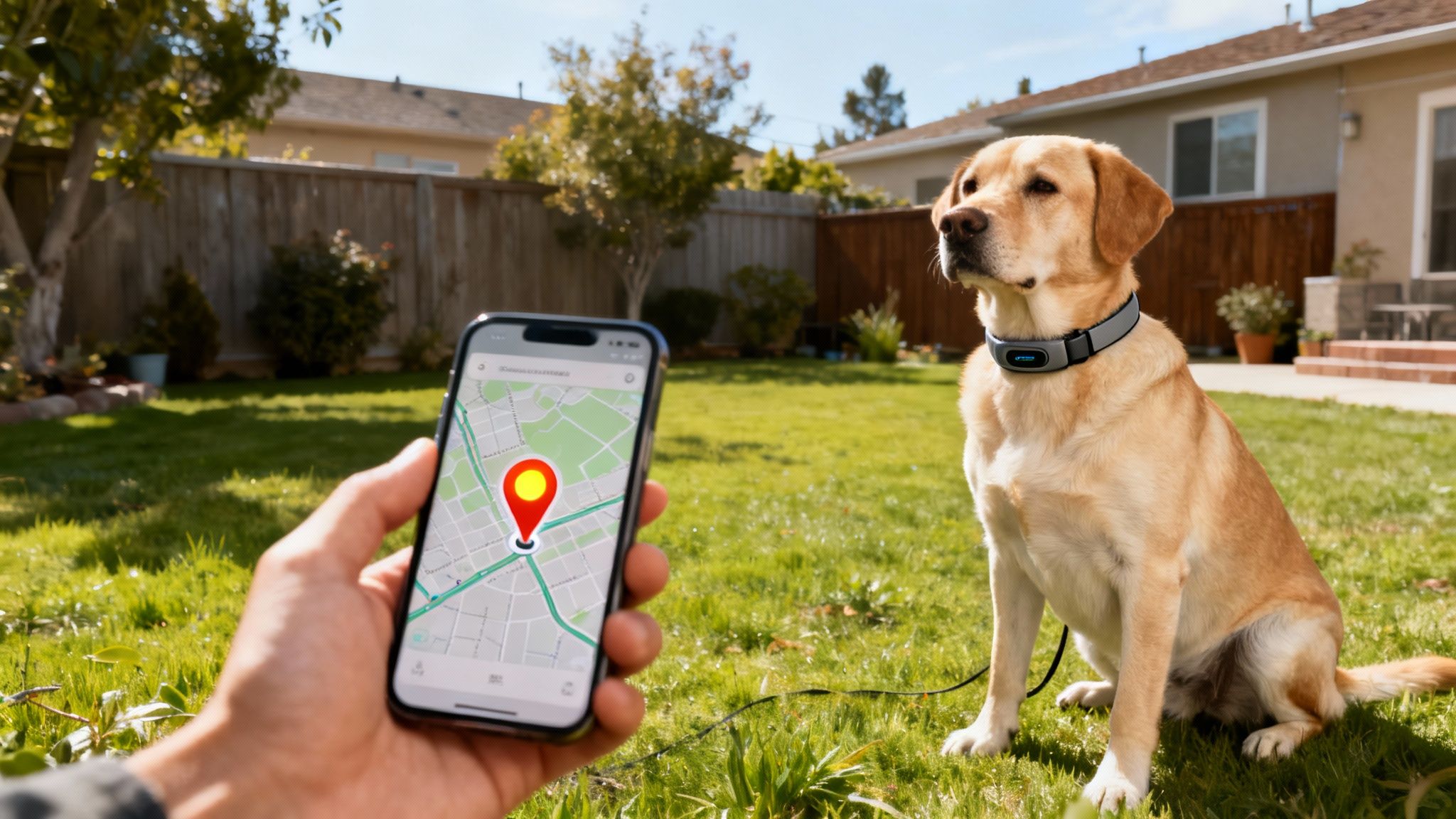
We’ve all felt that jolt of panic when a pet goes missing. Maybe it’s a dog who sees an open gate as an invitation for adventure or a cat who misjudges the journey home. Those moments of not knowing are agonizing. Thankfully, today’s technology gives us a powerful tool, turning your smartphone into a direct lifeline to your furry best friend.
A GPS pet tracker is a small, tough little device that clips onto your pet’s collar. It sends their real-time location straight to an app on your phone. Think of it as active tracking, not passive. A microchip is great, but it only works if someone finds your pet and takes them to a vet to be scanned. A GPS tracker, on the other hand, helps you be the one to find them, often within minutes.
How These Trackers Actually Bring Peace of Mind
These gadgets are a clever blend of a few different technologies working together to give you accurate, reliable location info. At its heart is the Global Positioning System (GPS), which talks to satellites to figure out your pet’s exact coordinates. But that’s only half the battle.
To get that location from the tracker to your phone, it needs a cellular connection—just like your phone does. This is why almost all the top-tier GPS trackers require a small monthly subscription; it covers the cost of the built-in SIM card and the data it uses. That cellular link is what gives you a virtually unlimited range, so you can track your pet from anywhere you have cell service.
Many of the more advanced trackers also layer in other tech to make them even better:
- Wi-Fi Positioning: When your pet is chilling near a familiar Wi-Fi network (like your home), the tracker can use that signal to save a ton of battery and confirm they’re in a designated “safe zone.”
- Bluetooth Proximity: For those moments when your pet is hiding somewhere inside the house, some trackers use Bluetooth to help you pinpoint their location when a GPS signal can’t reach them.
Ultimately, getting a GPS tracker is about more than just a cool piece of tech; it’s about buying a little security and a lot of peace of mind. For more tips on keeping your furry friends safe and sound, take a look at our guides on modern pet care. This guide will walk you through everything you need to know to choose the perfect device for your adventurous dog, curious cat, or four-legged escape artist.
Decoding Pet Tracker Technology
Not all pet trackers are created equal. Far from it. The technology packed inside that little device on your pet’s collar is the single biggest factor that determines how well it works, how far it reaches, and whether you can actually rely on it in a panic. Getting a handle on the core systems is the first step to finding the right fit for you and your pet.
At the heart of it all are three main technologies: GPS with Cellular, Radio Frequency (RF), and Bluetooth. Each one operates in a fundamentally different way, and that’s why you see such a huge variety in price, performance, and features. Understanding these differences will make it crystal clear why some trackers need a subscription and others don’t, and why one might be perfect for a country dog while another is better suited for an indoor cat.
GPS with a Cellular Connection
This is the gold standard for real-time, long-distance tracking. It’s the setup you want when “lost” could mean anywhere. A tracker like this first pinpoints its location by talking to the GPS satellites orbiting the Earth. Then, it uses a built-in SIM card and a cellular network—just like your phone—to zap those coordinates straight to an app on your screen.
- Best For: Tracking a pet over any distance, whether they’re just down the block or clear across town.
- Key Feature: The range is virtually unlimited, as long as there’s a cell signal.
- Trade-off: You’ll need a monthly or annual subscription fee to cover the cost of that cellular data.
This is the tech that makes true “find my pet anywhere” tracking possible. For owners of escape artists or dogs who love off-leash adventures where they could cover a lot of ground fast, this is pretty much essential.
Radio Frequency (RF) and Bluetooth Trackers
Unlike their GPS cousins, these trackers don’t use satellites or cell towers. Instead, they rely on local signals to create a direct link between the tag on your pet’s collar and a handheld device or your smartphone.
Radio Frequency (RF) Trackers work like a high-tech game of “hot and cold.” You hold a handset that directs you toward your pet, and the lights or sounds get more intense as you get closer. They are fantastic for pinpointing a pet who’s hiding somewhere nearby.
The big upside to RF and Bluetooth trackers is their pinpoint accuracy at close range and the fact that you don’t have to pay any monthly fees. The downside? Their range is seriously limited—usually just a few hundred feet—which makes them useless for a pet that has truly bolted.
Bluetooth Trackers (think Tile or AirTag) work on a similar principle but with an even shorter range, often less than 100 meters. They’re really only good for finding a pet hiding inside the house or maybe somewhere in your immediate backyard. Their effectiveness lives and dies within that very small Bluetooth bubble.
As the technology gets better, more and more pet owners are jumping on board. The broader pet wearable market is seeing GPS-enabled devices grow at an impressive clip. For a closer look at the latest innovations hitting the market, check out our coverage of new pet gadgets.
How We Tell the Good from the Gimmicks
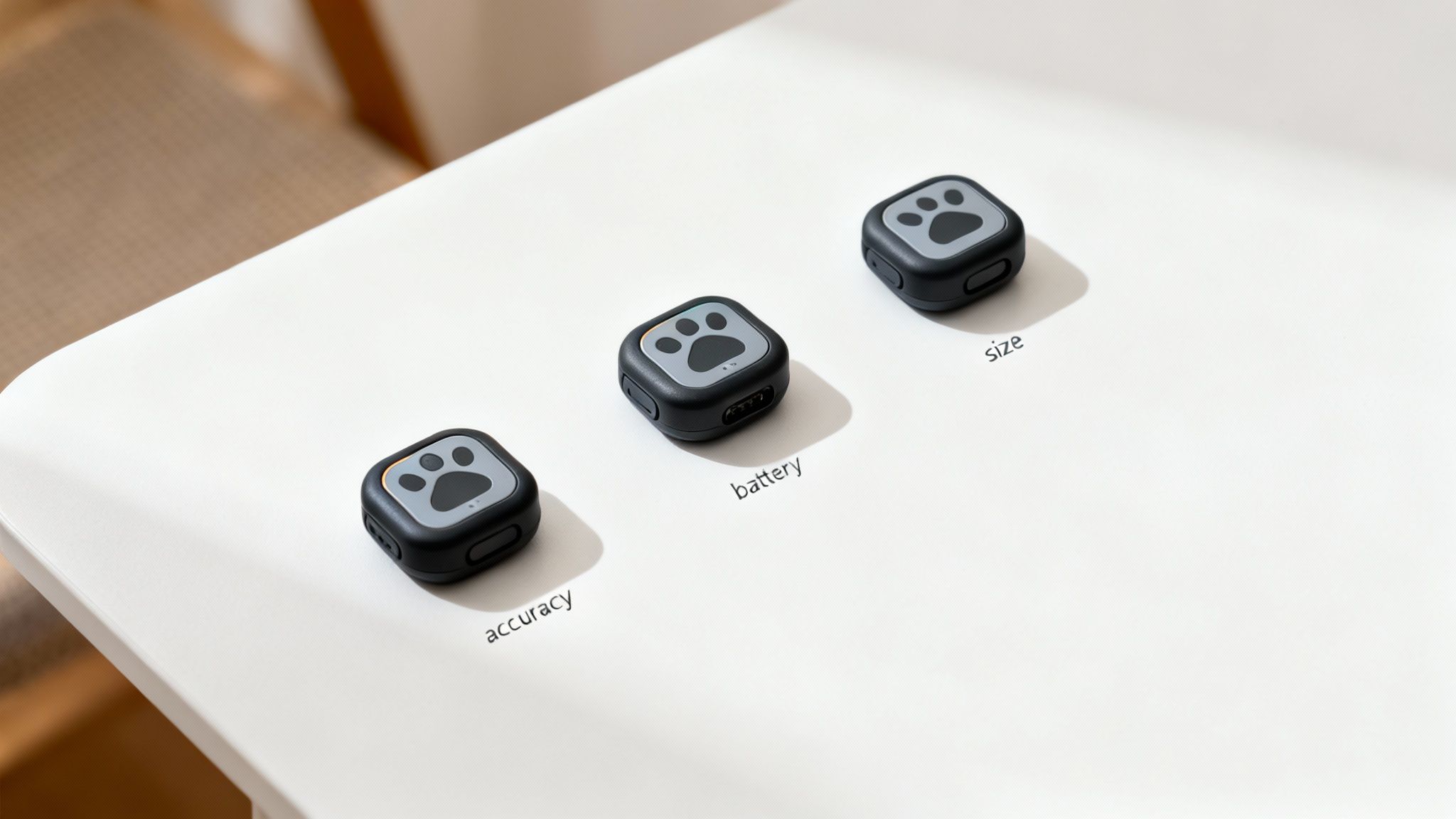
Choosing a GPS pet tracker isn’t just about comparing spec sheets. When your pet’s safety is on the line, you need to know a device will actually deliver in a real-world panic. That’s why we don’t just read the box—we put every tracker through a demanding, hands-on evaluation process. Our framework is built on seven pillars that truly matter.
This structured approach is how we separate genuinely life-saving gadgets from the ones that just look good online. The pet tech market is exploding, with some analysts predicting it could hit over $49 billion by 2035. That means a flood of new options is coming, making it even harder to cut through the noise. Our goal is to give you a clear, honest framework so you can analyze our top picks—and any other tracker—with total confidence. For a closer look at these trends, you can explore more about these market trends and future projections.
Real-World Location Accuracy
A tracker’s number one job is telling you exactly where your pet is, and “sort of close” is the same as “lost.” We test accuracy in all kinds of places: dense cities with tall buildings that block signals, sprawling suburbs with spotty cell coverage, and wide-open rural parks. We’re looking at how fast the tracker gets a signal lock and, more importantly, how precise its live tracking is when a pet is actually moving.
True Battery Endurance
A dead tracker is just a useless piece of plastic on a collar. We all know manufacturers’ battery claims are made under perfect, power-saving lab conditions. So, we test how long the battery really lasts with normal, everyday use. That means frequent live tracking sessions, geofence alerts for leaving and entering “safe zones,” and daily activity monitoring. This gives you a realistic idea of how often you’ll actually be reaching for the charger.
A tracker’s battery life is always a trade-off. More frequent location updates and live tracking drain power fast. Power-saving modes can stretch it for days, but you get less real-time data. We focus on finding that perfect balance between safety and convenience.
Pet-Friendly Size and Weight
Comfort is everything. A tracker can have all the features in the world, but if it’s too big or heavy, your pet simply won’t wear it. We evaluate each device’s physical footprint and recommend specific models for different sizes—from a tiny 5-pound Chihuahua to a massive 100-pound Great Dane. A good tracker should be so light your pet doesn’t even know it’s there.
Durability and Waterproofing
Let’s be honest, pets are tough on their gear. A tracker has to survive everything from a plunge in a lake to a roll in the mud or a smack against a fence post. We check the official IP (Ingress Protection) waterproof ratings and physically assess the build quality for ruggedness. A tracker designed for a mud-loving Labrador needs to be way more durable than one for an indoor cat who only wanders onto the patio.
Subscription Plan Value
Most genuine GPS trackers need a subscription to cover the cellular data they use to send location updates. We dig into these plans, looking beyond just the monthly price to see what you actually get for your money.
- Coverage Area: Does it rely on a single cellular network, or does it switch between several for better reliability?
- Update Speed: Do you have to pay more for faster location updates in an emergency?
- Feature Access: Are critical tools like location history or sharing access with family members hidden behind a premium paywall?
App Intuitiveness and Alerts
Even the best hardware can be ruined by a confusing, clunky app. We spend a lot of time in each tracker’s companion app to see how easy it is to use. How simple is it to draw a virtual fence? Are the escape alerts instant and easy to understand? The user experience during that heart-stopping “my pet is missing” moment is a huge part of our testing.
Health and Activity Monitoring
While location is the main event, many trackers now double as wellness monitors. We look at the accuracy of their step counts, calorie burn estimates, and sleep tracking. But more importantly, we ask: is this data actually useful for an average pet owner? Does it provide insights you can act on to improve your pet’s health, or is it just another set of numbers?
A Detailed Comparison of Top Pet Trackers
Alright, let’s get into the real-world stuff—pitting the top GPS trackers against each other in situations every pet owner understands. Instead of just rattling off a list of features, we’re going to look at models from Tractive, Fi, and Whistle through the lens of specific, everyday needs. This way, you can see which device actually wins when it matters most for you.
It’s no surprise that reliable pet tracking is becoming a must-have. The global pet GPS tracker market is exploding, which tells you just how much owners value this peace of mind. Analysts expect significant growth in the coming years as innovators like Tractive, Fi, Whistle GO, and Jiobit constantly raise the bar. If you’re curious about the numbers, you can discover the full market analysis on FactMr.com.
The Off-Leash Adventurer Scenario
Picture this: you have a high-energy dog—a Vizsla, a Husky, you name it—who’s your hiking partner in remote areas where cell service is sketchy at best. For this “Off-Leash Adventurer,” only two things truly matter: extreme battery life and rugged durability. This narrows the field pretty quickly to two main players: the Fi Series 3 and the Tractive DOG XL Adventure Edition.
Fi Series 3 really made a name for itself with its insane battery performance. Its biggest selling point is how cleverly it saves power. When your dog is chilling at home on its base or your Wi-Fi, the collar goes into a low-power mode, letting it last for weeks, sometimes even months, without a charge. That’s a huge win for anyone who hates adding another device to their nightly charging routine. But the real test is how it holds up on an actual adventure. Once it’s relying purely on GPS and the AT&T cellular network, that battery life starts to drop much faster.
The Tractive DOG XL Adventure Edition, however, was built from the ground up for exactly this scenario. It has a bigger, beefier battery made for long stretches outdoors, giving you up to a month of tracking under normal use. But its real secret weapon is the fiberglass-enclosed casing. It’s exceptionally tough and built to withstand bites, scratches, and bumps. While the Fi is certainly durable, the Tractive Adventure just feels like it was made for the wild.
Key Takeaway: For the true off-grid explorer, Tractive’s DOG XL Adventure Edition usually comes out on top thanks to its bomb-proof build and a battery that’s optimized for constant tracking away from home. Fi is a fantastic choice for dogs who are mostly homebodies but enjoy the occasional weekend adventure, as it makes the most of its incredible power-saving tech.
The Neighborhood Wanderer Scenario
Now, let’s switch gears. Think about a different kind of pet—a curious cat or a small dog who’s a known escape artist in a crowded suburb. For this “Neighborhood Wanderer,” the game is all about the speed of safe zone alerts and pinpoint accuracy in residential areas. Here, the top contenders are the Whistle Health & GPS+ and the standard Tractive GPS tracker.
The Whistle Health & GPS+ is a standout for its proactive health monitoring, all powered by its clever AI. But its core tracking is solid, too. It uses the AT&T network and Google Maps to deliver dependable location data. Its alert system is generally quick, usually pinging you within a minute or two of a breakout, which is absolutely critical when every second counts.
The design emphasizes a secure attachment mechanism, ensuring the tracker stays put during active play.
Tractive GPS, on the other hand, is a master of speed and precision. Its killer feature is the LIVE Tracking mode, which updates your pet’s location every 2–3 seconds. When you’re in a full-blown panic, this near-instant feedback is a lifesaver. You’re not seeing where your pet was a minute ago; you’re seeing where they are right now. That rapid refresh rate can be the difference-maker when a pet is darting between houses or heading toward a busy street.
And for those interested in smart pet technology that goes beyond just tracking, our deep dive into Petkit offers a look at where innovation meets pet care, exploring everything from automated feeders to health monitors.
Head-to-Head GPS Pet Tracker Comparison
To make the decision a bit easier, I’ve put together a table that breaks down the key specs of the top trackers. Think of it as a cheat sheet for comparing how each one stacks up on the metrics that matter most, from battery and size to the real cost of ownership.
| Feature | Tractive GPS | Fi Series 3 | Whistle Health & GPS+ | Jiobit Smart Tag |
|---|---|---|---|---|
| Best For | Extreme Adventures, Escape Artists | Long Battery Life, Homebodies | Neighborhood Safety, Health Data | Small Pets, Ultimate Discretion |
| Typical Battery Life | 7-30 days (depending on usage) | 2 weeks to 3 months | 5-15 days | 7-20 days |
| Size & Weight | 1.2 oz (Std) / 3.5 oz (XL) | 1.0 oz (module) | 1.1 oz | 0.8 oz |
| Waterproof Rating | IPX7 (Fully waterproof) | IP68 (Waterproof/dustproof) | IPX8 (Fully waterproof) | IPX8 (Fully waterproof) |
| Subscription Cost | Starts at ~$5/month (paid upfront) | Starts at ~$8/month (paid upfront) | Starts at ~$8/month (paid upfront) | Starts at ~$9/month (paid upfront) |
| Key Differentiator | 2-3 second LIVE updates | Smart power-saving modes | AI-powered health insights | Tiny, lightweight design |
Ultimately, the right tracker isn’t just about the tech specs—it’s about matching the device’s strengths to your pet’s personality and your lifestyle. Whether you need a rugged companion for the mountains or a lightning-fast alert system for your neighborhood escape artist, one of these is bound to be the perfect fit.
Our Top Picks for Every Pet Owner
Alright, after putting these trackers through their paces and comparing them head-to-head, we’ve made our final calls. This is where we cut through the noise and name the best GPS pet tracker for specific, real-world situations. Think of it as moving from research mode to making a confident decision.
We’re breaking our recommendations down into four distinct categories. This way, you can zero in on the perfect match, whether you need raw tracking power, something tiny for a small companion, epic battery life, or just the best bang for your buck.
This decision tree helps visualize which tracker might be right for your pet’s lifestyle, whether they’re a homebody or an adventurer.
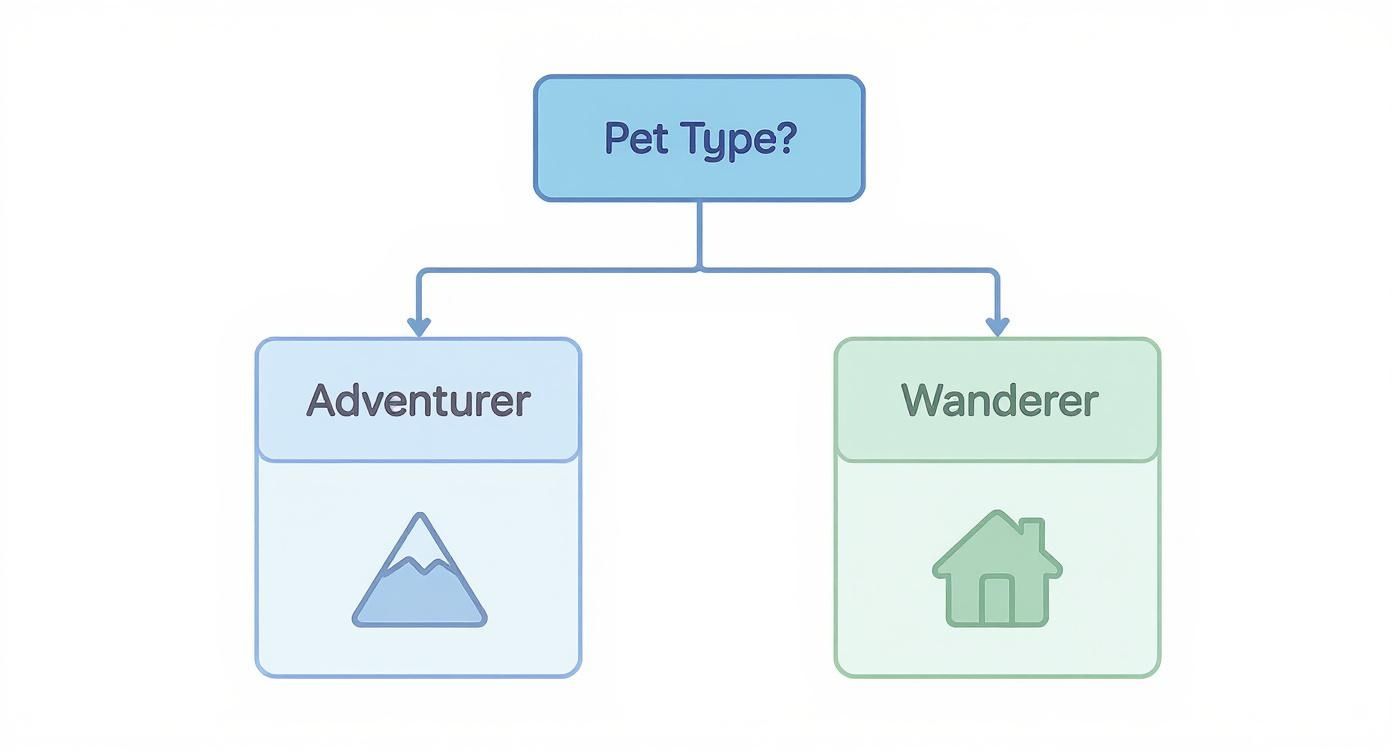
The biggest takeaway here? Your choice should hinge on your pet’s typical behavior. An adventurous dog who bolts has very different needs from a cat who occasionally wanders next door.
Best Overall Performance: Tractive GPS
When it comes to pure, reliable tracking performance, Tractive consistently comes out on top. Its crown jewel is the LIVE Tracking mode, which pings your pet’s location every 2–3 seconds. In a real escape scenario, that near-instant feedback is priceless and delivers a level of precision few others can touch.
The device itself is rugged, completely waterproof with an IPX7 rating, and the app is incredibly intuitive. From setting up virtual fences to sharing access with family members in an emergency, every feature feels like it was designed by someone who’s actually been in that stressful situation. For the pet owner who wants the most dependable, real-time tracking money can buy, Tractive is the clear winner.
Best for Small Pets: Jiobit Smart Tag
For cats and toy-breed dogs, size and weight are everything. The Jiobit Smart Tag absolutely nails this, weighing a feather-light 0.8 ounces. It’s so small that even the tiniest pets will barely notice it’s there—a massive advantage for comfort and ensuring they actually wear it consistently.
Don’t let its tiny size fool you, though. The Jiobit packs a serious technological punch, using a blend of GPS, cellular, Wi-Fi, and Bluetooth to deliver accurate location data while smartly preserving battery life. Its durability and IPX8 waterproof rating also mean it’s tough enough to survive the shenanigans of a curious cat or a playful pint-sized pup.
For owners of pets under 10 pounds, the Jiobit Smart Tag is the undisputed champion. It solves the biggest challenge in this category: finding a tracker that’s effective without being bulky or intrusive.
Best for Long-Lasting Battery: Fi Series 3
The Fi Series 3 collar is an engineering marvel when it comes to power management. If you’re a pet owner who dreads the thought of daily charging, this is your solution. By intelligently switching between GPS, your home Wi-Fi, and its charging base, the Fi can last for weeks—sometimes even months—on a single charge.
This makes it perfect for dogs who spend most of their time at home but need rock-solid tracking for walks and the occasional adventure. The collar itself is durable and well-designed, making it a seamless part of your dog’s daily gear. While its most impressive battery performance happens in familiar Wi-Fi zones, it still holds its own during active tracking sessions away from home.
Best Value Tracker: Whistle Health & GPS+
For pet owners looking for that perfect balance of great features and affordability, the Whistle Health & GPS+ hits the sweet spot. It provides dependable real-time GPS tracking powered by the AT&T network and Google Maps, along with prompt escape alerts that are critical for neighborhood wanderers.
But what really sets the Whistle apart at this price is its robust health and activity monitoring. It tracks metrics like licking, scratching, and sleep quality, serving up AI-powered insights that can give you a heads-up about potential health issues. This combination of reliable safety features and proactive wellness monitoring makes it the best overall value on the market, hands down.
Setting Up Your Pet Tracker for Success
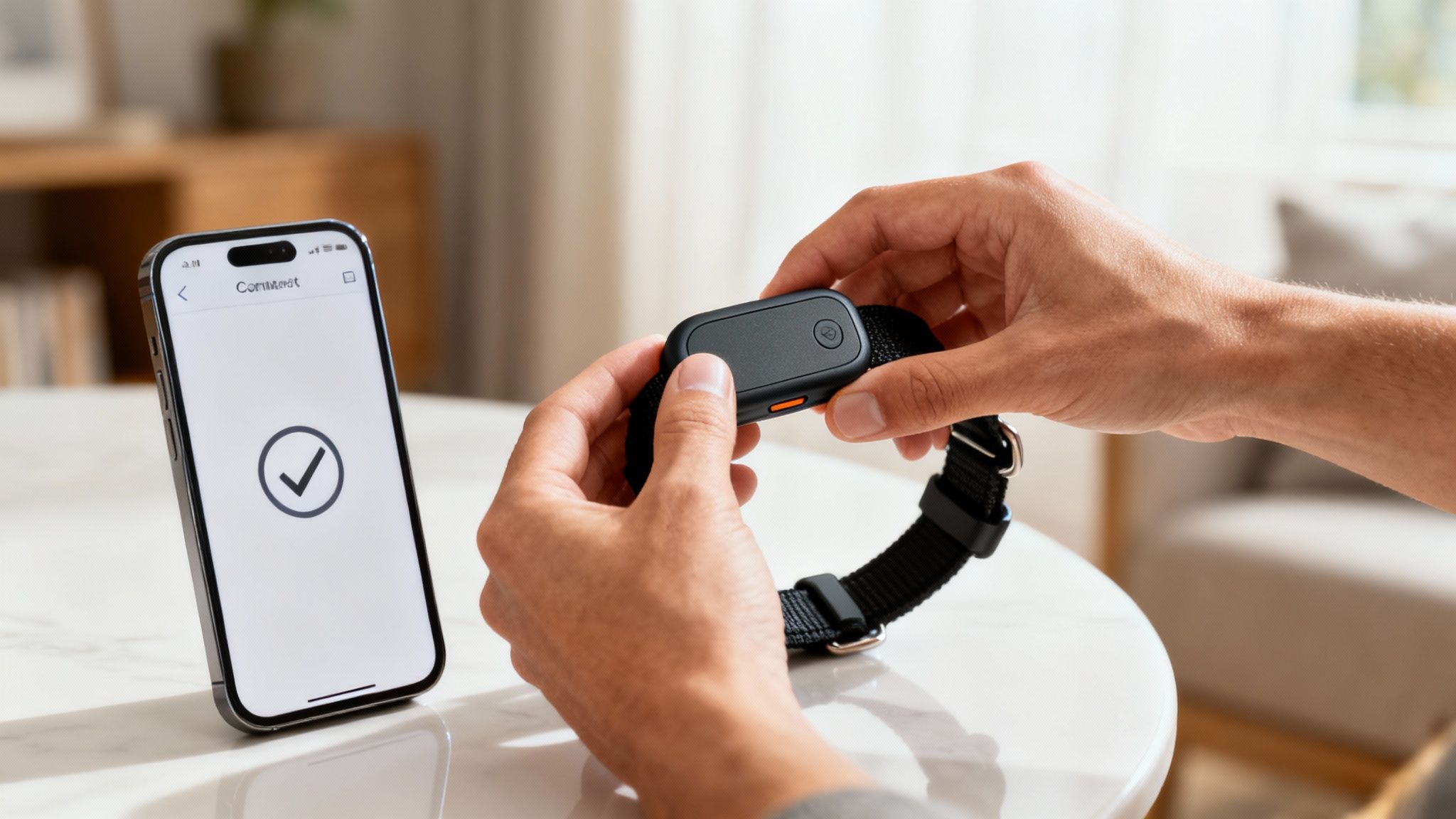
Unboxing a new gadget is always fun, but the real peace of mind with a pet tracker comes from setting it up right. Spending a few extra minutes on the initial setup can make all the difference, turning it into a reliable lifeline when you need it most. The process is pretty straightforward and breaks down into three main stages: activation, configuration, and a little bit of ongoing care.
First things first: charge the device fully before you do anything else. Once it has a full battery, grab your phone, download the companion app, and follow the prompts to create an account. You’ll usually need to enter a serial number from the device and pick a subscription plan to get it activated.
Initial Configuration and Collar Attachment
With the tracker activated, it’s time to get it on your pet. Attaching it securely to their collar or harness is key—it should be snug enough that it doesn’t dangle or get snagged on a branch, but loose enough to be comfortable. Most trackers come with a sturdy rubber or plastic clip that makes this easy.
Next, open up the app and start customizing the settings. This is where you turn a simple tracking device into a smart safety system tailored for your pet.
- Establish Safe Zones: Your first move should be creating a virtual fence (or geofence) around your home and yard. This teaches the tracker what you consider a “safe” area.
- Customize Notifications: Dial in your alert settings. You want to be notified the second your pet leaves a safe zone, whether that’s through a push notification, text, or email.
- Share Access: If you have family members or a pet sitter who helps out, add them to your account. This gives them the ability to see your pet’s location and get alerts, which is a lifesaver if you’re ever away.
Honestly, setting up the virtual fences properly is the most important thing you’ll do. An immediate escape alert is your first line of defense, often giving you the chance to find your pet before they’ve wandered too far off.
Long-Term Care and Maintenance
A little ongoing maintenance will ensure your tracker is always ready to go in an emergency. Battery health is the big one. Try to avoid letting the battery drain completely to 0%, as this can shorten its overall lifespan. A good habit is to recharge it once it drops to around 20%.
Finally, keep the device itself clean. If your pet is a fan of mud puddles or swimming, give the tracker and its charging contacts a regular wipe-down with a damp cloth. This helps maintain the waterproof seal and ensures it charges properly every time, keeping your tracker in top shape for years to come.
Common Questions About GPS Pet Trackers
If you’re digging into the world of GPS pet trackers, you’ve probably got a few questions. It’s totally normal. We hear the same ones from pet owners all the time, so we’ve gathered them here to give you some clear, straight-up answers. Think of this as your final check-in before you feel 100% confident in your choice.
Do I Really Need a Subscription?
For any tracker that gives you real-time location updates from anywhere, the answer is a simple yes. That subscription pays for the built-in SIM card that connects to cellular towers, which is how the tracker sends its location to your phone.
Any tracker that doesn’t require a subscription is almost certainly a Bluetooth or Radio Frequency (RF) device. Those are fine for finding a cat hiding under the porch, but they’re useless if your dog has actually bolted and is three blocks away.
Just How Accurate Are These Things?
Out in the open, a good GPS tracker will get you within 15–30 feet (5–10 meters) of your pet. It’s pretty impressive.
But, things like dense forests, a cluster of tall city buildings, or even just a really nasty storm can mess with the satellite signal and reduce that accuracy a bit. The best models get around this by using a mix of GPS, Wi-Fi, and Bluetooth to pinpoint your pet’s location, especially when they’re indoors or in a spot with a weak signal.
What Happens if My Pet Wanders into a No-Service Zone?
This is a great question and a crucial one to understand. Since the tracker needs a cell signal to send updates to you, it can’t transmit its location in real-time from a dead zone.
However, the device doesn’t just stop working. It will keep pulling its coordinates from GPS satellites and storing that path. As soon as your pet re-enters an area with cell service, the tracker will upload all that stored location history. So, you’ll be able to see exactly where they’ve been.
I Already Microchipped My Pet. Isn’t That Enough?
A microchip is absolutely essential, but it’s not a tracker. Think of it this way: a microchip is a passive tool. It’s a permanent ID that can only be used if someone finds your lost pet and takes them to a vet or shelter to be scanned.
A GPS tracker is an active tool. It empowers you to be the one who finds them, often within minutes of them going missing. The two technologies aren’t competitors; they work together to create the ultimate safety net for your pet. One helps others identify them, and the other helps you find them.
