



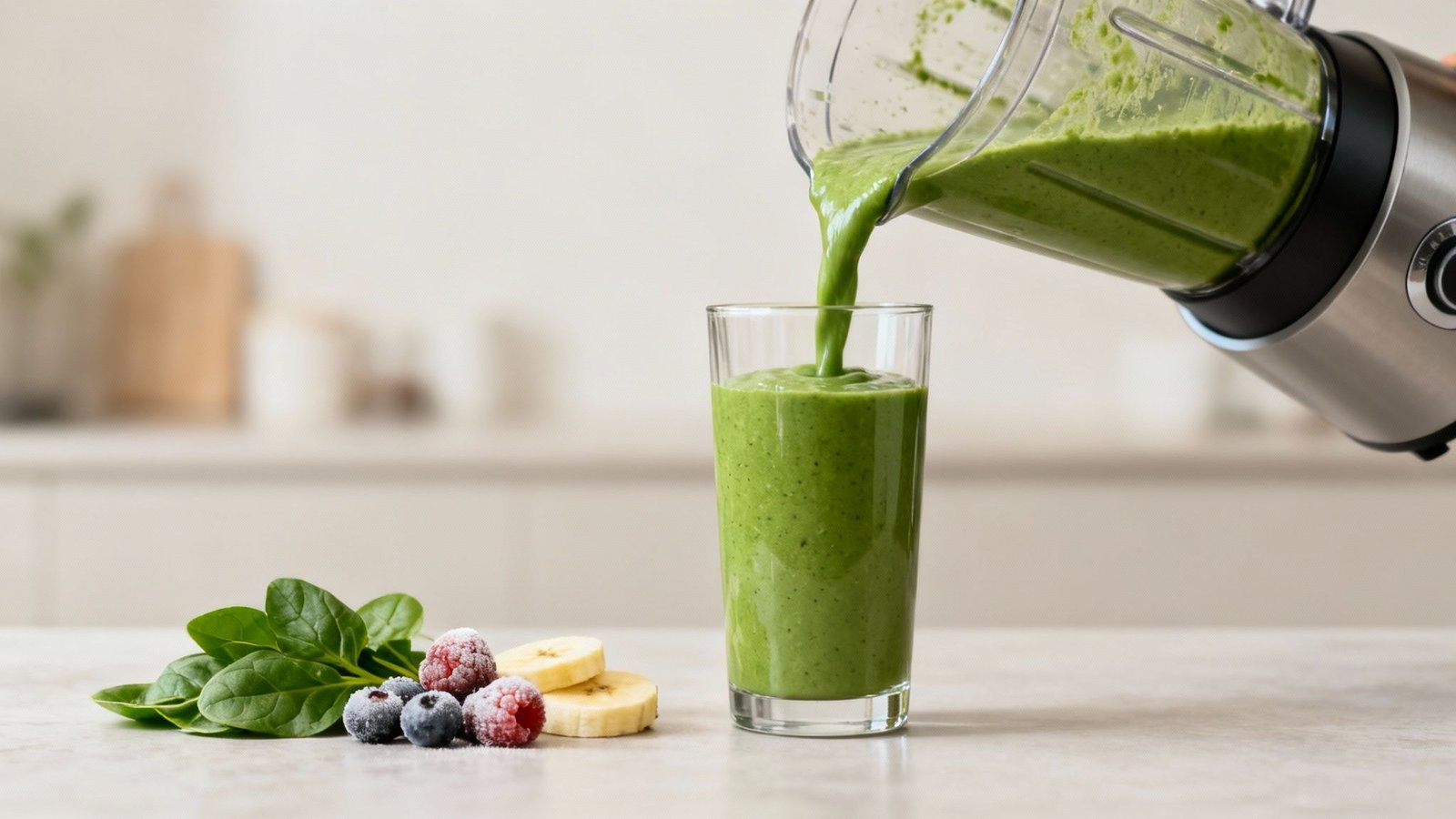
If you’re after the absolute best blenders for smoothies, the high-performance crowd-pleasers from Vitamix and Blendtec are legendary for a reason. They turn frozen fruit and tough, fibrous greens into silky-smooth perfection without breaking a sweat. That said, you don’t have to spend a fortune; fantastic mid-range options from brands like Ninja and NutriBullet strike an incredible balance of power and value for your daily blend. The right machine for you is all about finding that sweet spot between your budget and how smooth you really want your smoothie to be.
Finding the Right Blender for Perfect Smoothies
The gap between a gritty, chunky smoothie and a velvety, café-quality one almost always comes down to the machine. A blender that struggles isn’t just disappointing—leaving behind stubborn bits of kale or ice chunks—it can turn a healthy habit into a daily frustration. This guide is here to cut through the marketing noise and give you a clear, practical roadmap to choosing the right blender, making sure your investment pays off with every delicious sip.
Core Blender Features to Prioritize
To navigate the crowded market, we need to focus on the key features that directly impact the quality of your smoothie. Getting a handle on these factors is the first step toward finding a machine that meets your daily needs and helps you avoid common headaches like a burnt-out motor or just plain weak performance. Everything we evaluate in this guide is based on these core principles, and our home product guides often dive even deeper into these specifics.
- Motor Power and Blade Design: Think of this as the engine of your blender. Higher wattage combined with an efficient blade system is what creates that powerful vortex, ensuring no ingredient gets left behind.
- Pitcher Material and Capacity: From durable, BPA-free Tritan plastic to classic glass, the pitcher’s material affects its weight, safety, and how long it’ll last. Capacity is simpler—it just determines if you’re making a single serving for yourself or a big batch for the whole family.
- Durability and Build Quality: A good blender is an investment. We look for machines with metal drive systems, solid, heavy bases, and long warranties that signal they’re built to last through thousands of smoothies.
Comparing Blender Types at a Glance
Generally, blenders fall into three main categories. Each one is built for different lifestyles and performance expectations, so figuring out where you fit is a great place to start.
| Blender Type | Primary Use Case | Power Level | Best For |
|---|---|---|---|
| High-Performance | Daily use, tough ingredients | High (1200W+) | Silky-smooth green smoothies, nut butters, hot soups |
| Mid-Range | Regular use, varied tasks | Medium (900-1200W) | Daily fruit smoothies, protein shakes, light food prep |
| Personal/Portable | Single servings, on-the-go | Low (300-900W) | Simple protein shakes and basic fruit blends |
What Really Matters: A Guide to Blender Specs for Smoothies
When you start shopping for a blender, it’s easy to get lost in a sea of technical jargon. Marketers love throwing big numbers at you—watts, RPMs, blade counts—but what do those specs actually mean for your morning smoothie? The secret to finding a truly great blender is learning to look past the marketing hype and understand the components that deliver that silky-smooth texture we’re all after.
And it’s a good time to be learning. The global blender market was pegged at around USD 3.47 billion in 2024 and is expected to hit USD 6.06 billion by 2035, all thanks to a huge collective shift toward healthier living. As more of us jump on the smoothie train, knowing what makes a blender tick is more important than ever. You can dig into the numbers and trends yourself in this detailed report on the blenders market.
Motor Power: Are Watts Everything?
Wattage is the first number most people look at, but it only tells part of the story. Think of it as a measure of raw strength. A higher wattage generally means the motor can tear through tough stuff like frozen bananas, fibrous kale, or hard nuts without breaking a sweat or overheating.
For simple, daily fruit smoothies, a blender with 900 watts will get the job done. But if you’re serious about pulverizing every last bit of grit from your green smoothies or want to crush ice into snow, you’ll want to look for models with 1200 watts or more. These are the machines built to handle dense, challenging ingredients without the motor sounding like it’s about to give up.
Key Insight: Wattage is the engine’s horsepower. But a powerful motor is only as good as the machine it’s in. High wattage needs to be paired with smart blade design and solid construction to actually create a better smoothie. A powerful motor in a cheap blender is like putting a V8 in a car with bad tires—all that potential just spins its wheels.
The Art of Blade Design
The blades are where the real work happens. It’s not just about being sharp; it’s about the shape, number, and angle working in harmony to create a vortex. That cyclonic action is what pulls ingredients down from the pitcher’s sides and forces them into the blades, ensuring nothing gets left behind.
- Blunt vs. Sharp Blades: Believe it or not, some of the best blenders, like Vitamix, use blunt blades. Instead of slicing, they pulverize ingredients through sheer force and speed, which is incredibly effective for turning nuts, seeds, and grains into powder.
- Multi-Pronged Systems: Other brands, like Ninja, often use a tower of stacked blades with multiple sharp prongs. This design is fantastic for chopping its way through big frozen chunks and keeping the consistency even from top to bottom.
At the end of the day, a great blade system is designed to eliminate those annoying pockets of unblended food. It keeps everything moving and ensures every last ingredient gets its turn with the blades, resulting in a perfectly uniform blend.
RPMs vs. Torque: The Speed and Strength Showdown
People often mix up RPMs (Revolutions Per Minute) and torque, but they handle two different jobs. RPMs measure how fast the blades spin, while torque measures the rotational force—or pure muscle—behind that spin.
High RPMs are great for liquefying soft fruits and whipping air into your blend for a light, smooth texture. But the moment the blades hit a frozen strawberry or a chunk of ice, that’s when torque takes over. A blender needs torque to power through resistance without slowing down. The best blenders strike a perfect balance: high speed to blend fast and high torque to keep that speed steady, no matter what you throw in. It’s why a premium machine can obliterate frozen fruit in seconds while a cheaper one just jams and stalls.
Build Quality: From the Pitcher Down to the Base
Finally, let’s talk about what holds it all together. A blender’s overall build quality is what determines whether it lasts for a year or a decade. You want to see pitchers made from BPA-free Tritan plastic. It’s lightweight, nearly shatterproof, and won’t impart any weird tastes or chemicals into your food. Glass pitchers look nice, but they’re heavy and can crack under the stress of high-speed blending and drastic temperature changes.
Pay close attention to the spot where the motor base meets the blade—the drive system. A metal-to-metal drive connection is what you want. Plastic-on-plastic or plastic-on-metal connections are the first things to strip, crack, and fail over time. A heavy, solid base is also a good sign, as it keeps the blender from doing the “countertop walk” when it’s working hard, making it safer and more stable to use.
Comparing Blender Categories for Every Lifestyle
Picking the right blender for smoothies isn’t about finding one single “best” model. It’s about figuring out which category of blender fits your daily routine and kitchen space. Let’s be honest, blenders aren’t one-size-fits-all. A high-performance beast might be total overkill for someone who just makes a simple protein shake, while a little personal blender will absolutely let down anyone dreaming of silky-smooth green smoothies packed with fibrous kale and frozen berries.
This isn’t just a list of features. We’re going to take a real look at the three main types of blenders out there. We’ll get into their specific use cases, the performance trade-offs you’ll make, and what they offer in long-term value. The goal is to give you clear, practical advice so you can invest in a machine that actually lines up with your lifestyle, budget, and smoothie goals.
High-Performance Blenders: The Power User’s Choice
High-performance blenders are the undisputed champs of the smoothie world. They’re built for people who refuse to compromise on texture. These machines, usually rocking motors of 1200 watts or more, are designed to turn the toughest ingredients into a perfectly smooth, grit-free liquid. We’re talking frozen pineapple chunks, whole nuts, fibrous ginger root, and big handfuls of spinach—these blenders don’t just mix; they liquefy.
Their secret sauce is a combination of high wattage, serious torque, and smart blade design. This synergy creates a powerful vortex that yanks ingredients down, ensuring every last bit gets obliterated. For anyone who’s serious about their daily green smoothie or wants to experiment with making things like nut butters or even hot soups, this is the gold standard.
The High-Performance Differentiator: It’s not just about a burst of power; it’s about sustained performance. These blenders can run longer without overheating, which allows them to do things like create hot soup from raw vegetables using blade friction alone—a trick that’s impossible for mid-range or personal models.
Durability is another huge selling point. They almost always feature tough, all-metal drive systems and heavy bases that keep them from “walking” across your countertop. They are truly built to handle daily, hardcore use for years. While the initial price tag is steep, their versatility and sheer longevity often make them the more cost-effective choice in the long run for anyone who’s truly dedicated.
This visual breaks down the core components that really define a blender’s capability, from its motor power to its overall construction.
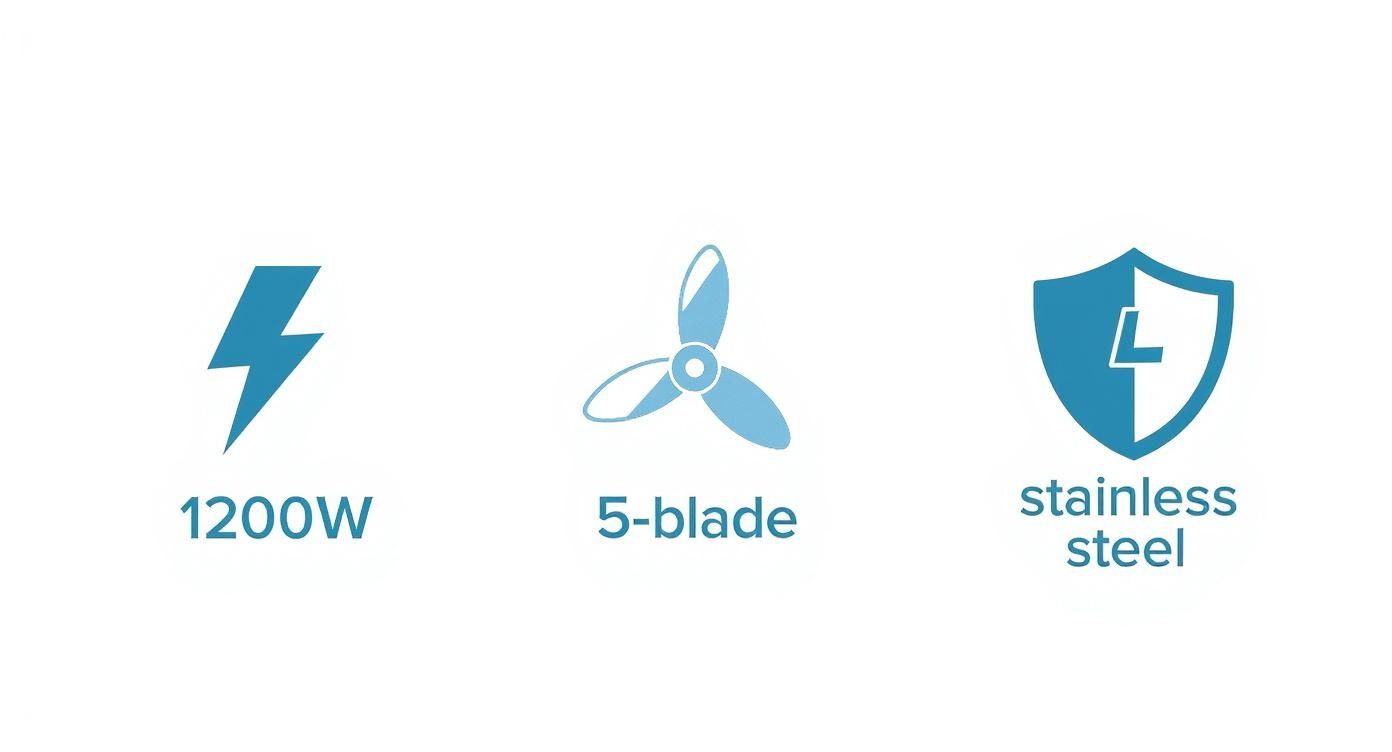
It really comes down to a trifecta of performance: raw wattage for tough stuff, efficient blades for that silky-smooth texture, and a durable build that you can rely on for years.
Mid-Range Power Blenders: The Versatile All-Rounder
Mid-range blenders are the sweet spot for a lot of people, offering a fantastic balance of performance, versatility, and price. Typically running between 900 and 1200 watts, these machines have no problem handling daily fruit smoothies, protein shakes, and lighter food prep like making salsas or sauces. They can get through frozen fruit and some leafy greens without much trouble, producing a respectably smooth result.
It is important, however, to know their limits. While they’re a huge step up from your basic, cheap blender, they might struggle to completely pulverize really fibrous ingredients like kale stems or blackberry seeds. You might end up with a smoothie that’s just a little less silky than what you’d get from a high-performance machine.
Situational Use Cases for Mid-Range Blenders:
- The Daily Fruit Smoothie Drinker: Perfect for blending soft fruits, yogurt, and protein powder into a quick breakfast or post-workout shake.
- The Occasional Green Smoothie Maker: Handles spinach and softer greens well but might leave a bit of texture with tougher, fibrous veggies.
- The Home Cook: Excellent for kitchen tasks beyond smoothies, like creating dressings, pureeing soups (after they’ve cooled!), and making dips.
These blenders often sweeten the deal with extra attachments, like single-serve cups and even food processing bowls, which adds a lot of value. For the average person who wants a reliable, multi-purpose appliance without the premium price tag, a mid-range model is often the perfect fit.
Personal and Portable Blenders: Convenience First
Personal and portable blenders are designed for one thing above all else: pure convenience. With motors generally under 900 watts, their job is to whip up single-serving smoothies quickly and with almost no cleanup. Their main appeal is the design—the blending container doubles as a travel cup with a to-go lid. This makes them a lifesaver for busy mornings, office lunches, or a quick shake at the gym.
Their small size and lower power mean they’re best suited for simpler recipes. They’re great at mixing protein powders, soft fruits like bananas and berries, and liquids. But they will almost always struggle with tough greens, large chunks of frozen fruit, or a lot of ice. Trying to force these ingredients through them often leads to a chunky, unappealing texture and can seriously strain the motor.
Who Should Choose a Personal Blender?
- The Commuter: Anyone needing a fast, grab-and-go breakfast they can make in under a minute.
- The Fitness Enthusiast: Ideal for mixing simple protein and supplement shakes at home or taking to the gym.
- The Small-Space Dweller: Their tiny footprint makes them a great fit for apartments, dorm rooms, or kitchens with limited counter space.
While they aren’t the best choice for making complex, gourmet smoothies, their focused design and affordable price make them an excellent second blender or the primary choice for someone with simple needs. They’re all about speed and ease, not raw power and texture perfection.
Smoothie Blender Category Feature Comparison
To help you see the differences at a glance, here’s a breakdown of what each blender category brings to the table. This should make it easier to see where your own needs fall.
| Blender Category | Ideal For | Power Range (Watts) | Texture Quality | Typical Price Range |
|---|---|---|---|---|
| High-Performance | Daily green smoothies, nut butters, hot soups, heavy-duty use | 1200+ | Silky-smooth, grit-free | $350 – $700+ |
| Mid-Range Power | Daily fruit smoothies, light food prep, occasional green smoothies | 900 – 1200 | Mostly smooth, minor texture | $100 – $250 |
| Personal/Portable | Single-serving protein shakes, simple fruit smoothies, grab-and-go | Under 900 | Noticeable texture, not ideal for tough ingredients | $50 – $120 |
Ultimately, the best blender is the one that fits seamlessly into your life. Whether you need a powerhouse for culinary experiments or just a quick way to make a morning shake, matching the blender’s category to your habits is the key to a happy purchase.
Our Top Blender Picks for Smoothie Lovers
Alright, now that we’ve waded through the technical specs and different blender types, it’s time for the fun part: naming the models that actually deliver. But here’s the thing—I’m not going to give you a single “best overall” winner. Why? Because the best blender for you depends entirely on your lifestyle, your budget, and what your idea of a perfect smoothie even is.
It just makes sense. The powerhouse machine that’s perfect for a family of four would be total overkill for someone in a studio apartment. In 2024, with a staggering 180 million Americans making smoothies a regular part of their lives, the market has exploded to meet every possible demand. This is great for us, as it’s pushing companies to build stronger motors and smarter blade systems at every price point. If you’re a data nerd, you can dig into this growing market in this detailed report on blender market trends.
So, let’s break down our recommendations by category to help you find the right fit, no second-guessing involved.
The Ultimate High-Performance Blender
For those who simply refuse to compromise on texture and need a machine that can pulverize anything you throw at it, a high-performance blender is the only way to go. These models are engineered for sheer power and durability. Think of them as a real kitchen investment.
Our top pick here is the Vitamix Ascent Series (A3500). It’s the gold standard for a reason. With a motor pushing over 2.2 horsepower, it doesn’t just blend—it completely liquefies. Tough, fibrous kale, rock-hard frozen strawberries, and tiny chia seeds are no match; they all get turned into a silky-smooth liquid without a single trace of grit. The variable speed control gives you precision, while the pre-programmed settings for smoothies, hot soups, and frozen desserts offer pure convenience.
But what really sets it apart is the tank-like build quality. The full-metal drive system and commercial-grade construction mean this thing is built to survive daily use for a decade or more, and it’s often backed by a 10-year warranty. Yes, the price is steep, but for serious smoothie fanatics, its performance and longevity offer incredible long-term value.
Best Mid-Range Value Blender
Look, not everyone needs the top-of-the-line power—or the price tag—that comes with a high-performance machine. The mid-range category offers a fantastic sweet spot, giving you robust performance that’s much more affordable. These blenders are perfect for daily fruit smoothies and can handle tougher ingredients pretty darn well.
In this space, the Ninja Professional Plus Blender with Auto-iQ really stands out. Its 1400-peak-watt motor and unique stacked blade design create a powerful vortex that absolutely demolishes ice and frozen fruit. While it might not achieve the perfectly silky texture of a Vitamix when you’re blending fibrous greens, it gets impressively close for a fraction of the cost.
Key Differentiator: The Auto-iQ technology is what makes this a winner. It runs pre-set programs that take all the guesswork out of blending. The smoothie setting, for example, uses a specific pattern of pulsing and pausing that continuously pulls ingredients down toward the blades, ensuring you get a consistent, smooth result every single time.
It’s a versatile workhorse that delivers reliable performance for smoothies, shakes, and even frozen cocktails, making it a fantastic all-around choice for most homes.
Top Personal Blender for Convenience
For single servings, quick post-workout protein shakes, and grab-and-go lifestyles, you just can’t beat the convenience of a personal blender. These compact machines are designed for speed and minimal cleanup, making them a perfect fit for hectic mornings or kitchens with limited counter space.
The NutriBullet Pro 900 is our go-to recommendation here. Its 900-watt motor has plenty of juice to break down soft fruits, protein powders, and even a handful of spinach. It’s going to struggle with a cup full of frozen fruit or tough, fibrous veggies, but that’s not what it’s for. It excels at its main purpose: creating simple, nutrient-packed smoothies in less than a minute.
Its biggest advantage is the dead-simple, intuitive design. You just load the cup, twist it onto the base, and blend. The cup you blend in doubles as your to-go cup, complete with a flip-top lid, which seriously streamlines the morning routine. If you’re focused on making quick, individual shakes without the hassle of a big machine, the NutriBullet Pro offers unmatched convenience.
Best Quiet Blender for Early Mornings
Let’s be honest, a common complaint about powerful blenders is the noise. They can sound like a jet taking off in your kitchen, which is a huge problem for early risers or anyone living with other people. Thankfully, some companies have actually designed models to run at a lower decibel level without sacrificing much performance.
The KitchenAid K400 Blender is a top contender for its much quieter operation. Now, no high-powered blender is ever going to be silent, but the K400’s heavy, die-cast metal base does an excellent job of dampening motor vibrations and noise. It pairs this smart design with a powerful motor and a unique asymmetric blade that blends at four different angles, pulling ingredients into the vortex for a super smooth finish. You can get the full scoop on its performance in our in-depth review of KitchenAid’s blender lineup.
This model proves you don’t have to pick between a quiet kitchen and a great smoothie. It’s the perfect solution for anyone who wants to make their breakfast without waking up the rest of the house.
So, What Else Can This Thing Do? Unlocking Your Blender’s Full Kitchen Potential
When you get one of the best blenders for smoothies, you’re not just buying a smoothie machine. You’re bringing home a surprisingly versatile kitchen workhorse. Sure, its main gig might be whipping up your morning shake, but a powerful blender can handle an incredible range of other jobs, easily justifying its price tag and earning that permanent spot on your counter. It quickly goes from being a one-trick pony to a core part of your cooking toolkit.
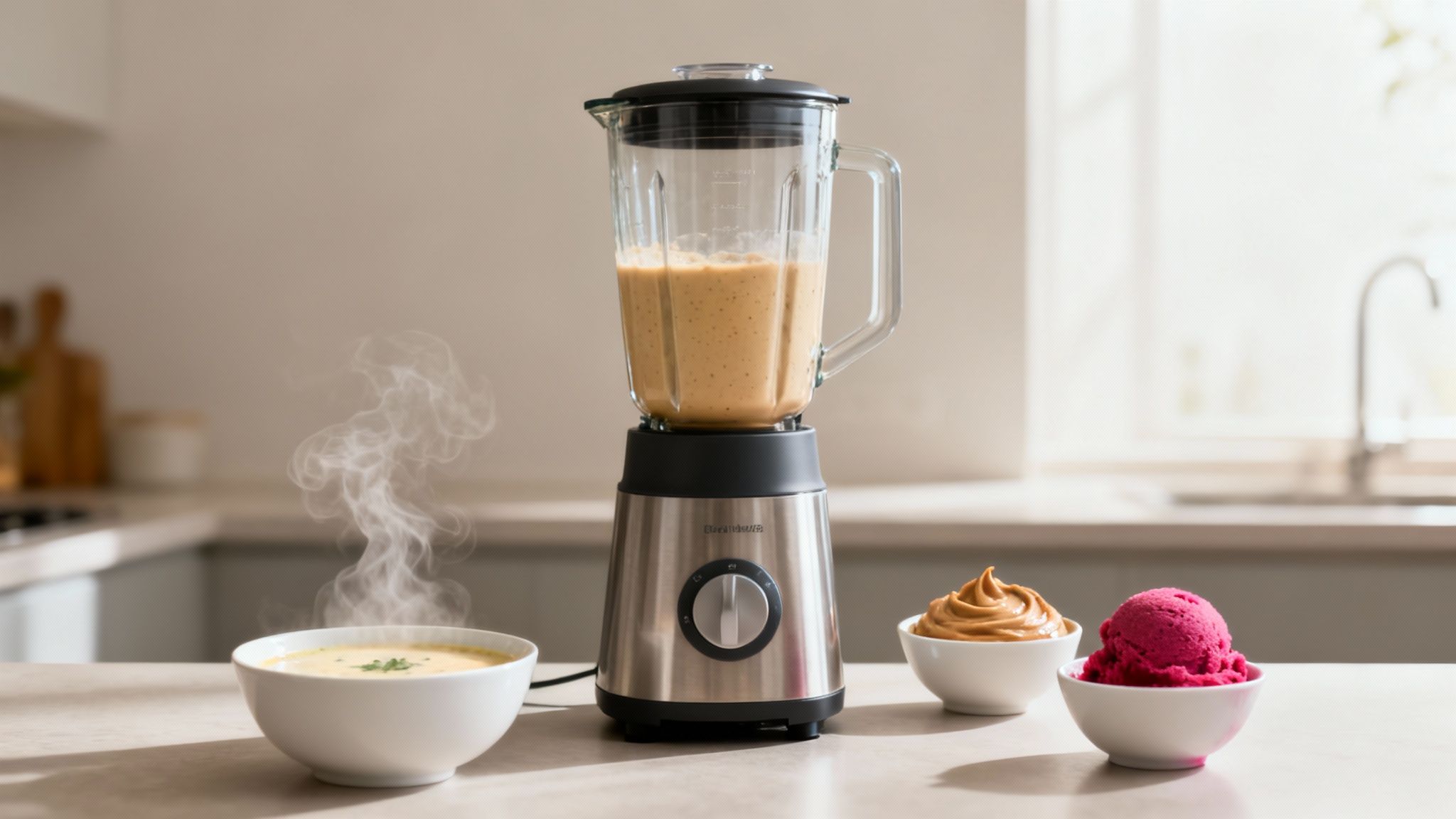
What a lot of people don’t realize is that a high-performance blender does more than just blitz cold ingredients. Some of them can actually cook.
From Piping Hot Soups to Frozen Desserts
The intense speed of the blades in a high-end blender generates a wild amount of friction—enough to heat ingredients until they’re steaming hot in about six minutes. You can literally toss in raw vegetables, broth, and some seasonings and end up with a velvety-smooth soup, like a creamy tomato or butternut squash, cooked right there in the pitcher. This is a feature you’ll only find in seriously powerful models with sustained high-speed settings.
Then, at the complete opposite end of the temperature spectrum, these same blenders are champs at making frozen desserts. By blending frozen fruit with just a splash of milk or yogurt, you can whip up instant sorbet or a healthy “nice cream” with a perfectly smooth, scoopable texture. The magic here is a strong motor that can pulverize those frozen chunks without stalling or overheating.
Pro Tip: When you’re making frozen desserts, use the tamper. Seriously. You have to keep pushing the frozen ingredients down into the blades to prevent air pockets. This gives you that consistently creamy result without adding extra liquid, which would just turn your dessert back into a smoothie.
Homemade Nut Butters and Flours
Let’s be real: store-bought nut butters and alternative flours can be pricey, and they’re often packed with weird additives. A good blender puts you in the driver’s seat, letting you make your own from scratch. You get total control over the ingredients and freshness.
- Creamy Nut Butters: Just blend roasted nuts—almonds, peanuts, cashews, you name it—until they break down and release their natural oils. They’ll transform into a smooth, spreadable butter right before your eyes. This is a job that requires a blender with high torque to muscle through that thick, heavy mixture.
- Freshly Milled Flours: You can also grind whole grains like oats, wheat berries, or rice into fine flours for baking. This is fantastic for gluten-free recipes or for anyone who wants the nutritional kick of fresh, whole-grain flour.
Playing with these functions is where you start to see the true value of investing in a robust machine. It’s not just about expanding your culinary skills; it’s about making healthier, preservative-free staples right at home. For more ideas on outfitting your kitchen, check out our guides to essential kitchenware, where we cover appliances that offer this kind of multi-functional value.
Once you unlock these capabilities, your blender becomes an indispensable ally for way more than just smoothies.
Keeping Your Blender in Top Shape: Cleaning and Maintenance
If you want your blender to last, you have to treat it right. Proper cleaning isn’t just about hygiene—it prevents the motor from getting overworked and keeps funky smells from ingredients like garlic or ginger from sticking around. A little care goes a long way in making sure every smoothie tastes fresh.
The easiest trick in the book is the 30-second self-clean. As soon as you’re done blending, give the pitcher a quick rinse. Then, fill it halfway with warm water, add a single drop of dish soap, and let it rip on high for 30 to 60 seconds. This little vortex trick is surprisingly effective and handles most of the daily gunk.
Deeper Cleaning and Long-Term Care
Of course, the daily soap-and-water spin won’t always cut it, especially with stubborn stuff like nut butters or sticky date paste. For a more serious clean, take the lid and blade assembly apart (if your model is designed for it) and give them a good scrub by hand. If you’ve got stains or odors, a simple paste of baking soda and water works wonders.
To really protect your investment, you’ll want to do a quick inspection every now and then. Think of it as a wellness check for your blender.
- Check the Drive Socket: This is where the pitcher meets the base. Look for any stripping or cracking. A worn-out socket is a one-way ticket to a strained motor.
- Inspect the Blades: High-end blades are tough, but not invincible. Keep an eye out for nicks, dull spots, or any wobbling. A shaky blade assembly is inefficient and can cause leaks down the road.
- Don’t Overload It: That “max fill” line isn’t just a suggestion. Pushing past it forces the motor to work way harder than it should, which is the fastest way to burn it out.
These aren’t complicated steps, but they’re the ones people usually skip—and they make all the difference. A well-maintained blender doesn’t just stay clean; it performs better and delivers those perfectly smooth results for years.
Got Questions? We’ve Got Answers.
As you get closer to picking the right blender, a few last-minute questions usually pop up. It’s totally normal. Getting these details sorted out is the final step in making sure the blender you bring home is the one you’ll actually love using every day.
Let’s clear up some of the most common ones.
Is a 1000+ Watt Blender Really Necessary for Smoothies?
Honestly, it depends on what’s in your smoothie. If you’re just blending protein powder with a banana and some almond milk, a basic personal blender will do the job. But if you’re serious about your smoothies, a motor with 1000 watts or more is a game-changer.
Why? Because ingredients like frozen strawberries, tough kale, almonds, and chia seeds need serious muscle to break down completely. Without enough power, you’re left with a gritty, chunky mess. With it, you get that silky-smooth, cafe-quality texture every single time. Think of it as an investment in better smoothies.
Glass vs. Plastic Pitchers: Which Is Better?
This is a classic debate, and both sides have good points. Glass pitchers look great, won’t stain or hold onto odors (goodbye, lingering garlic smell), but they’re heavy and can shatter if you’re not careful.
On the other hand, high-quality, BPA-free plastic pitchers—especially those made from a material called Tritan—are what you’ll find on most of the best blenders for smoothies. They’re incredibly durable, lightweight, and practically shatterproof, which is why they’ve become the industry standard for high-performance machines.
For the daily grind, a tough plastic pitcher is usually the more practical and safer choice. It can handle the chaos of a busy morning and the stress of high-speed blending without you having to worry about accidental drops.
How Big of a Deal Are Pre-Programmed Smoothie Settings?
Pre-programmed settings are all about convenience. That “set it and walk away” feature is a lifesaver on hectic mornings when you’re trying to do three things at once. The blender runs through a cycle of different speeds and pulses on its own, ensuring everything gets pulled down into the blades for a perfectly consistent blend.
Are they essential? Not at all. You can get the exact same results using manual speed controls and a little practice. Think of presets as a nice bonus that simplifies your routine, not a make-or-break feature. They streamline the process but don’t fundamentally change the end result.
At Reva Housing, our goal is to give you in-depth, real-world reviews that help you feel confident about the choices you make for your home. Explore our latest guides and product comparisons to find the perfect tools for your lifestyle.
